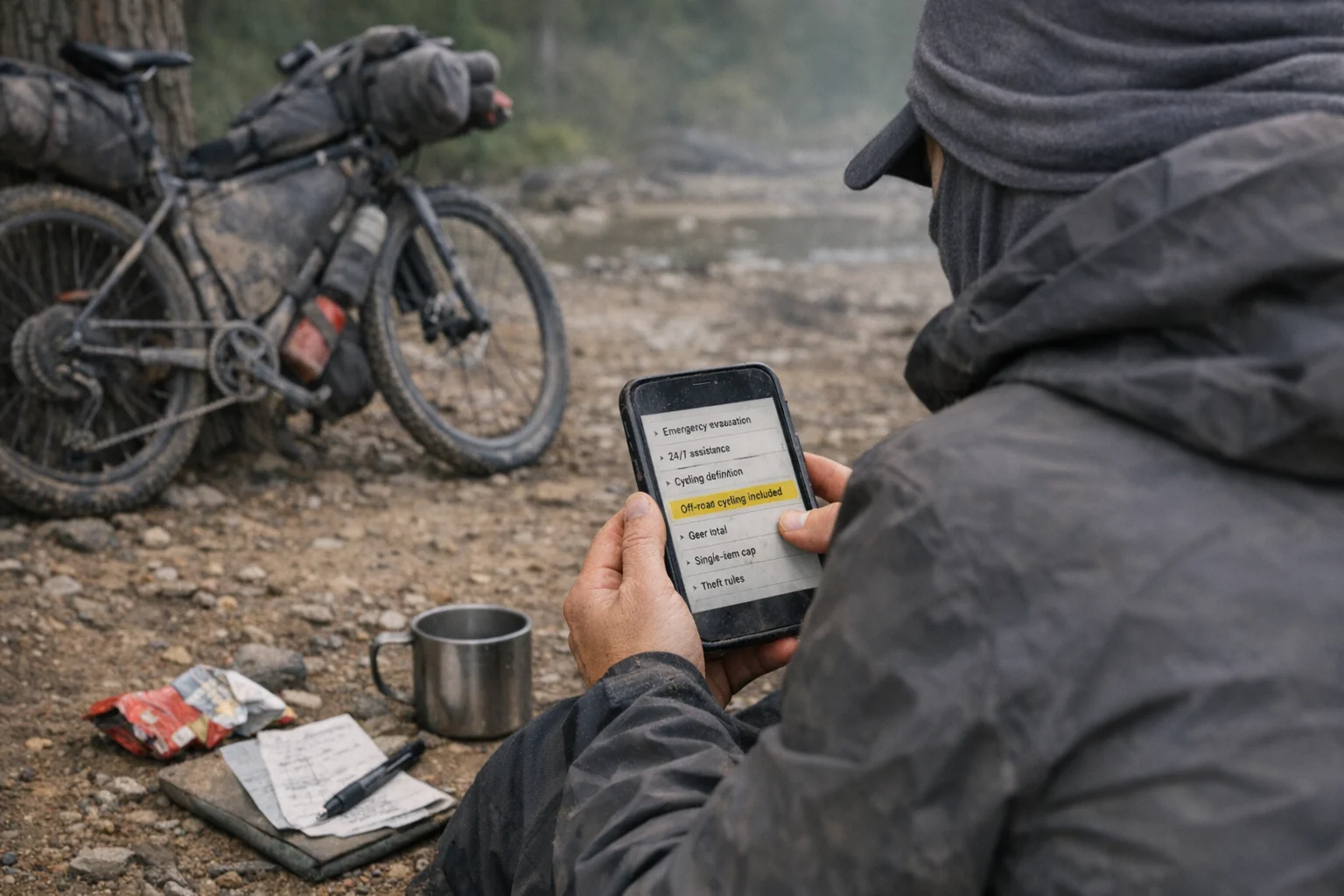
Travel insurance costs real money—and one vague exclusion can turn a bad day into a very expensive one. This best travel insurance for bikepacking guide shows you what to check (fast), so you can buy coverage that matches how you ride. If you’re specifically looking for travel insurance with bike coverage, the two deal-breakers are the cycling definition and the single-item limit.
I once saw a bikepacker’s frame snap on a remote Patagonian trail—the bigger shock was learning his “comprehensive” policy wouldn’t pay because of vague wording and missing proof. Most bikepacking claim headaches come down to wording and proof. If you haven’t priced your full kit yet, use our beginner bikepacking guide to make a complete gear list before comparing policies.
In a hurry? Jump to the shortlist. Otherwise, use the tool below to build a policy-screening checklist first.
This page contains affiliate links and may include sponsored content. As an Amazon Associate, I earn from qualifying purchases at no extra cost to you. Amazon links are labeled #ad; other affiliate links may be marked as “affiliate link,” “Sponsored,” or “(paid link).” Learn more.
Table of Contents
- Build Your Bikepacking Insurance Checklist
- Claim-proof in 10 minutes
- Where General Travel Insurance Can Fall Short for Cyclists
- Common Bikepacking Insurance Exclusions to Check
- Coverage Types to Check for Long-Distance Bikepacking
- Comparison of Bikepacking Travel Insurance Options
- Quick Shortlist: Insurance Options to Compare
- My Evaluation Criteria for Bikepacking Insurance
- Alternative Protection Strategies
- Build Your Bikepacking Insurance Strategy
- Frequently Asked Questions
- Choose Coverage You Can Actually Use
Build Your Bikepacking Insurance Checklist
Pick one option from each category to build a practical policy-screening checklist for your bikepacking trip.
Trip length
Route remoteness
Total gear value
Your screening checklist
Complete all three choices to build your policy-screening checklist.
💡 Start with route remoteness; it usually changes the assistance questions you need to ask.
Before comparing plans: write down your bike’s replacement value and the single-item limit you would need, then verify how the policy defines your riding surfaces and classifies bicycles or sports equipment.
Claim-proof in 10 minutes (before you buy)
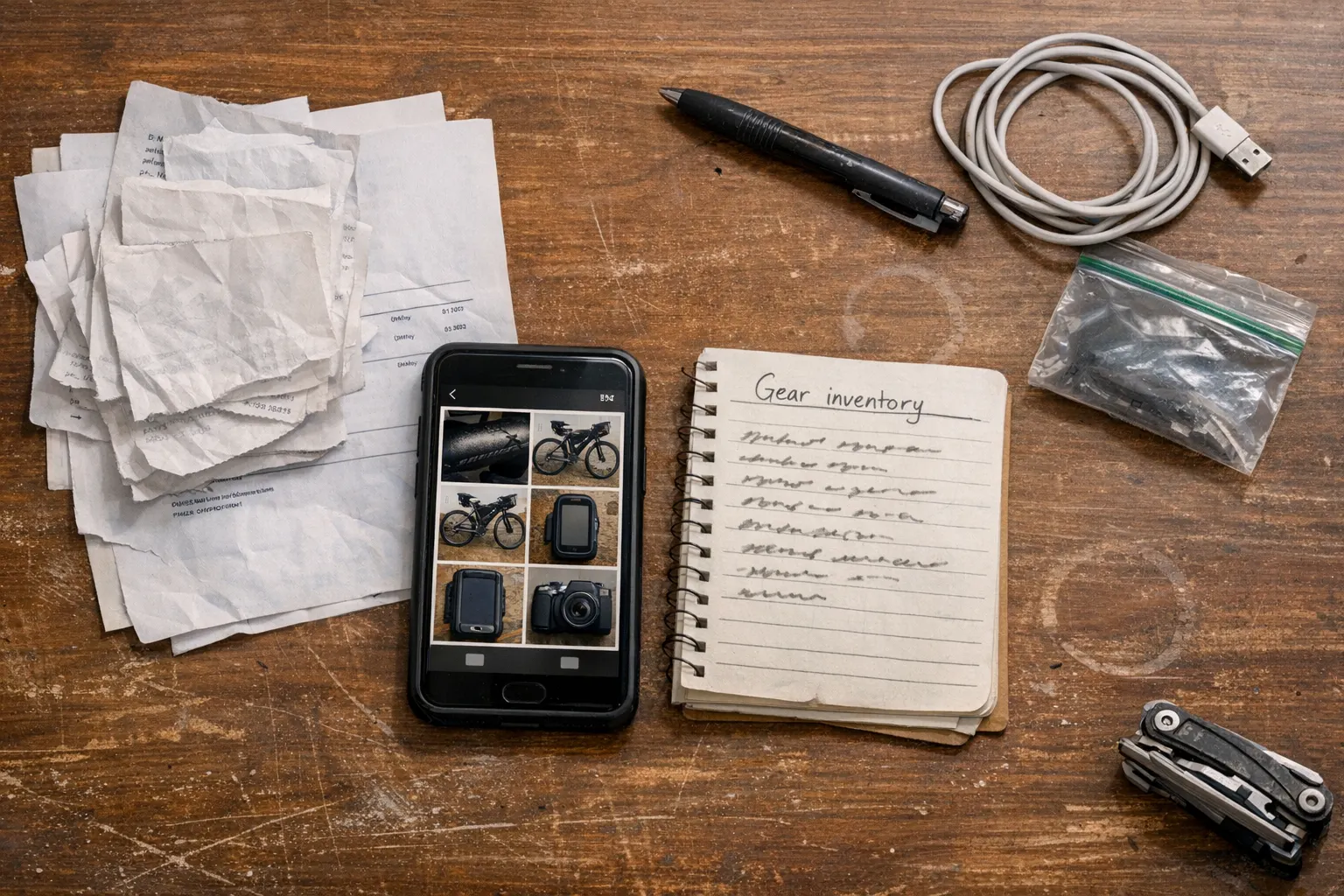
Documentation is one of the easiest claim variables you can control. Do this once so you can compare policy limits against your actual gear and keep stronger records if something goes wrong:
- Photograph your bike from both sides + a close-up of the serial number
- Screenshot your top 3 receipts/order confirmations (bike + phone/GPS + one big-ticket item)
- Make one “gear inventory” note with rough values (one list is enough)
- Save the insurer’s 24/7 assistance number + claim steps in your notes (and offline if possible)
- Quick “reasonable precautions” proof: take one photo of your lock setup and where the bike/bags were stored (camp/hotel/garage)
Optional tools that make documentation and recovery easier
These don’t make you “covered,” but they make proof and “reasonable care” rules easier to satisfy on the road.
| Item | Why it helps | Link |
|---|---|---|
| YUMQUA Waterproof Document Bags (3-Pack) | Designed to protect receipts and passport copies from rain. The clear front lets you identify contents without opening the bag. | View on Amazon |
| Pelican Marine Waterproof Phone Pouch | Helps protect a phone while photographing damage in wet conditions. The regular pouch fits phones up to 6.1 inches, so check your phone size before buying. | View on Amazon |
| TICONN Zipper Tool Pouches (3-Pack Combo) | Organizes serial notes, receipts & small tools. Durable fabric, carabiner clip, reflective strips. Different sizes keep proof separate from wet gear. | View on Amazon |
Optional: a hidden tracker for location evidence
A tracker won’t replace insurance, but it may help recovery by showing a recent or last known location you can share with police or an insurer. Choose one that matches your phone ecosystem.
| Phone | Tracker | Why it helps | Link | Optional mount |
|---|---|---|---|---|
| iPhone | Apple AirTag | Apple’s Find My network can show an approximate or nearby item location. Start with one on the bike; a 4-pack is useful only if you plan to tag several items. |
Single AirTag AirTag 4-pack |
Low-profile adhesive mount |
| Samsung Galaxy | Galaxy SmartTag2 | SmartThings Find can show the tag’s reported location on compatible Galaxy devices. Start with one on the bike; a 4-pack is useful only if you plan to tag several items. |
Single SmartTag2 SmartTag2 4-pack |
Adhesive case |
Places to consider hiding a tracker (choose 1–2):
- Steerer tube / headset cap stash
- Under saddle (inside saddle bag or under-seat mount)
- Inside handlebar end plug
- Inside frame bag (sewn or hidden inner pocket)
- Under bottle cage (behind cage or mount plate)
- Seatpost area (only if not easy to access)
- Tool can / pump compartment
Quick safety note: Use purpose-built mounts or stash caps—don’t wedge a loose tag somewhere that can rattle or interfere with steering or brakes. Never confront someone over a tracker location; share the information with local law enforcement.
Compatibility note for other Android phones:
SmartTag2 is designed for compatible Samsung Galaxy devices through SmartThings Find. If you use another Android brand, choose a tracker that explicitly supports Google’s current Find Hub network and verify compatibility with your phone before buying.
Why this matters: you’ll have the numbers and records needed to judge whether a policy’s single-item limit and theft rules could realistically replace your bike—and whether its claim requirements are practical on the road.
Where General Travel Insurance Can Fall Short for Cyclists
General travel policies may be written around conventional trips. Bikepacking is different: you’re riding loaded, on mixed surfaces, and sometimes far from towns—exactly where definitions can get fuzzy. It’s the kind of surprise that can hit at 2 a.m. when you’re staring at a policy PDF on your phone, realizing a claim might hinge on what “off-road” means.
Plain-English note: when people search for bikepacking insurance (sometimes called cycle touring insurance), they usually mean a policy that (1) clearly covers cycling on the surfaces you ride and (2) has gear limits that can actually replace a bike.
The “Risky Activity” Trap
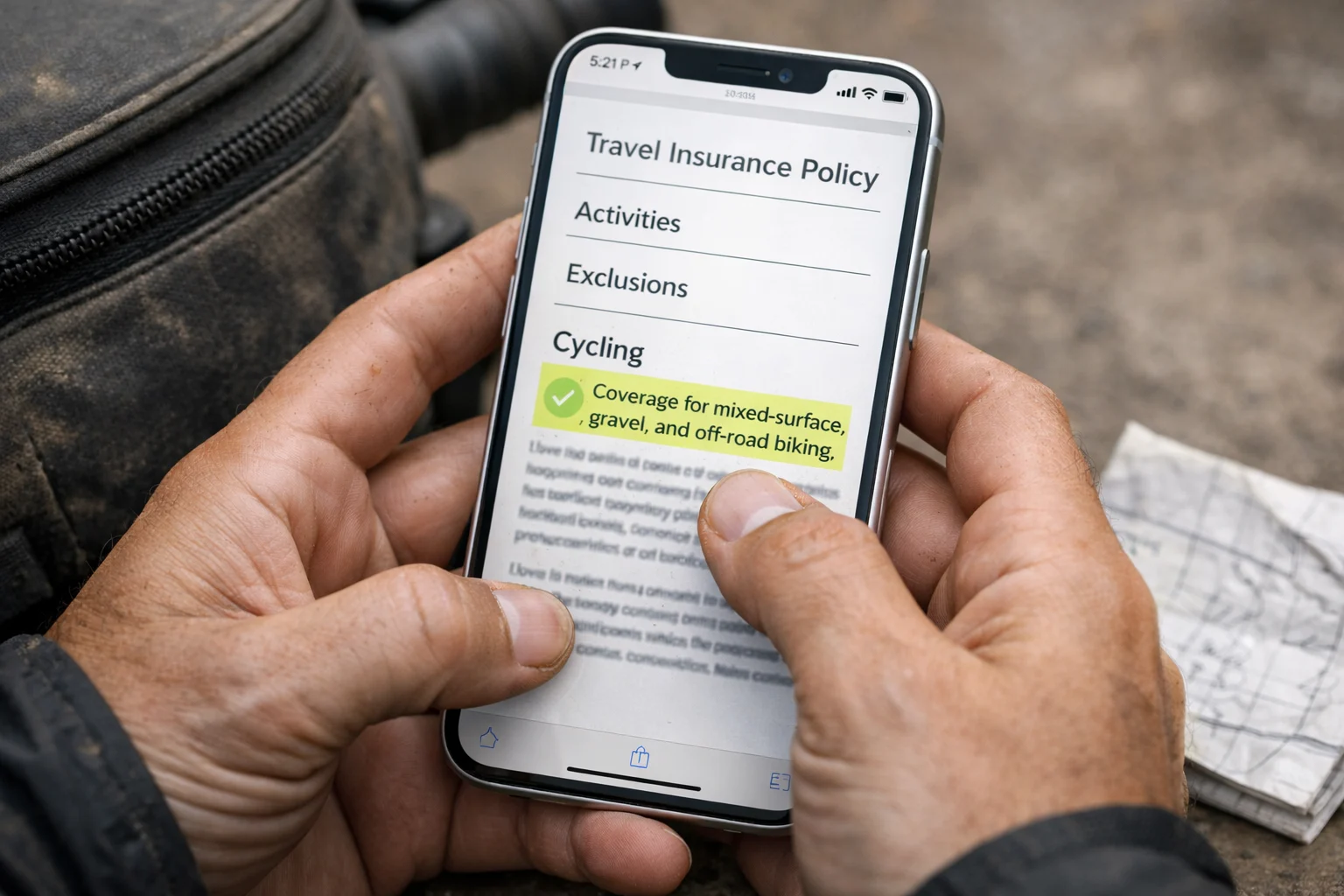
Some plans classify cycle touring, mountain biking, altitude, racing, or off-road riding differently. If you’re shopping for touring coverage, slow down here and read the exact cycling definition.
- Mountain biking may be excluded
- Unpaved touring can be classed as an adventure sport
- Multi-day riding can trigger “hazardous activity” clauses
- Remote riding can expose assistance and territory limits
When Gear Value Exceeds Policy Limits
General baggage cover can leave a large gap between your equipment value and the policy limits. Here’s what to compare:
| Your gear | Policy check |
|---|---|
| $3,000–$8,000+ bike | Is there a bicycle or sports-equipment sublimit below the bike’s value? |
| $2,000+ in camping/cycling gear | Do total baggage limits and category sublimits cover the full kit? |
| GPS units, power banks, cameras | Are electronics subject to separate item limits, depreciation, or theft conditions? |
| Custom/specialty components | How are custom components valued, and what proof is required? |
Quick reality check: you can be “covered” on paper and still get a disappointing payout—so treat gear limits as a deal-breaker, not a detail.
Common Bikepacking Insurance Exclusions to Check
Exclusions derail tours because they’re predictable and easy to miss. Even good policies draw hard lines around wear-and-tear, pre-existing issues, and paperwork.
Mechanical Failures and Wear Items
Travel policies commonly exclude normal wear. Incident-related damage may be covered only when the policy includes it and the event is documented.
| Item / issue | Usually excluded | Sometimes covered if… |
|---|---|---|
| Chain, brake pads, tires | Wear and replacement | Damage is clearly caused by a crash/incident (and documented) |
| Cables, housing, bearings | Gradual degradation | A documented incident causes sudden breakage |
| Derailleur / hanger | Routine failure | Impact damage from a crash or transport mishandling |
| Wheel damage | Normal wear / maintenance | Crash/obstacle impact with photos + repair receipt |
| Frame cracks | Pre-existing / manufacturing issues | Clearly tied to a single event, with proof of condition before the trip |
Pre-Existing Conditions (Gear and Medical)
- Gear: known damage, previously repaired parts failing again, and worn components that break predictably.
- Medical: ongoing treatment needs or prior injuries (knees, back, wrists). Mental health coverage varies by provider.
Geographic and Activity Limitations
- Conflict zones and active government travel advisories
- Altitude limits on high-mountain routes
- Competitive events including organized races
- Guided vs. independent distinctions
- Trip duration caps if you’re traveling long-term
The Documentation Trap
This is the unglamorous part: missing documentation can weaken an otherwise valid claim. Common problems to prevent include:
- ❌ No receipts / order confirmations for high-value items
- ❌ No serial numbers for bikes/electronics
- ❌ Missing theft report when it’s required
- ❌ Weak photos (or none) of damage and the scene
- ❌ Late reporting when the policy expects quick notification
Do this today: use the Claim-proof in 10 minutes checklist above and save it in one cloud folder you can access from your phone.
Coverage Types to Check for Long-Distance Bikepacking
Do not assume one policy covers every bikepacking risk. Check the pieces separately: medical and evacuation assistance first, then gear rules, interruption, and liability.
Medical and Emergency Evacuation
Why it matters: on remote routes, the cost and coordination of care can escalate quickly. Check whether the assistance service coordinates eligible care and transport, or whether the policy mainly reimburses you afterward.
- Emergency evacuation coverage that fits your remoteness
- 24/7 assistance that can coordinate care
- Clear cycling inclusion for the terrain you ride
- Repatriation if you need to return home for care
According to the CDC’s travel insurance guidance, evacuation from a remote area can cost more than $100,000. The U.S. State Department’s medical guidance gives a broad $20,000–$200,000 range for air ambulance transport back to the United States, depending on location and medical needs. Those figures show why a fixed web-tool “minimum” cannot replace route-specific policy review.
Equipment and Gear Protection
Gear coverage is rarely “all or nothing.” For most bikepackers, it comes down to the single-item limit (for the bike), theft rules, documentation expectations, and how the policy classifies bicycles (personal effects vs. sports equipment).
Quick decision rule (high-value bike):
If your bike’s value is higher than the policy’s single-item limit, consider a two-policy setup: (1) travel medical + evacuation/assistance, plus (2) separate bike/gear cover that can actually replace the bike.
If the insurer won’t confirm key wording in writing, treat it as “not covered.”
Trip Interruption and Delay
Interruption coverage matters when you can’t ride but still need to keep moving: extra nights, alternate transport, or getting to a safer place while your bike is repaired.
Personal Liability Protection
Liability can help if you damage property or injure someone, and it may cover legal defense costs in some cases.
Which coverage level fits you?
Short trip + towns + modest gear: prioritize medical + basic theft/damage; gear cover can be lower if your bike isn’t a big-ticket item.
1–3 months + mixed surfaces: you’ll want clearer cycling wording, stronger interruption, and a realistic single-item limit.
Remote routes: treat evacuation + 24/7 assistance as the anchor, then build gear coverage on top.
Do this next: save the insurer’s assistance number in your phone and write one line: “If I crash remote, who coordinates care?”
Comparison of Bikepacking Travel Insurance Options
If you’re trying to pick the best travel insurance for bikepacking, don’t start with brand names. Start with your route (remoteness), trip length, and the bike’s single-item limit problem. Most riders land in one of these setups.
If you see providers describing themselves as adventure cycling insurance, treat that as a starting signal—not proof. You still need the exact cycling definition and the gear limits in writing.
| Coverage route | Why bikepackers use it | Main watch-out |
|---|---|---|
| Adventure-focused travel insurance | Often clearer activity language + better fit for remote routes | Documentation can be stricter; item limits still matter |
| Mainstream travel insurance + add-on | Can be cheaper; easy to buy in many countries | Cycling may be excluded unless the add-on is the right one |
| Travel medical/evac + separate bike/gear cover | Works when your bike value blows past single-item limits | You’re managing two policies (and two claim processes) |
| Evac membership (supplement) | Strong option for remote extraction + coordination | Not a full replacement for medical/gear cover |
Shortcut: remote route → prioritize evacuation + 24/7 assistance. High-value bike → prioritize the single-item limit (or a two-policy setup).
Quick Shortlist: Insurance Options to Compare
There is no honest universal winner here: eligibility, plan names, activity cover, and limits vary by country of residence and policy. These are current examples riders commonly research, not a ranking. Verify the exact cycling definition, item limits, assistance rules, and trip-duration terms before paying.
- World Nomads (plan and activity options vary by country of residence)
- Best for: adventure-style trips where you want clear activity guidance as a starting point.
- Ask/verify: whether independent cycle touring, your surfaces, and your altitude are included for your country-of-residence plan.
- Watch out for: bicycles or accessories being excluded or limited by plan, plus unattended-equipment and in-use damage exclusions.
- True Traveller (current activity list and packs)
- Best for: riders who like the clarity of selecting an activity tier/pack.
- Ask/verify: whether your trip qualifies as incidental cycling, an organised tour, or another activity tier—and whether independent loaded touring is included.
- Watch out for: mismatch between “cycling” vs “mountain biking” vs “off-road” definitions.
- SafetyWing (Nomad Insurance Essential or Complete)
- Best for: long-term travelers who prioritize medical-style coverage and ongoing trips.
- Ask/verify: whether your riding needs the Adventure Sports add-on on Essential, how Complete treats the activity, and whether the bike is covered as luggage or equipment.
- Watch out for: gear/bike caps being lower than you expect; confirm claim steps work while traveling.
- Global Rescue (rescue and evacuation membership)
- Best for: remote routes where extraction/coordination is the real risk (supplement layer).
- Ask/verify: field-rescue and evacuation eligibility, destination and activity restrictions, and what still requires separate medical or travel insurance.
- Watch out for: treating membership as insurance; Global Rescue states that it is not an insurance company and does not reimburse treatment or trip costs.
| Option (example) | Best for | Check cycling wording | Check gear/bike limits | Good “fit” signal |
|---|---|---|---|---|
| Adventure travel insurer | Mixed terrain tours, flexible itineraries | Does it cover loaded touring on unpaved roads? | Single-item limit for a bicycle; theft-from-campsite rules | Clear activity list + clear claim steps |
| Activity-pack insurer | Trips where you choose an activity tier | Which pack covers your riding type? | How bikes are categorized; item caps | Tier language matches your route |
| Travel medical subscription | Long trips where medical is priority | Is cycling normal activity or add-on? | Gear terms and caps | Medical coverage is simple and continuous |
| Evac membership | Remote extraction + coordination support | Not the focus—this is logistics | Doesn’t replace gear cover | Remote route + limited local rescue options |
My Evaluation Criteria for Bikepacking Insurance
I use a simple scorecard because policy wording and claim requirements matter more than how polished an insurer’s website looks.
- Coverage fit: cycling definition matches your terrain; evacuation/assistance matches your remoteness; gear limits are realistic.
- Claim reality: you can actually do the steps while traveling (photos, reports, timing, support).
- Cost & friction: deductible you can stomach; clear reimbursement process; predictable proof requirements.
Ask these questions (and get answers in writing)
- Equipment: “If my bike is stolen from my tent at a campground, what proof do you require?”
- Equipment: “What is the single-item limit for a bicycle, and can it be increased?”
- Equipment: “Are aftermarket/custom components covered at full replacement cost?”
- Medical/evac: “If I crash on a remote trail and need evacuation, who coordinates rescue and who pays providers?”
- Medical/evac: “Does coverage include cycling on unpaved roads and multi-day touring routes?”
- Claims: “Can I submit claims fully online with photos if I’m traveling?”
- Claims: “What’s the reporting deadline for theft/damage, and what happens if I’m offline?”
Copy/paste template: get the answer in writing
Use this as an email or support chat message (short is better—your goal is a clear “yes” you can save):
Hi — I’m planning a multi-day bikepacking trip.
1) Can you confirm this policy covers loaded cycle touring on mixed surfaces (including unpaved/gravel roads), not just “recreational cycling”?
2) What is the single-item limit that would apply to a bicycle, and how is the bike categorized (personal effects vs sports equipment)?
3) If my bike is stolen from a campsite/hotel, what proof do you require (receipt, serial photo, police report, lock requirement, time window)?
4) For a remote crash: who coordinates evacuation, and do you pay providers directly or reimburse later?
Please reply confirming the above in writing. Thanks.
Deductibles, claim windows, and “who pays first”
Picture yourself at a clinic desk or repair counter. What matters is what you pay now and what you can recover later.
- Deductible/excess: what you pay per claim (and whether gear claims differ).
- Claim deadline: when you must notify, and what counts as notification.
- Coordination: whether assistance helps you arrange care, not just reimburse afterward.
Alternative Protection Strategies
Insurance is one layer. Smart bikepackers also reduce risk so insurance becomes a backstop—not the plan.
Gear-risk reduction
- Split high-value items across bags (don’t put everything in one “steal me” pouch).
- Carry the small spares that end tours: derailleur hanger, brake pads, a spare chain link.
If wild camping is part of your route, the solo wild camping safety tips cover campsite security and other risk-reduction steps that complement—not replace—insurance.
Financial backstop
- Keep an emergency buffer for gaps insurance won’t cover (wear items, minor repairs, fast replacements).
- Carry at least two payment methods and a small cash buffer.
Build Your Bikepacking Insurance Strategy
Here’s the simplest way to build coverage that matches your tour—without overbuying.
Step 1: Profile your trip
- Duration: weekend vs. months changes everything.
- Remoteness: the biggest driver of evacuation/assistance needs.
- Surface mix: paved touring vs. mixed terrain affects “activity” wording.
- Gear value: the single-item limit can quietly make bike coverage meaningless.
Step 2: Find the deal-breakers
- Activity exclusions (off-road, “hazardous,” “mountain biking,” undefined “trail riding”).
- Single-item limits for a bicycle and how “sports equipment” is defined.
- Trip duration caps if you’re going long.
Step 3: Choose your coverage route
- Remote route? prioritize evacuation + 24/7 assistance first.
- High-value bike? prioritize single-item limits (or separate bike/gear cover).
- Long trip? prioritize extension flexibility and claim logistics.
Do this last: use the checklist tool above and screenshot your result—then compare policies against that checklist, not the marketing page.
Frequently Asked Questions
Choose Coverage You Can Actually Use
“Best” doesn’t mean “most expensive.” It means the policy definitions, limits, and claim process match the way you ride. Start with remoteness, trip length, and the bike’s single-item limit, then choose a policy you could realistically use from the road. Not yet sure what gear you’re insuring? The beginner bikepacking guide walks through the full kit so you can calculate its replacement value.
Still planning your route? The best bikepacking routes guide helps you compare terrain and remoteness before deciding which coverage features matter most.
This guide is general education, not personalized insurance or medical advice. Policies vary widely by provider, residence, and trip details—so your coverage and outcomes may differ. For your situation, review the policy wording carefully and consider speaking with a licensed insurance professional or qualified advisor before you buy.