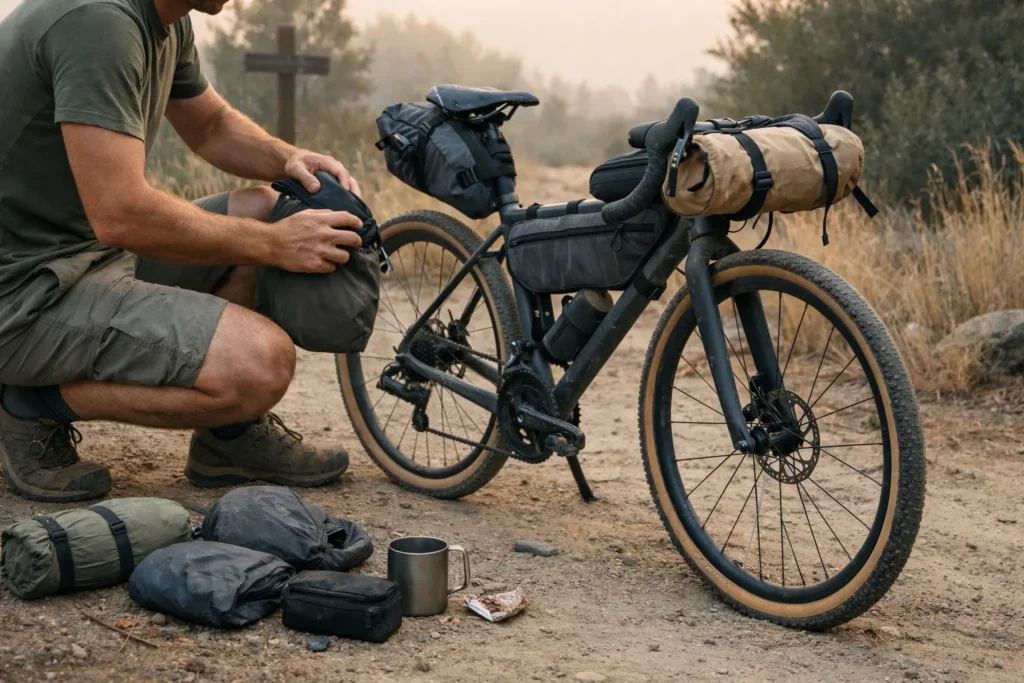
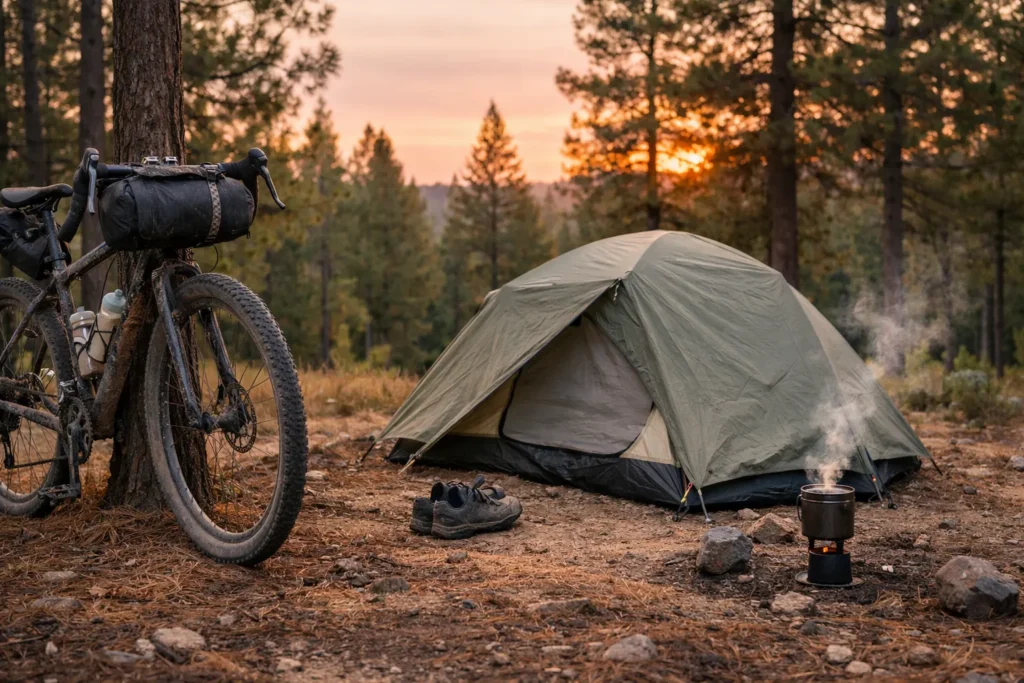
I was three nights into a solo bikepacking loop in the Balkans when I made a classic mistake. I’d found a perfect stealth spot the first night — tucked behind a stone wall, invisible from the road, flat ground, stream nearby. So I stayed a second night. Same spot. Same bike, same orange frame bag propped against the same tree. On the third morning I came back from refilling water to find a car idling ten metres from my tent. Not a threat. Just a local farmer who’d driven the same track for thirty years and noticed something new. My heart was in my throat for a solid minute before he waved and drove off.
That moment — the fear, then the relief, then the lesson — is what this whole post is about. The fear was real. The situation was manageable. And there was a fix: a simple rule I hadn’t followed. Don’t camp the same spot twice.
If you’re planning your first serious solo female bikepacking trip — or your first wild camping nights alone — this is the framework I wish I’d had. Not to make you paranoid. To give you enough system that you can stop lying awake imagining worst-cases and start actually packing. More on the mental side of solo travel is in the guide to managing the mental load of solo touring.
This page contains affiliate links and may include sponsored content. As an Amazon Associate, I earn from qualifying purchases at no extra cost to you. Amazon links are labeled #ad; other affiliate links may be marked as “affiliate link,” “Sponsored,” or “(paid link).” Learn more.
Table of Contents
- The Fear Is Real — and It’s Not the Enemy
- The Stealth Camping System: From “Somewhere Flat” to Actually Invisible
- The Camp Safety Scoring Matrix
- When Someone Approaches: What Actually Works
- Fear vs Intuition: How to Tell the Difference at 2am
- The Communication System That Works Off-Grid
- The 5 Gear Items That Actually Matter
- Day-Before Checklist
- Frequently Asked Questions
- Conclusion
Solo Female Bikepacking Safety: The Fear Is Real — and It’s Not the Enemy
Fear before a solo trip isn’t a character flaw. It’s your brain doing a threat assessment with incomplete data. The problem isn’t that you’re scared — it’s that fear without a plan just loops. Same scenarios, same 3am spiral, nothing resolved.
Solo female bikepacking safety comes down to three systems:
- Where and how you camp
- How you communicate when there’s no cell signal
- How you read and respond to people on the road
This guide walks through each one — with a scoring tool, real scripts, and a checklist — so you can stop imagining worst-cases and start actually packing.
The goal of everything in this post is to give your brain something to do with that fear. A framework converts “what if something goes wrong” into “here’s what I’ll do if X happens.” Once you have the answer, the loop breaks. That’s not toxic positivity — it’s just how the nervous system works.
One more thing before we get practical: the actual risk profile of solo bikepacking doesn’t match the imagined one. The things most likely to go sideways are mechanical failure, weather, and exhaustion-driven bad decisions — not the scenarios your brain rehearses at 2am. In my experience, the first three nights are the hardest — after that, the calibration kicks in and the noise starts making sense. That doesn’t mean you ignore the other scenarios. It means you weight your preparation accordingly.

The Stealth Camping System: From “Somewhere Flat” to Actually Invisible
Stealth camping with a bike means setting up camp without being seen, heard, or leaving traceable signs. It’s the core system this guide builds on — everything else supports it. Most advice stops at “find a hidden spot and arrive late.” That’s fine if you’re on foot with a 10-litre pack. It’s incomplete when you’re riding a loaded bike with a bright frame bag and reflective tyres. These bikepacking safety tips are built for that situation — the mechanics nobody covers for a loaded bike. The Leave No Trace Seven Principles are also worth knowing cold — solid grounding for wild camping safety for women on any route.
Timing your arrival
Aim to reach your campsite during the last 30–40 minutes of daylight — not after dark. You need enough light to assess the spot properly, but arriving in full daylight gives passing cars time to clock you. The sweet spot is golden hour: you can see, they can’t easily identify you as someone setting up for the night.
Bike colour and visibility
Bright orange frame bags, silver bar bags, reflective tyre sidewalls — these all glow in headlights far more than your tent does. Before dark, face your bike away from the road, cover reflective surfaces with a dark stuff sack or rain jacket sleeve, and if possible tuck it behind natural cover rather than leaning it against something obvious. Your bike is the biggest visible object in your camp. Treat it that way.
Entry angle and track management
Pushing a loaded bike through long grass or soft ground leaves a clear track. Approach your spot from the least visible angle, and if you’re pushing through vegetation, do it once — not back and forth. Look behind you as you leave in the morning. If you’ve made a track, you’ve made a sign.
The water-source problem
Good water sources and good stealth spots often don’t overlap. If your nearest water is 300m from the only flat ground, carry an extra 1–1.5 litres into camp and treat it there. Don’t make multiple trips to the stream after dark. One trip in, one trip out in the morning.
The no-same-spot rule
Never camp the same location two nights running. Even if nobody noticed you the first night, the second night you’re a pattern. Locals notice patterns. Move. For a wider approach to reading terrain and staying safe on the road, the wild camping safety tips for solo travellers covers day-to-day decision-making.
The Camp Safety Scoring Matrix
Before you commit to a site, run it through this framework. Five factors, each scored 1–5. Your total tells you whether to stay, adjust, or keep riding.
| Factor | 1 (High risk) | 3 (Moderate) | 5 (Low risk) |
|---|---|---|---|
| Road visibility | Visible from road or track | Partially screened | Fully hidden, no sightlines |
| Vehicle access | Car can drive directly to site | Track nearby but rough | No vehicle access possible |
| Natural cover | Open field, no cover | Some trees/scrub | Dense cover on multiple sides |
| Exit strategy | One route in/out only | Two options if needed | Multiple exit directions |
| Proximity to help | >20km from any town | 10–20km | <10km or cell signal present |
Score 20–25: Green. Good site — set up and sleep well.
Score 13–19: Yellow. Usable but make one adjustment before sleeping (reposition bike, move tent, note exit route).
Score below 13: Red. Keep riding if you have daylight. If you don’t, adjust two factors before stopping — at minimum improve cover and confirm your exit.
Use this every evening. It takes 90 seconds and converts a vague gut feeling into a specific decision.
Interactive: Camp Safety Scorer
Slide each factor to match your campsite tonight — get a green, yellow, or red recommendation.
When Someone Approaches: What Actually Works
Most interactions you’ll have on the road are curious, friendly, and entirely safe. The occasional uncomfortable one is usually someone who hasn’t read the room, not someone who means harm. Knowing the difference — and having a few phrases ready — takes most of the anxiety out of solo riding for women. Safe stealth camping for women is as much about these social moments as it is about campsite selection — and the two reinforce each other.
“Are you alone?”
This is the most common question and the most loaded. You don’t owe anyone a truthful answer. Standard deflection: “My partner’s just catching up — we got separated a few miles back.” Or the classic: “I’m meeting friends tonight.” Delivered flatly, with no elaboration, it lands as fact. Don’t over-explain. The more you say, the less it sounds true.
Someone who won’t leave your site
Friendly but persistent — the person who sits down uninvited and shows no sign of leaving. Don’t escalate, but do end it: “I’ve got to get sorted before dark — thanks for chatting.” Then stand up and start doing something purposeful with your kit. Physical action signals the conversation is over far more effectively than words do.
Reading the approach
The question to ask yourself isn’t “is this person dangerous” — that’s too binary and too slow. Ask: is this person respecting my space? Friendly curiosity looks like someone stopping at a distance, calling out hello, waiting for a response before coming closer. The alternative — walking directly into your space without pause — is worth noting regardless of how their face looks.
What “trust your gut” actually means
Your gut is useful but imprecise. What you’re actually sensing is a pattern mismatch — something in the situation doesn’t fit normal social behaviour. When that happens, you don’t have to name it or justify it. Just act on it. Leave. Move your camp. Ride another five kilometres. You don’t owe anyone an explanation for that.
Fear vs Intuition: How to Tell the Difference at 2am
Night anxiety in a tent is almost universal on solo trips — especially the first few nights. It doesn’t mean you’re bad at this. It means your threat-detection system is running in an unfamiliar environment with no prior data, and every unclassified sound feels dangerous.
Here’s the mental check that actually helps:
- What am I hearing? Name it specifically. “Footsteps” or “a car” or “something moving in the bushes.” Vague = more frightening. Specific = more manageable.
- Is this consistent with where I am? Animal sounds, wind through trees, distant traffic — all normal. Sounds that are human and getting closer without stopping — that’s different.
- What is one concrete action I could take right now? Not a plan for every scenario. Just one action. “I could unzip the tent and look.” “I could check my phone.” Having a next step breaks the freeze response.
If you’ve gone through that check and the noise doesn’t resolve and you still feel wrong — trust that. Get up. Look. A false alarm costs you five minutes of sleep. The alternative costs more.
Exhaustion is a safety issue
This doesn’t get said enough: tired = worse decisions. If you’re pushing big mileage days and running on four hours of sleep, your threat assessment gets noisy. You either under-respond (too exhausted to care) or over-respond (everything feels like a risk). This is where the burnout layer matters — if you’ve been on the road for more than a week and the fear voice has gotten noticeably louder, that’s often your body telling you it needs a rest day, not that the road has gotten more dangerous. The travel burnout recovery post covers that pattern in more detail.
The Communication System That Works Off-Grid
Cell service on remote routes can disappear for days. “I’ll text when I can” isn’t a safety plan — it’s a recipe for your contact not knowing when to worry. One thing that often gets missed: posting your location on Instagram or Strava in real time tells strangers exactly where you are and where you’re sleeping. Save the posts for when you’ve moved on.
Set this up before you leave:
- One designated contact who knows the plan in detail — your route, your daily mileage range, your expected camp zones. Not everyone you know. One person who will actually act if something’s wrong.
- A check-in schedule with explicit triggers. Not “I’ll message when I can” but: “I’ll send a GPS ping every evening by 9pm. If you don’t hear from me for 36 hours and I’m not in a known dead zone, call the non-emergency line for the region I was last in.”
- A satellite messenger as your off-grid baseline — this is the one non-negotiable item. A satellite messenger is a GPS-enabled device that lets you send messages and trigger SOS alerts without any cell coverage — and it’s the single most important purchase for remote bikepacking. If you’re riding anywhere without reliable signal, this isn’t optional — it’s the thing that turns “I hope she’s okay” into “I heard from her an hour ago.” Garmin inReach Messenger is the default pick (~$165, two-way messaging, 28-day battery). ZOLEO works well too (~$149, plans from $20/mo, slightly more phone-dependent). If you need standalone GPS without a phone, look at the Garmin inReach Mini 2 (~$366). Everything else is optional. This isn’t.
- A shared route document — even a simple Google Maps link with your planned waypoints — that your contact has access to. You don’t need to share your live location publicly. You need one person to have it.
The 5 Gear Items That Actually Matter
You don’t need to turn your bike into a mobile panic room. Most “women’s safety” gear lists are either fear-driven, impractical, or full of things you won’t carry past day two. Female solo cyclist safety comes down to a handful of light, practical items — not a kit that adds a kilogram to your load. For broader gear guidance, see the bikepacking gear essentials list and the common beginner mistakes to avoid. Here’s what’s actually worth the weight:
| Item | Why it matters | Weight penalty |
|---|---|---|
| Garmin inReach Messenger (see comparison above) | Off-grid check-ins, two-way messaging, SOS if needed. The whole communication plan depends on this. | ~100g |
| Emergency whistle (pealless, 120dB) | Loud, weatherproof, no batteries. Attach to zip. Weighs nothing. 2-pack — one on you, one spare. | <20g |
| Headtorch with red-light mode | Red light preserves night vision and is far less visible from a distance than white light when you’re setting up camp. | ~90g |
| Dry bag for phone + documents | Accessible from sleeping bag. Phone is your map, your torch, your contact point — keep it reachable at night. | <30g |
| Basic first aid + blister kit | Most solo emergencies are medical not criminal. Blisters and saddle sores derail more trips than anything else. | ~120g |
Under 400g total. No weapons, no sprays, nothing that creates legal complications in different countries. These are the items that will actually be in your hand when you need something.

Day-Before Checklist
This is the exact pre-departure system I run before every solo trip. Copy into your notes app and work through it the evening before you leave:
BIKE
- Tyres inflated, checked for cuts or embedded debris
- Brakes tested front and rear — full stop from speed
- Drivetrain clean and lubed
- All bags secured — no straps catching wheel or chain
- Lights working (front + rear)
- Satellite messenger charged and synced with contact
BODY
- Good sleep last night (if not, consider a gentle first day)
- Food for at least one full day packed before first resupply
- Water capacity full + filter/treatment accessible
- Any meds packed and accessible (not buried at the bottom)
- Chamois cream on and spare in easy-reach pocket
MIND
- Contact briefed: route, check-in schedule, trigger for concern
- Route document shared with contact
- First two nights’ camp zones identified (rough area, not exact)
- You’ve accepted that day 1 might be hard — that’s normal
ROUTE
- First day’s route loaded on device + paper backup of key waypoints
- First bailout town noted with distance
- Weather checked for first 48 hours
- Any permit or land access requirements confirmed
Frequently Asked Questions
Conclusion
The fear doesn’t go away on day one — but it gets quieter every day you’re out there. The first night in your tent alone, listening to the dark, is the hardest part. Not because something is wrong with you — because this is genuinely new terrain, and your brain is doing exactly what it’s supposed to do. After that, it just becomes the way things are. And then, eventually, it becomes the thing you miss when you’re home.
A solid system — good stealth habits, a scored camp, one contact who knows the plan — doesn’t eliminate risk. It makes the risk manageable, and that’s enough to get you out the door. These solo women bikepacking tips won’t make every night feel easy, but they’ll give you something real to do with the fear. Text your friend. Book the time off. Start packing.
This solo female bikepacking safety guide is for general education and planning purposes. Trail conditions, land access rules, and local safety considerations vary by region — always research the specific area you’re riding and consult local resources where available.