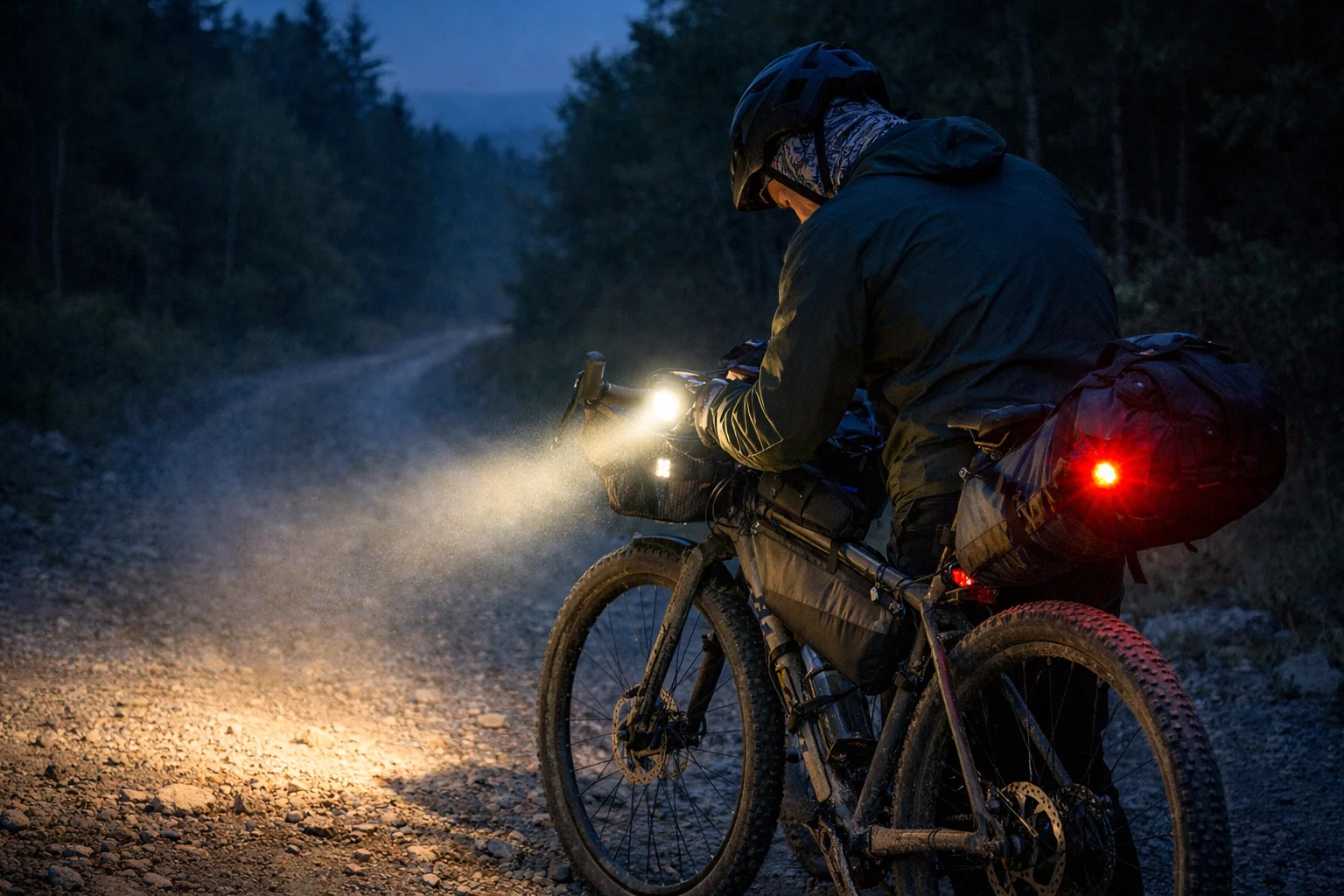
Night riding shouldn’t feel sketchy. The problem usually isn’t “more lumens” — it’s a beam you can actually read, a runtime you can trust, and a backup plan for when something dies at the worst time. In 5 minutes you’ll know what beam pattern to look for, roughly how bright you need for your terrain, and how to build a front + rear + backup setup that won’t implode on your longest night.
Whether you’re starting before dawn, rolling into camp at dusk, or doing a long night section, choosing the right bike lights for bikepacking decides how calm (or tense) the ride feels. I’ve run a bunch of lights on city paths, washboard gravel, and rough trail — and the patterns were consistent. If you’re dialing in the rest of your kit too, see our bikepacking gear guide. For the fast version, start with the setup tool.
Your Best-Fit Bike Lights Setup Tool
Pick your ride style and priorities — get a setup suggestion instantly.
Choose based on your most common night riding: mixed gravel = smooth, readable beam you can hold on medium; remote/technical = the same plus real redundancy (backup front + backup rear, and a helmet light if you’re pushing descents); road-heavy connectors = prioritize rear visibility and awareness (radar helps). Build for steady, sustainable light — not max-lumen bursts.
This page contains affiliate links and may include sponsored content. As an Amazon Associate, I earn from qualifying purchases at no extra cost to you. Amazon links are labeled #ad; other affiliate links may be marked as “affiliate link,” “Sponsored,” or “(paid link).” Learn more.
Top 3 setups that actually work
Top 3Pick the one that matches your most common night riding: mixed gravel, remote/technical, or road-heavy connectors.
Ravemen PR1400 (DuaLens, USB-C)
If you want one front light that feels “calm” instead of bright-but-stressful, prioritize beam shape and a mode you can actually hold. The DuaLens-style beam spreads usable light close + wide while limiting glare for other road users.
- Best for: gravel/mixed routes where readability and a steady “medium” mode matter more than chasing max lumens
- Format: bar-mounted front light (USB-C; runtime display helps you manage long nights)
Lezyne Macro Drive 1300XXL & Strip Pro (pair)
If you like “one purchase, done,” a matched front + rear pair makes your baseline setup easy — then you can upgrade or add redundancy later. Treat the rear in this kit as your everyday rear light.
- Best for: riders who want a straightforward front + rear combo with a simple baseline setup
- Format: USB-rechargeable front + rear light pair
Garmin Varia RTL515
If your route includes fast road connectors, what changes the experience most isn’t raw brightness — it’s awareness and predictability. This adds visibility plus earlier notice of approaching cars.
- Best for: road-heavy touring where you want both visibility and earlier notice of cars
- Format: rear light with radar
Quick note: If the PR1400 is overpriced, look for a smooth-beam ~800–1200 lm front you can sustain on medium + a real backup; if you want a true cut-off beam, the Outbound Lighting Detour (official) is the upgrade.
Table of Contents
- Setup Tool
- Top picks
- Key Takeaways
- Why Beam Pattern Matters More Than Lumens
- Minimum Lighting Setup by Riding Environment
- Lumens cheat sheet
- Front light picks for bikepacking
- Rear Light Recommendations
- Runtime Reality: Claimed vs. Real-World Performance
- Legal Requirements and Regulations
- Charging Strategy for Multi-Day Trips
- Frequently Asked Questions
- Conclusion
Key Takeaways
If you’ve ever “white-knuckled” a descent because the edges of the trail disappeared, you already know the basics. Here’s the stuff that actually changes how safe and confident you feel at night:
- Beam rule: a smooth beam on medium beats a spiky beam on turbo — readability matters more than peak lumens
- Runtime reality: plan around the mode you’ll actually ride (usually “medium”) and assume cold + age will shorten claimed numbers
- Redundancy wins: build a failure plan (backup front + backup rear, or a helmet light if you’re remote) and keep steady/flash options for changing road rules
Build your setup for your “worst-case night” (your longest + darkest stretch), not the best one.
Why Beam Pattern Matters More Than Lumens
Ever buy a “high-lumen” light and still feel underlit? That’s usually a beam issue: a bright hotspot in the middle, and darkness where the potholes and ruts live. A smoother beam with usable spill often feels brighter — because your brain isn’t constantly guessing what’s in the edges.
Flood vs. Throw: What You Actually Need
Flood beams spread light wide and close. They’re perfect for slow technical sections, tight turns, and anything where you want strong peripheral vision.
Throw beams project light farther down the trail. They shine on faster gravel descents, road connectors, and long straight sections where distance vision matters.
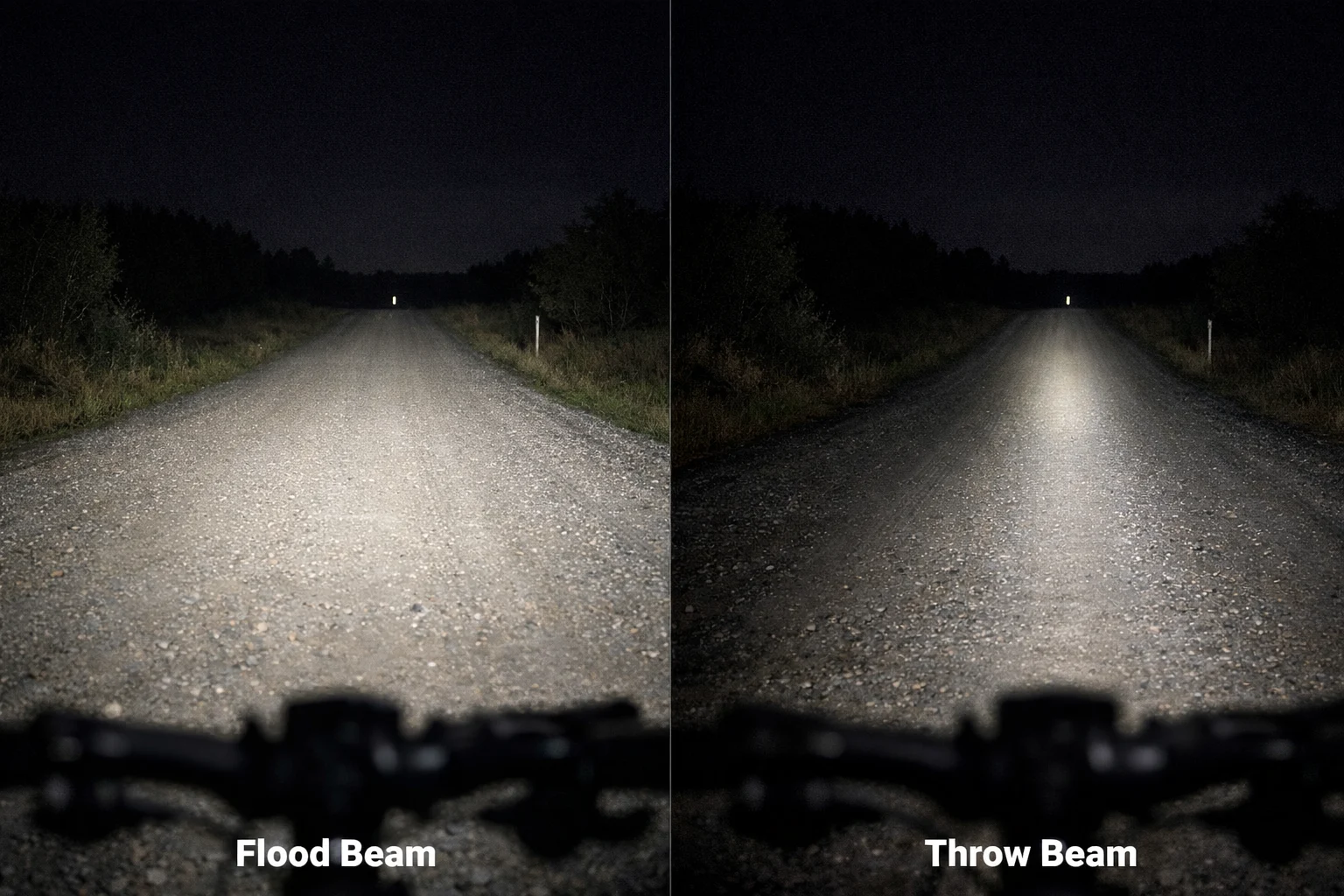
Mixed routes usually want a bit of both: flood for the near field + edges, throw for distance.
The safest-feeling lights weren’t the ones on “max” — they were the ones that made the road feel evenly lit and predictable. If your beam looks like a harsh hotspot + dark edges on a wall test, you’ll feel that on trail.
Minimum Lighting Setup by Riding Environment
Your lighting needs scale with remoteness and terrain. With bike lights for bikepacking, redundancy matters more the farther you are from help. Treat these as common starting points — then adjust for your speed, route tech, and how dark your nights really get.
Note: lumen and runtime numbers vary by mode and temperature. Use these as ballparks, then build around the mode you’ll actually ride.
| Environment | Front Light | Rear Light | Backup | Notes |
|---|---|---|---|---|
| Urban/City | ~400+ lumens | ~50+ lumens flashing | Phone light | Be seen + side visibility |
| Gravel/Mixed | ~800+ lumens | ~100+ lumens | Backup front ~200+ | Hybrid beam works best |
| Remote/Technical | ~1000+ lumens | ~100+ lumens | Full backup set | Add helmet light for descents |
Lumens cheat sheet (bikepacking reality)
Use these as starting points, then plan around the mode you’ll actually ride (usually medium). The “best” number is the one you can sustain for your longest night.
| Your night riding | Front (bar) lumens to have available | What you’ll usually ride on | What to carry as backup |
|---|---|---|---|
| Urban / paths | ~400–800 | Low–medium (aimed down, “be seen” + readable pavement) | Phone light or tiny clip light |
| Gravel / mixed | ~800–1200 | Medium (steady, smooth spill + usable throw) | Backup front ~200–400 + reliable rear |
| Remote / technical | ~1000–1500+ | Medium–high (save max for descents / surprises) | True redundancy: backup front + backup rear (or helmet light) |
| Fast descents / rough singletrack at night | ~1500–2400+ | High when needed (but don’t plan your whole night on max) | Helmet light strongly recommended + spare rear |
Ready to choose? Jump to Top picks, compare in the front lights table, or grab a system in rear picks. Once you choose a front, the “system win” is adding a reliable rear + a backup you can deploy fast.
Community pattern: On multi-day trips, riders tend to value predictability more than peak output—things like a runtime display, a stable mount, and a backup light you can deploy fast.
How experienced bikepackers avoid “light failure” moments: they treat lights like navigation—redundant. A common pattern is one primary front, one backup front (even small), and two rear options (a main + a tiny clip-on or second rear). If you ride remote, add a headlamp/helmet light that works in camp and can get you moving if your bar light dies. If you already carry a headlamp for camp, test it on-helmet at home — it’s often the simplest redundancy. For a simple lightweight option, see the headlamp pick in Budget visibility + camp backup options.
Budget visibility + camp backup options
If you’re building a simple plan without overbuying gear, separate “ride-by” light from “support” light. The support light is what you use in camp (tent, cooking, repairs), and it also doubles as a true emergency fallback if your main light fails.
- Budget visibility + emergency set: A Cuvccn rechargeable front + rear light set is a solid “be seen / got dark earlier than planned” option — and it’s useful as a backup set. Just don’t treat a ~300 lm front as a fast, unlit-trail headlight.
- Camp + repairs + emergency fallback: A lightweight headlamp like the Nitecore NU20 Classic covers cooking, finding gear, fixing flats, and those “my main light died” moments. Some riders also use a headlamp on their helmet as a directional backup while riding — especially for quick repairs or a slow roll to camp.
Durability & Weatherproofing (IP ratings)
It’s a rough moment when the weather flips and you still have miles to camp. Look for a clearly stated water-resistance rating, and protect charging ports like they’re fragile gear—because they are.
My Current Bike Lights Setup
Primary Front: Ravemen PR1400 (DuaLens, USB-C)
Backup Front: Lezyne Macro Drive 1300XXL (from the pair kit)
Rear (daily): Lezyne Strip Drive Pro 400+ (USB-C)
Rear (road-heavy days): Garmin Varia RTL515
Helmet: Petzl Swift RL (for technical sections)
One-minute setup: Mount your backup light once at home. Don’t let the first time be on the side of a dark road.
Front lights for bikepacking
These are solid picks across budgets and ride styles — essentially my bikepacking headlight recommendations for riders who care about beam quality, mounting security, and real-world usability. Weight matters when you’re packing small, but reliability still matters more.
Quick gut-check: If your plan includes rough descents or fast gravel, prioritize beam shape and mounting stability before chasing maximum lumens.
Table note: Specs vary by mode and battery age, and many listings bundle multiple versions. Use the “best for” + beam notes as your main filter, and match the exact model name shown. (Front bar lights only — rear picks are in the rear section.)
| Light | Lumens | Runtime (High) | Weight | Beam Pattern | Typical price | Best For | Where to buy |
|---|---|---|---|---|---|---|---|
| Ravemen PR1400 (DuaLens, USB-C) | 1400 (claimed) | Varies by mode | ~209 g | Dual-lens style beam (usable spill + reduced glare) | ~$70–$90 | Most gravel/mixed routes (steady “medium” + readable beam) | |
| Lezyne Macro Drive 1300XXL & Strip Pro (pair) | 1300 | Varies by mode | Varies | Focused center beam | ~$130–$160 | Bundle value + easy baseline | |
| Cygolite Metro Plus USB-C 850 | 850 | Varies by mode | ~140 g | Balanced hybrid (wide, practical) | ~$55–$65 | Budget conscious (solid “default” for paths + mixed commuting) | |
| Magicshine ALLTY 1500S (removable battery, USB-C) | 1500 (claimed) | Varies by mode | ~153 g | Road-style beam + daytime running light; OLED runtime display; removable battery | ~$55–$110 | Riders who want removable battery + smart controls (feature-heavy, but reviews are mixed) | |
| Ravemen PR2400 (high/low beam, USB-C) | 2400 (claimed) | Varies by mode | ~282 g | High beam + anti-glare low beam (more headroom for speed/tech) | ~$150–$180 | Remote/technical routes, faster gravel descents (use max sparingly) | |
| Exposure Strada Mk12 RS AKTIV | 1450 (measured) | 2–36 hours (claimed) | ~203 g | Optimized road beam + strong side spread | ~$330–$400 | Premium splurge (best beam spread feel) |
Important: Some Amazon listings (like the Cygolite Metro line) contain multiple versions in a dropdown. If you use that listing, select the exact variant named in the table (for example, “Plus USB-C 850”) — don’t assume the default option matches this guide.
Note: Many “families” of lights (like Cygolite Metro / Metro Plus) come in multiple outputs. If you see several lumen options on one listing, pick your model based on your longest night + how fast you descend — not the biggest number on the box.
Mounting Security on Rough Roads
It’s a miserable feeling when you hit washboard and your beam starts pointing at the sky. For bikepacking, favor mounts that don’t creep over time, and consider a secondary light you can move quickly if the primary mount slips.
Decision gate: If your handlebar bag forces your light too low, off-center, or partially blocked, an extender is usually the simplest fix. For rough roads, a double-clamp extender is typically more resistant to twisting than a single-clamp style.
A solid fix: BRCOVAN double-clamp handlebar extender (11.81″) — creates a clean mounting zone when bags crowd your bars.
Good for lights, GPS, or a phone mount on loaded setups. Measure your handlebar diameter before ordering, and avoid curved sections for installation.
Why I Recommend the Ravemen PR1400
If you’re trying to pick the best front light for bikepacking, this is a strong “start here” option when you want a beam that stays readable on mixed terrain without living on max power. The dual-lens approach helps keep the near field and edges usable, and the runtime display makes it easier to plan real nights instead of guessing.
- Dual-lens beam that feels more readable than a harsh hotspot
- Runtime display so you can manage long sections without surprises
- USB-C charging for a simpler one-cable routine
- Works best with a backup plan: a small second front + a reliable rear
Quick check: With your bike loaded, do a 10–15 foot “bag block” test. If your handlebar bag cuts into the beam, add an extender or raise the mount.
Budget Alternative: Lezyne Macro Drive Series
This is a strong “primary + backup” light because it’s widely available and built to take abuse.
- Pros: durable, decent runtime on practical modes, easy mounting
- Cons: beam has more hotspots than premium options; some versions are micro-USB
Before your next ride: Pick a default mode (usually “medium”). Plan around that mode, not “high.”
Rear Light Recommendations
Rear lights are about being seen. Brightness matters, but so do flash patterns, side visibility, and mounting options that still work when you’ve got a seat bag and straps everywhere.
If you’ve ever looked back and realized your light is blocked by a buckle, you know this is less about specs and more about real placement.
Decision gate: If your seat pack blocks your rear light (or your setup changes day to day), carry a tiny clip-on backup rear light you can mount anywhere.
If you ride road connectors, the Varia is the biggest upgrade; otherwise run one strong main rear + a small backup you can mount anywhere.
Rear picks (3 simple roles)
Main rear (most trips): Lezyne Strip Drive Pro 400+ (USB-C)
Bright, wide visibility, lots of usable modes, and USB-C charging so your “lights kit” stays one-cable simple.
How to choose (so you don’t overbuy): If you mostly ride dirt/gravel, a strong main rear + a tiny backup covers almost everything. If you ride fast road connectors (or busier roads), the Varia is the “stress reducer.” If your seat pack blocks lights often, prioritize a backup that can mount anywhere.
Road connectors upgrade: Garmin Varia RTL515
If you ride fast road stretches, radar awareness is the biggest “stress reducer” you can add. Use it on road-heavy days; keep a simple rear for everything else.
Backup rear (cheap insurance): Cygolite Hotshot Pro 200
Small “second rear” you can move to a rack, bag loop, or wherever stays visible when your seat pack blocks the main light.
Optional cheap insurance: If you want a tiny “throw it anywhere” backup that fits odd frames and bags, a basic clip-on rear light can be handy. Treat this as backup-only, not your primary safety light.
Mounting Considerations for Bikepacking
Seatpost mounts can collide with bags. These options tend to work better on loaded bikes:
- Seat bag loops (many bags include light attachment points)
- Rack mounting (stable and visible if you run a rack)
- Helmet rear light as a backup when bag placement is messy
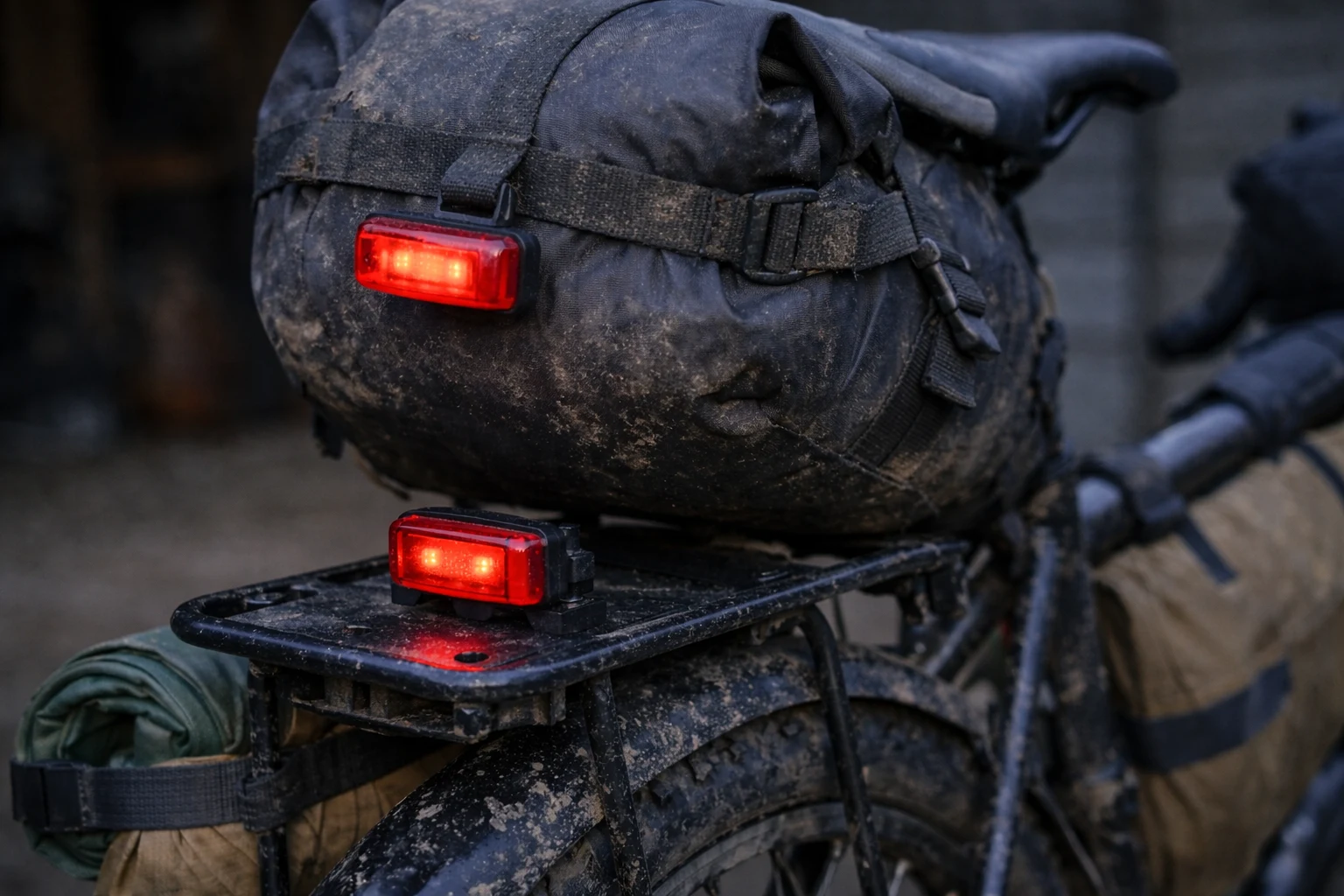
Visibility check: Sit behind your loaded bike and confirm you can see your rear light clearly. If you can’t, drivers won’t either.
Runtime Reality: Claimed vs. Real-World Performance
Runtime claims are usually best-case. Real-world bike light runtime is usually shorter: cold nights, older batteries, and “turbo” modes all cut the real number. Plan around the mode you actually ride, then add buffer.
| Light Category | Claimed Runtime | Actual Runtime | Notes |
|---|---|---|---|
| Budget (<$50) | 3–5 hours | 2–3.5 hours | Output often drops as the battery drains |
| Mid-range ($50–150) | 2–4 hours | 1.5–3 hours | More consistent regulation |
| Premium ($150+) | 2–6 hours | 1.8–5 hours | Best regulation and more honest runtime |
Factors That Affect Real-World Runtime
- Temperature: cold can reduce runtime noticeably
- Age: older batteries fade (especially after a few seasons)
- Mode selection: “high” might not equal “max output”
If you want a fast sanity check at home, run your usual mode for 20 minutes and note the battery drop. It’s a simple way to spot “marketing high mode” vs. reality.
Legal Requirements and Regulations
Lighting laws aren’t consistent — and they get especially weird once you cross borders or switch from bike paths to roads. The safest move is simple: bring lights that can do steady and flash, then use the mode that matches where you’re riding.
Common Legal Requirements
- Most regions: white front light + red rear light/reflector after dark
- Flashing vs steady: some places restrict flashing modes at night or require steady
- Reflectors: pedals and rear reflectors may be required in certain countries
If you want one “easy reference” example, the UK Highway Code (Rule 60) lays out required lights and reflectors: Highway Code Rules for Cyclists (Rule 60). For a UK lighting summary, see: Pedal cycles — lighting.
Before you travel, practice switching your rear light between steady and flash so it’s muscle memory (especially if you’ll be riding in traffic).
Charging Strategy for Multi-Day Trips
Here’s the real problem on multi-day trips: it’s 10 p.m., you’re tired, and the one cable you need is buried in your bag. A tiny charging routine prevents that spiral. This post focuses on choosing lights (not building a full power system), but these habits keep your setup from turning into chaos — especially if you’re relying on a rechargeable bike light for bikepacking and a simple power-bank routine.
USB-C vs. Micro-USB vs. Proprietary
- USB-C: durable, fast, one-cable life
- Micro-USB: fine if you protect ports and carry a reliable cable
- Proprietary docks: convenient until you lose the cable — risky for remote trips
Power Bank Compatibility
- Charge rate: some lights sip power painfully slowly
- Indicators: battery % or clear LEDs help you plan
- Use-while-charging: handy for long nights or emergencies (test at home first)
One more option for truly long tours: a dynamo hub can reduce charging stress by generating power while you ride. It’s not required, but many long-distance riders like it for reliability.
Helpful tools for charging on tour
When you’re tired and it’s dark, the “best” charging plan is the one that feels effortless enough to actually do.
What to look for: USB-C in/out, a form factor you’ll actually carry, and (if you need it) pass-through charging. The “best” power bank is the one that reliably shows up in your routine.
Decision gate: If your longest planned night is longer than your light’s usable “medium” runtime, a small power bank turns “hope” into a plan.
Hard to regret: Nitecore NB10000 Gen II (10,000mAh) — light enough to actually carry, strong enough to make your runtime plan real.
Best for most bikepacking trips. If you’re doing very long nights or charging multiple devices, consider a 20,000mAh option instead.
A 2-pack of 1ft USB-C cables (like the INIU 100W short USB-C to USB-C set) is the tiny upgrade that stops the nightly “where’s my cable?” scramble — especially if you’re charging in a tent vestibule or a café. Two short cables usually beats one long cable that becomes a knot.
Quick pack tip: One cable standard + one spare cable in a small pouch. That’s it. It saves disproportionate frustration.
Frequently Asked Questions
Conclusion
Great lighting is a mix of beam shape, honest runtime, and a backup plan you’ve actually tested. Build your setup around the nights you really expect to ride — then add redundancy if you’re going remote.
If you want the quick answers again, jump back to the Top picks and choose a front + backup + rear combo that fits your terrain.
If you want the bigger gear picture, start with our bikepacking gear guide so everything works together.
This guide is general education about bike lights for bikepacking, not personalized safety or legal advice. Laws, conditions, and real-world runtime vary (especially with cold, rain, and battery age). If you’re unsure about local requirements or night-riding safety for your route, consult a qualified local bike shop, event organizer, or cycling authority.