This page contains affiliate links and may include sponsored content. As an Amazon Associate, I earn from qualifying purchases at no extra cost to you. Amazon links are labeled #ad; other affiliate links may be marked as “affiliate link,” “Sponsored,” or “(paid link).” Learn more.
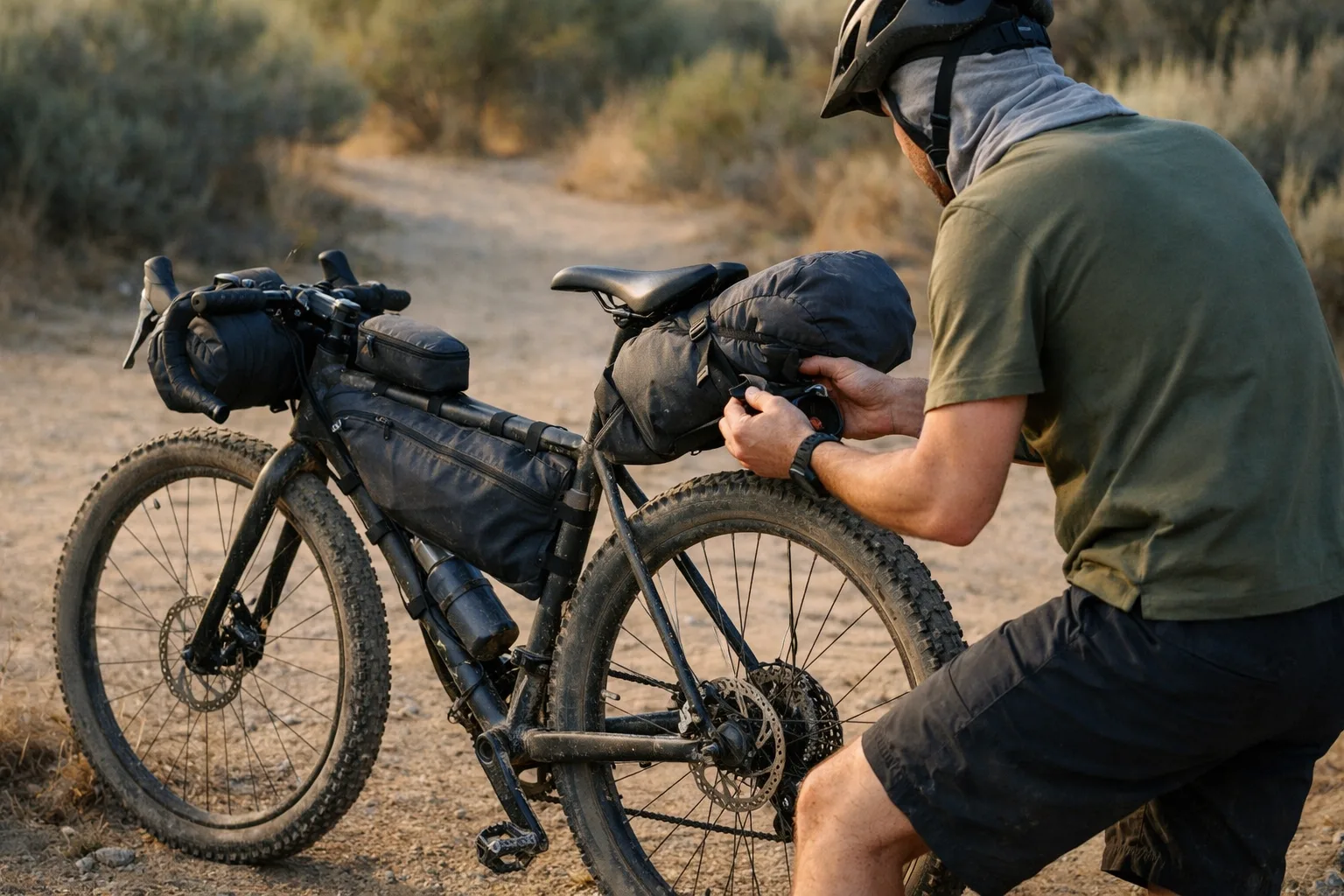
If your bike starts to feel wobbly the second the trail gets chunky, it’s usually not your legs—it’s your bikepacking bags system. Put dense weight close to the frame, bulky/light items in the seat pack, and quick-grab gear up front. The bike stays calm and predictable even when the terrain gets messy.
Fast shortcut: See the picks table below. Not sure what fits your bike or terrain? Use the interactive setup tool right after it. For the full bikepacking gear list—including shelter, sleep, cooking, navigation, and repair—check our complete bikepacking gear guide.
60-second blueprint (do this before you shop): Load dense/heavy items (tools, food, batteries) in the frame bag first, bulky/light gear (sleep kit, layers) in the seat pack, and light/quick-access items (rain layer, snacks) up front. If the rear “wags” on descents, remove weight from the seat pack before buying bigger bags.
How I Picked These
I prioritize (1) rock-solid mounting under braking and chatter, (2) reinforced strap anchors and abrasion points, (3) weather resistance that survives dust + real rain, (4) usable access while riding, and (5) fit across common bikes. A slightly smaller bag that stays planted beats a huge one that sways. These picks favor stability on rough descents over maximum liters.
Picks at a Glance
| Bag position | Best overall | Best value |
|---|---|---|
| Frame |
Blackburn Outpost Frame Bag
|
WOTOW Triangle Bag (2L) — cheap fit tester
|
| Seat |
Revelate Terrapin Seat Bag (8L)
|
Topeak BackLoader — proven & easy to live with
|
| Handlebar |
Ortlieb Handlebar Pack (9L)
|
Blackburn Outpost Cargo Rolltop (6.5L) — versatile & solid mounting
|
Find Your Stable Bag Setup
Select your bike, terrain, and trip length to see a tailored, stable setup with capacity targets.
Select your bike, terrain, and trip length above to see your tailored recommendation.
Table of Contents
- Key Takeaways
- Choose a stable bag setup (terrain + frame)
- Why frame + seat + handlebar bags work (centered weight)
- Bag-by-bag breakdown: top picks for each position
- Optional upgrades (quick access + low mount storage)
- My current setup (what I run)
- Capacity planning + mounting tips
- Common mistakes to avoid
- Keep your bags alive (quick care)
- Budget-conscious setup building
- Troubleshooting the top 3 issues
- Real-world notes (what held up)
- Frequently Asked Questions
- Conclusion
Key Takeaways
- Stability comes from centered weight: frame first for dense gear, seat for bulky/light, bars for light + quick access
- Bike type affects compatibility: full-suspension limits frame space; drop bars require cable/hand clearance
- Mounting beats max liters: secure strap paths and reinforced anchors reduce sway and failures
- When handling feels sketchy: remove rear weight before you upsize anything
Choose Your Bag Setup by Terrain and Bike Frame
Your ideal bag setup depends on two things: frame space (what fits) and terrain (how stable it must be). Use this as your quick compatibility check.
Hardtail Mountain Bikes 🚵♂️
Best for: Rough terrain, big frame triangles, stability-focused builds
Recommended setup: Large frame bag + medium seat bag + compact handlebar bag
- Compatibility note: You can usually run a larger full-frame bag without clearance headaches.
- Don’t buy if: your triangle is very small/tight (high knee rub risk).
Full-Suspension Mountain Bikes 🏔️
Best for: Aggressive terrain and comfort—if you plan around frame space
Recommended setup: Half-frame bag + large seat bag + medium handlebar bag
- Compatibility note: Measure around the shock/linkage and check seat pack clearance at full compression.
- Don’t buy if: you need lots of dropper travel (clearance issues).
Drop-Bar/Gravel Bikes 🚴♀️
Best for: Long days, smoother surfaces, efficient front loads
Recommended setup: Medium frame bag + compact seat bag + large handlebar bag
- Compatibility note: Handlebar loads must clear cables, hands, and (if used) lights/computers.
- Don’t buy if: cable routing is tight or you stack big lights/computer (hand clearance issues).
Garage test: Pack your front roll, then turn the bars fully left/right. If anything binds or rubs (cables, brake hoses, tire), fix it now.
Why Frame, Seat, and Handlebar Bags Form the Core Setup
Panniers can be great for smoother touring, but on rough routes they often feel wide and “swingy.” A modern three-bag setup keeps weight close to your bike’s center of gravity so handling stays predictable.
What you gain (in real riding)
- Calmer handling: less rear wag and less steering wobble at speed
- Better clearance: fewer snags on tight singletrack and fewer heel-strike issues
- Easy scaling: run smaller for overnights, add capacity only when you need it
Bag-by-Bag Breakdown: Top Picks for Each Position
The goal isn’t max liters—it’s a setup that stays stable when you stand, descend, and grind washboard.
Frame bag vs seat pack: what goes where?
Put dense/heavy items (tools, food, batteries) in the frame bag first. Use the seat pack for bulky/light gear (sleep kit, layers). If the rear starts to wag, lighten the seat pack before you change anything else.
Frame Bags: The Foundation of Your Setup
Frame bags carry your heaviest gear in the most stable position. Fit matters as much as capacity—especially width.
Best Overall: Blackburn Outpost Frame Bag
- Why it wins: strong performance, widely available, great price-to-stability ratio
- Best for: most riders building or upgrading a stable setup
- Don’t buy if: your triangle is very small/tight (high knee rub risk).
Verdict: The smartest all-rounder that “just works” for the majority of bikes and terrain.
Still worth it in 2026? Yes—because this position is about fit + strap stability more than “latest model.” A frame bag that stays tight under braking is always the right answer.
Hard to regret add-on for tools/spares:
Apidura Expedition Downtube Pack (1.2L) — keeps heavy spares low and out of the seat bag.
If you’re still dialing in sizing and strap routing, start with a cheap tester before committing to a premium low-mount option.
Best value fit tester:
WOTOW Triangle Bag — cheap way to test strap routing and sizing before upgrading.
Seat Bags: Add Capacity (Without Rear Sway)
Seat packs handle bulky, lightweight gear like sleep systems and spare layers. Stability comes from tight strap paths and a bag that matches your route.
Best Overall: Revelate Terrapin Seat Bag
- Why it wins: stable mounting, dry-bag style, low sway under load
- Watch for: seatpost/tire clearance and dropper post needs
- Don’t buy if: you need lots of dropper travel (clearance issues).
Verdict: Choose this if rear sway drives you nuts and you want a set-it-and-forget-it mount.
Solid value pick:
Topeak BackLoader — proven, easy to live with, great for weekend+ trips.
Budget note: Rhinowalk can work, but expect more re-tightening and less weather confidence (especially after rough descents).
Handlebar Bags: Quick-Access Storage Up Front
Think “light + often used”: rain layer, snacks, small essentials. Front loads feel best when they’re even left-to-right and don’t interfere with cables or hands.
Best Overall: Ortlieb Handlebar Pack
- Why it wins: excellent waterproofing, secure roll-top closure, reliable mounting
- Best for: riders in variable weather who want zero-fuss access
- Don’t buy if: cable routing is tight or you stack big lights/computer (hand clearance issues).
Verdict: Premium waterproofing and durability make this a long-term winner.
Stable & affordable:
Blackburn Outpost Cargo Rolltop — versatile, solid mounting at a fair price.
For handlebar bag bikepacking setups, especially on drop bars, prioritize designs with good cable and hand clearance to avoid steering interference.
Optional Upgrades (Quick Access + Low-Mount Storage)
These aren’t required for your core setup. Add them only after your frame/seat/bar system is stable and dialed—prioritize if you need faster access (top tube for phone/snacks), lower heavy spares (downtube to avoid rear wag), or extra front capacity without bars (fork/strap-on if your bike supports it).
| Upgrade | Best Pick | Capacity | Pros | Cons / Watch | Best For | Link |
|---|---|---|---|---|---|---|
| Top Tube Bag (phone + snacks) | Rhinowalk Top Tube Bag | 1.2L | Easy on-the-go access, side mesh pockets for tools, good phone fit, budget-friendly | Water-resistant (not fully waterproof), may need re-tightening on rough trails | Quick grabs on any ride; most riders’ first add-on when testing top-tube storage | Rhinowalk Top Tube Bag |
| Downtube Pack (heavy spares low) | Apidura Expedition Downtube Pack | 1.2L | Keeps dense items low/centered, no rear wag penalty, durable roll-top, purpose-built for bikepacking | Requires downtube space (check bottle bosses), gets muddy in wet conditions | Fighting rear sway or need low/secure spares storage without overloading seat | Apidura Expedition Downtube Pack |
| Strap-On / Fork Cargo (extra front if bosses/cages available) | Ortlieb Handlebar-Pack Fork Mount | 9L | Excellent waterproofing, secure roll-top, reliable fork mounting, good for bulky/light gear | Requires proper fork cage/bosses; higher price than basic rolls | Bikes with fork mounts; riders who want premium waterproof fork storage | Ortlieb Handlebar-Pack Fork Mount |
Quick rule: Start with one upgrade that solves your biggest annoyance (e.g., digging for phone/snacks → top tube; rear wag from tools → downtube). Test on a short ride before committing. If your bike lacks fork bosses, skip anything-cage styles.
My Current Frame + Seat + Handlebar Bag Setup
Here’s what I run for 2–5 day trips when I want stability first and simple access for food/tools. (I’m not religious about brands—if something stays tight and survives abuse, it earns its place.)
| Bag Position | Specific Model | Capacity | Primary Contents | Weight Distribution |
|---|---|---|---|---|
| Frame | Blackburn Outpost Frame Bag | ~10–14L (size-dependent) | Tools, food, batteries, dense supplies | 45% |
| Seat | Revelate Terrapin (8L) | 8L | Sleep kit, shelter, spare layers (bulky/light only) | 35% |
| Handlebar | Blackburn Outpost Cargo Rolltop | ~6.5–10L | Rain layer, small essentials, and whatever I want fast (I keep dense gear in the frame) | 20% |
| Total System | – | ~28–35L | Complete multi-day setup | 100% |
Quick-access first aid for your frame bag:
Adventure Medical Kit .9 — a solid default size for most solo/multi-day rides.
Availability tip: If the .9 is out of stock or too bulky, consider the lighter .7 (for solo/short trips) or the tiny .3 (a minimalist starter). All are water-resistant and part of the trusted Ultralight/Watertight series.
Blister prevention tape (pre-cut strips): Leukotape P — keep a few pre-cut pieces inside your first-aid kit.
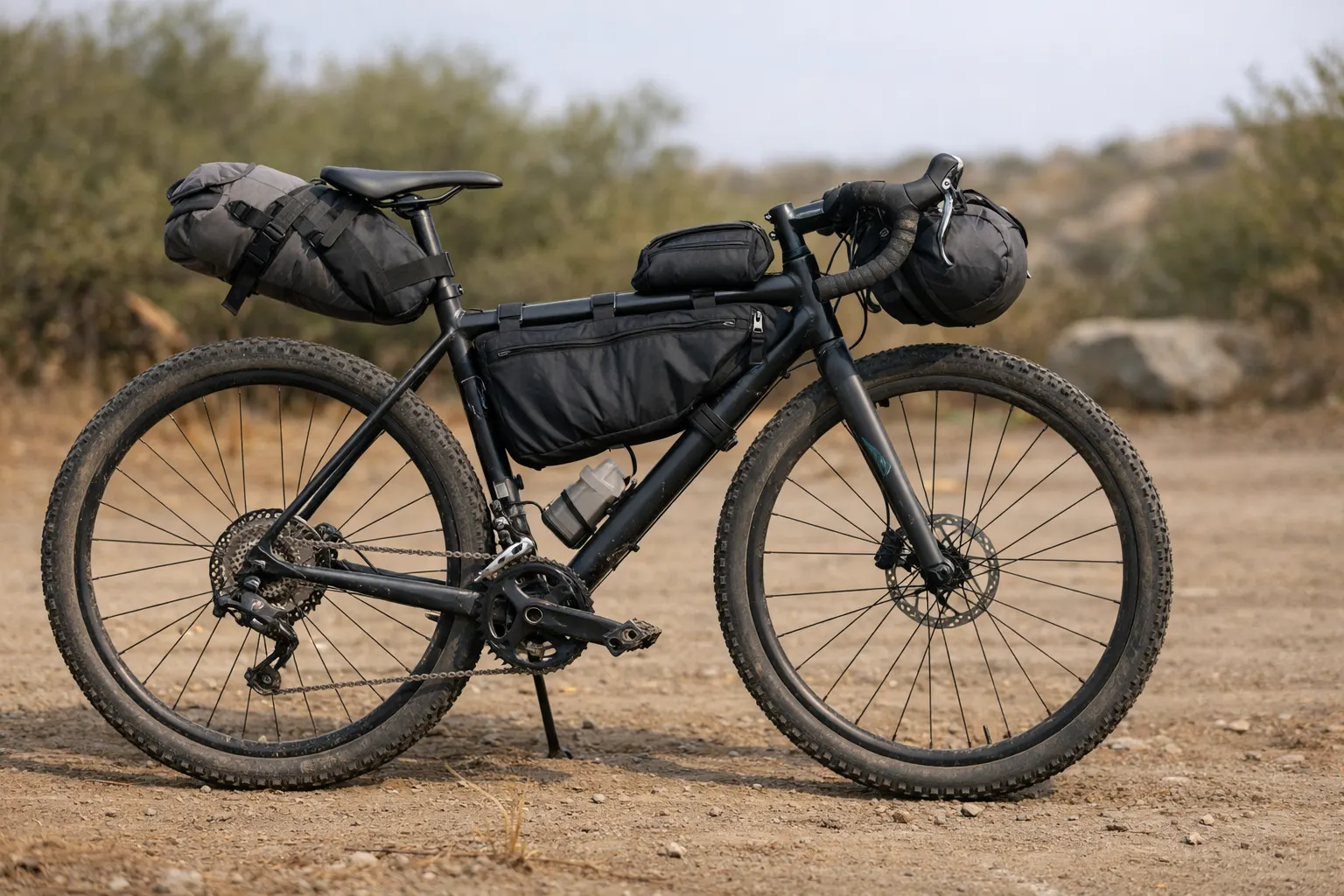
Safety check: Do one hard brake test in a safe spot. If the rear feels like it’s pushing forward, move one dense item into the frame bag.
Capacity Planning and Mounting Tips for Your Setup
A stable bag setup starts with capacity you can control, then you fine-tune placement. Use these targets as a starting point and adjust after your first overnight.
Capacity Guidelines by Trip Length
Overnight (1–2 days): 20–25L total capacity
- Frame bag: 8–10L
- Seat bag: 6–8L
- Handlebar bag: 6–7L
Weekend (2–3 days): 30–35L total capacity
- Frame bag: 12–14L
- Seat bag: 10–12L
- Handlebar bag: 8–9L
Extended (4+ days): 35–45L total capacity
- Frame bag: 14–16L
- Seat bag: 12–15L
- Handlebar bag: 9–12L
- Optional add-ons: top tube bag, fork bags (only after the core is stable)
If your frame bag steals bottle space, plan water early—many riders use a Sawyer Squeeze + Cnoc Vecto combo to filter from shallow sources and carry clean water without extra bottles.
Core water filter solution:
Sawyer Squeeze — lightweight, reliable, filters directly from sources.
Critical Mounting Tips 🔧
- Protect the frame: add tape where straps rub.
- Check full clearance: steering lock, tire clearance, and (for full-sus) compression clearance.
- Prioritize strap anchors: multiple attachment points beat single “one-strap-to-rule-them-all” designs.
Common Mistakes to Avoid With Your Setup
Most handling problems aren’t “bad bags”—they’re a rear-heavy load or loose strap paths. These are the fixes that matter most.
1. Overloading the Rear ⚠️
Fix: Move dense items forward (frame bag first). If the rear still wags, reduce seat pack volume before upsizing anything.
2. Ignoring Clearance ⚠️
Fix: Check rub points (cables, knees, tire, shock/linkage) before your first real ride. Protect contact areas with tape.
3. Weak Strap Paths (Where bags fail first) ⚠️
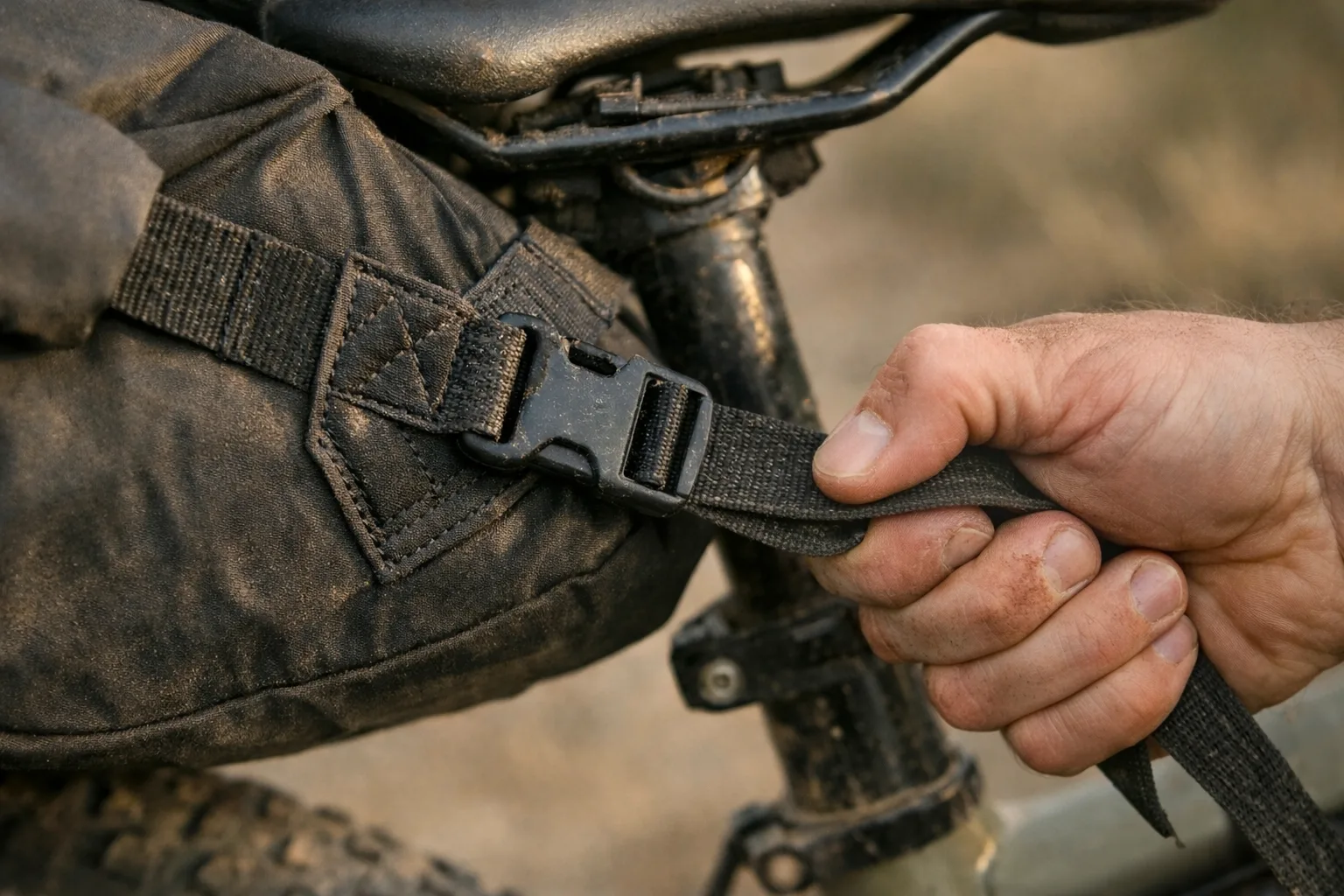
The first weak point usually isn’t the fabric—it’s the strap path: buckles slipping, webbing stretching, and anchors chewing into stitching. Adding a protective patch/tape at high-rub points and running a backup strap in the main load direction can meaningfully reduce failures.
Keep Your Bags Alive (Quick Care)
You don’t need a maintenance ritual—just a few habits that prevent the common failures.
- Rinse grit off zippers and buckles after dusty rides.
- Check strap anchors and rub points; re-tape protection before it wears through.
- Dry bags fully before storage (especially after rain or river crossings).
- Carry one spare strap (Voilé-style is popular) for fixes and extra stability.
Budget-Conscious Setup Building
If you’re building slowly, that’s normal. Buy in the order that improves stability first, then convenience.
Budget / try-it-first options (when you’re not sure yet)
| Bag position | Budget option | Reality check |
|---|---|---|
| Frame | WOTOW Triangle Bag (2L) | Great for learning fit/strap routing; limited capacity vs full frame bags. |
| Seat | Rhinowalk Saddle Bag | Works, but plan to re-tighten straps more often (especially on rough descents). |
| Handlebar | Rhinowalk Handlebar Bag (2.4L) | Good “front storage test” pouch; not a full roll system. |
Phase 1: Frame Bag (stability first)
A frame bag does the most important job: it carries dense weight close to the bike.
Phase 2: Handlebar Bag (access + balance)
Handlebar storage is the best “quality of life” upgrade for quick access items.
Phase 3: Seat Bag (volume for multi-day)
Seat packs add volume—just keep bulky/light back there and keep strap paths tight.
Money-saving reality check: A stable mid-size bag usually beats a huge bag that sways.
Troubleshooting the Top 3 Issues
1) Bag sway / rear wag
- Reduce seat pack weight first (bulky/light only).
- Tighten straps in order: anchor → buckle → stabilizers (if present).
- Move one dense item forward into the frame bag.
2) Rub and clearance problems
- Reposition the bag and re-route cables before you accept “it’s fine.”
- Add frame protection tape anywhere straps or buckles touch paint.
3) Wet gear
- Use internal dry bags for sleep systems and electronics.
- For heavy rain, add a tough internal liner like the Sea to Summit Big River Dry Bag (5L) for “must-stay-dry” items (sleep layers, electronics).
- Prioritize better closures/zippers before “more liters.”
Real-World Notes (What Held Up)
After extensive riding across rocky descents, washboard gravel, and wet rides, the consistent pattern was simple:
- Rear-heavy loads made handling feel twitchy; moving dense gear into the frame calmed it immediately.
- Mid-range gear most often failed at zippers/buckles before fabric; stability and strap anchors mattered more than material hype.
- Budget bags were useful for testing fit, but showed more strap slip and anchor wear over time.
Frequently Asked Questions
Conclusion
Building an effective bikepacking bags system comes down to matching your setup to your bike, terrain, and trip length, then keeping dense weight centered. Start with a frame bag, add a handlebar bag for access and balance, and finish with a seat pack for volume—while prioritizing mounting stability over max liters. This bags-focused approach fits into the bigger picture of lightweight, self-supported bikepacking—see our full bikepacking gear guide for shelter, cooking, navigation, and more.
Quick Bikepacking Bags Checklist
- Frame bag first → dense/heavy items (tools, food, batteries)
- Seat pack second → bulky/light items (sleep kit, layers)
- Handlebar third → light/quick-access (rain gear, snacks, small essentials)
- Check clearance + do a hard-brake test before long rides
Next Steps:
- Measure your frame triangle (and full-sus clearance) before you buy.
- Choose a stable core setup (use the tool above).
- Pack dense items in the frame first, bulky/light in the seat.
- Do the clearance + brake checks before longer rides.
- Run a quick pre-ride checklist: full steering lock, tire clearance, strap tension, and one hard-brake test.
This bikepacking bags system guide is for general education only and isn’t personalized gear or safety advice. Your bike, route, and packing style can change what works, and results will vary. If you’re unsure about fit, clearance, or safety—especially for rough terrain—consider checking in with a qualified bike shop or experienced guide before a bigger trip.