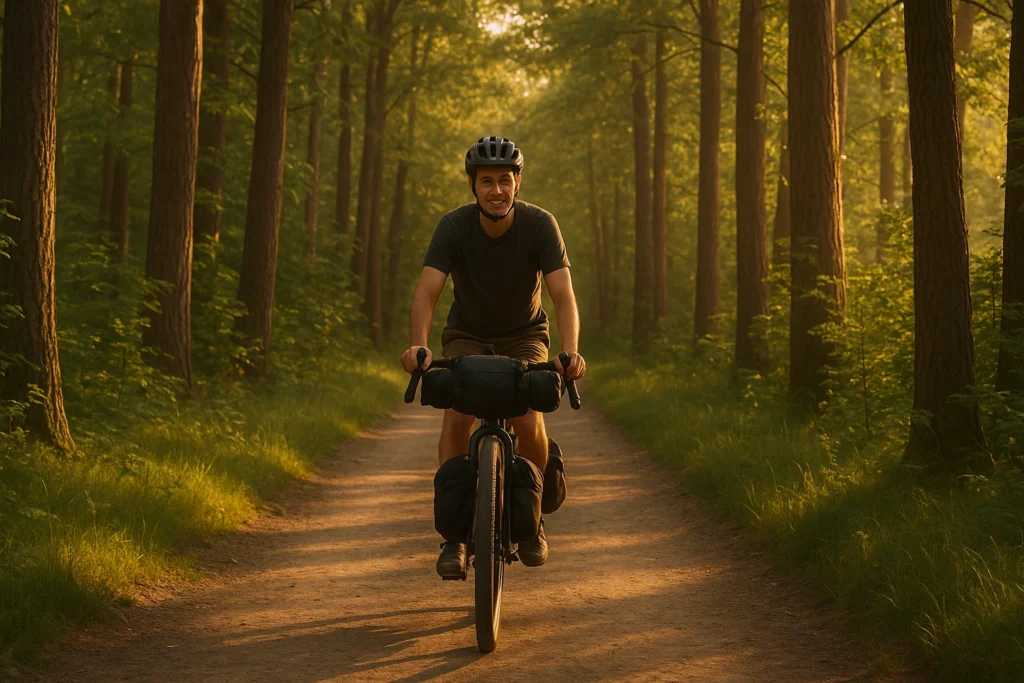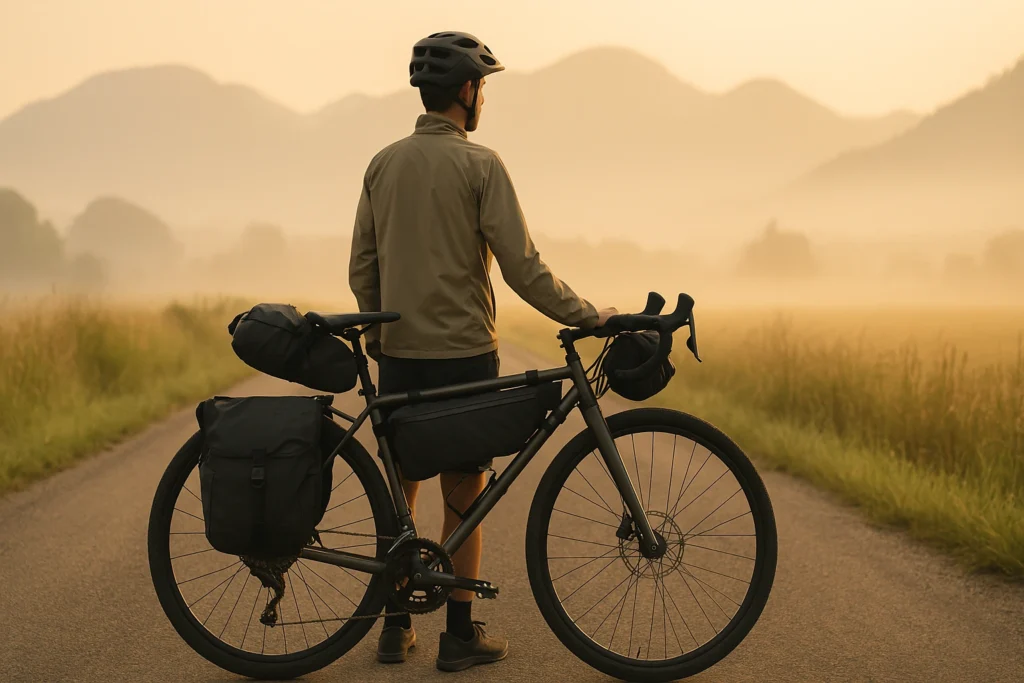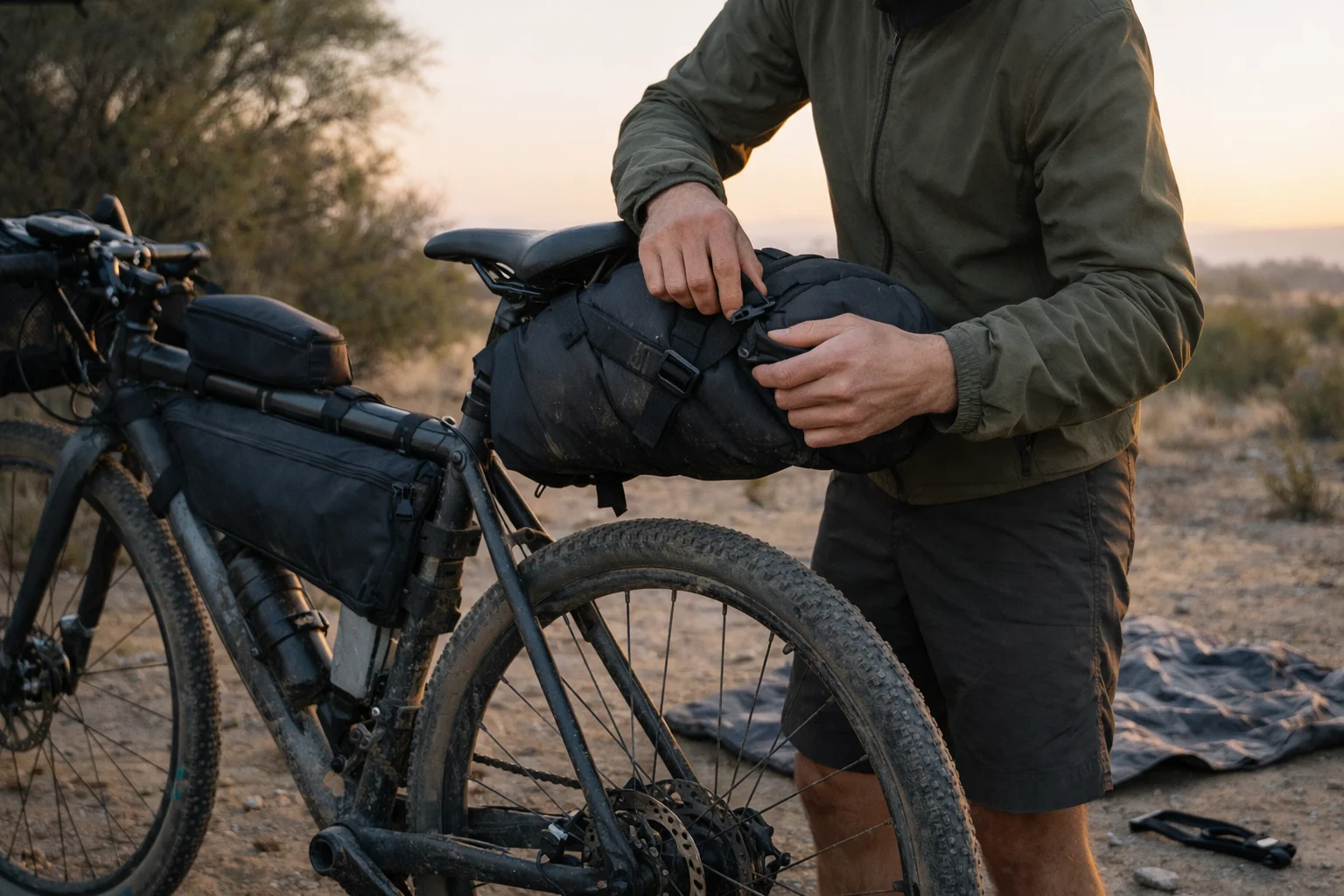
Don’t want $500 bags? You’re not alone. If you’re trying to build budget bikepacking bags that won’t fall apart on day two, it helps to know which corners matter (and which ones don’t) before you hit “buy.”
After three years of testing affordable bikepacking bags on everything from weekend gravel rides to month-long tours, I’ve learned something simple: the right setup can go the distance. But you’ve got to pick the right compromises—and reinforce the predictable weak spots (strap anchors, zipper corners, hardware under tension) before they fail. For the bigger picture on building a full kit, see our bikepacking gear guide.
Budget Bikepacking Bag Builder
Choose trip, weather, priority—get a budget split. Pick one option in each row to unlock your plan.
Plan for: Choose your options
Your plan shows up here
Choose one option in each row to get a recommended budget split and the first 2 reinforcements to do.
Tip: If something failed last trip, bump “Trip style” up one level and re-check the split.
This page contains affiliate links and may include sponsored content. As an Amazon Associate, I earn from qualifying purchases at no extra cost to you. Amazon links are labeled #ad; other affiliate links may be marked as “affiliate link,” “Sponsored,” or “(paid link).” Learn more.
Table of Contents
- Key Takeaways
- Budget vs Premium: What Matters
- Where Affordable Bikepacking Bags Fail First (And How to Fix Them)
- Frequently Asked Questions
- My Tested Budget Alternatives: Bikepacking Bags Under $200 (Real Performance Table)
- Bag Reliability Extras (Worth It)
- The Smart Upgrade Path
- Maintenance That Multiplies Lifespan
- Real-World Durability: My 3-Year Test Results
- Smart Shopping: Getting the Best Budget Deals
- Building Your Complete Budget System
- Conclusion: Smart Compromises for Real Adventures
I’ve watched $40 frame bags outlast $200 premium options. I’ve also watched cheaper setups fail on day two. The difference usually isn’t luck—it’s choosing the right category to “go cheap,” then reinforcing the few spots that always take the abuse.
Key Takeaways
It’s the night before a trip. Your bike is leaning against the wall, and you’re tugging straps thinking, “Please don’t be sketchy.” Start here—these are the fastest wins.
- Budget-friendly bikepacking bags fail predictably at strap anchors, zipper corners, and seam edges—but many failures are preventable
- Durability is mostly materials + construction—thicker ripstop and clean stitching usually outlast thin fashion fabrics
- The sweet spot is $30–80 per bag—below $30 is often false economy; above $80 can mean you’re paying for premium features you may not need
- Category matters for trade-offs—frame bags can go more budget, but don’t skimp on seat packs that carry heavy loads
- Wear timelines are learnable—in my experience, many budget bags show meaningful wear between ~500–1,500 miles depending on terrain and load
If you only “don’t gamble” on one thing, make it hardware under tension—seat pack straps and handlebar mounts are where budget systems usually feel sloppy first.
Budget vs Premium: What Matters
Premium bikepacking bags cost more because durable construction is genuinely expensive. But “premium” isn’t one thing—you’re mostly paying for a handful of features that matter more on certain routes than others.
What premium buys (when it’s worth it)
- Stronger mounting systems that stay tight over long, rough days
- Better seams and reinforcements at strap anchors and zipper corners
- More reliable weather management (materials + closures + seam strategy)
When budget is the smart move
- You’re still learning your setup (capacity, placement, what you actually use)
- You ride established routes where a failure is annoying, not dangerous
- You’re willing to reinforce early (a little prep prevents most trip-ruiners)
When spending up is the safer call
- Remote touring where bag failure could be dangerous
- Constant rain or wet season riding where “weather-resistant” won’t cut it
- High-mileage use where strap stretch and hardware fatigue show up fast
One simple way to decide: fill in the blank—“If this bag fails, the consequence is ____.” If your answer is “wet sleep kit,” “no food,” or “no safe bailout,” you’re looking at a premium-first category.
Where Affordable Bikepacking Bags Fail First (And How to Fix Them)
If you’ve ever pulled over to re-tighten a swaying seat pack (again), this is for you. After testing dozens of lower-cost options, I can predict where most bags start showing stress. The good news: a little reinforcement up front prevents most trip-ruiner failures.
Stitching Stress Points
Where it happens: Strap anchors, zipper corners, load-bearing seams
Why it fails: Budget manufacturers often use lighter thread and fewer passes to save time. In my own testing, this shows up first at strap anchors and zipper corners.
Prevention fixes:
- Add bartacks at mounting points using heavy-duty thread
- Apply Seam Grip to zipper stress corners before first use
- Reinforce high-tension attachment points with additional stitching passes
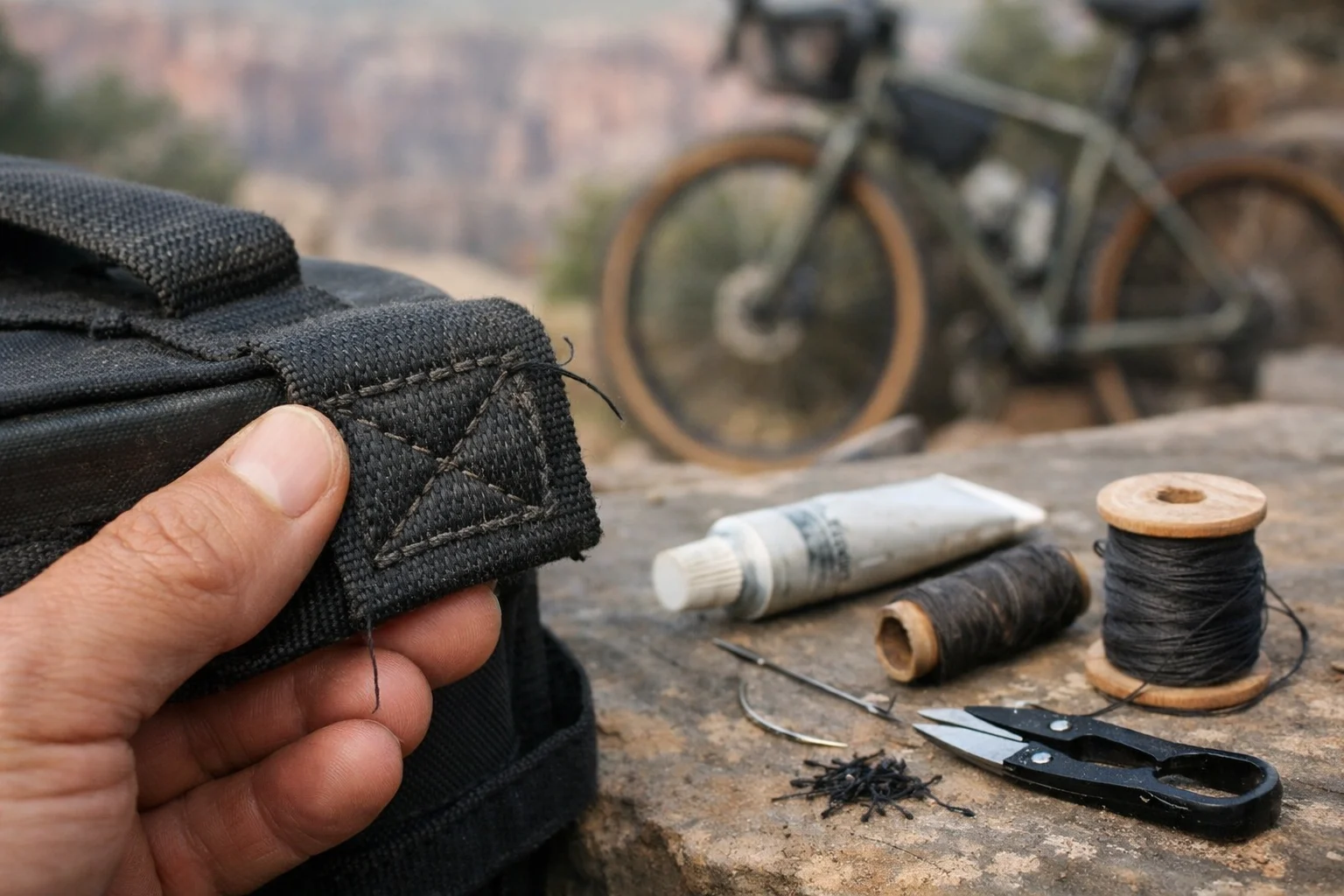
Real example: My $45 budget frame bag started showing loose stitching at the top tube mount after ~200 miles. Five minutes with a sewing machine added hundreds more miles of reliable service.
Fit + Frame Rub: The Silent Bag Killer
This one sneaks up on people. If your bag is slightly too tall in the triangle—or your straps sit on cables—you can get constant abrasion that kills the fabric fast. Before your first ride, check clearance at full steering lock, look for cable pinch points, and consider simple frame-protection tape under strap contact areas.
Buckle and Hardware Failures
Where it happens: Plastic buckles under constant tension, cheap carabiners, elastic cord locks
Why it fails: Budget bags often use basic hardware that’s fine—until cold, heat, or over-tightening creates stress fractures.
Prevention fixes:
- Replace questionable buckles early (cheap upgrade, big reliability gain)
- Carry a spare strap for critical attachment points
- Carry backup elastic cords—they’re often the first thing to snap
Waterproofing Degradation
Where it happens: Seam edges, zipper runs, fabric coating wear points
Why it fails: Many budget bags are best described as weather-resistant, not waterproof. Coatings can degrade with abrasion and grime, and seams are the usual entry points.
Prevention fixes:
- Re-seal seams as needed with an appropriate seam sealer
- Refresh water beading with a DWR treatment when fabrics stop shedding water (how to test and revive DWR)
- Use dry bags inside for critical gear—especially on wet/unpredictable trips
Quick rub check: turn the bars lock-to-lock, compress the fork a few times, and make sure no strap is sawing into paint, cables, or the bag fabric.
Quick FAQs before the big comparison: This is the spot where most people have “one last question” (capacity, sway, panniers) before diving into the tested table and picking a setup.
Frequently Asked Questions
My Tested Budget Alternatives: Bikepacking Bags Under $200 (Real Performance Table)
If you’ve ever bought a “deal” bag that looked fine until the first rough descent, this section saves money. I’ve tested these in real touring conditions—not just a couple neighborhood rides—so you can see the trade-offs clearly.
How I judged them: stitching at strap anchors, hardware under tension, and closures that still work when dusty/wet. (Stars are my durability rating from use—not Amazon ratings.)
Quick way to use this table: Skim the “Likely failure point” + “First fix” columns—those two prevent most trip-ruiners.
| Category | Budget Pick | Capacity (claimed) | Price | Durability (my real use) | Likely failure point | First fix | Best For | Check price |
|---|---|---|---|---|---|---|---|---|
| Frame Bag | Blackburn Outpost Frame Bag | Varies (by size) | $45–65 | ⭐⭐⭐⭐ | Fit/cable rub if sized wrong | Size carefully; protect contact points | “Real brand” option without full premium pricing | |
| Seat Pack | Rhinowalk Waterproof Saddle Bag 10L | 10L | $30–40 | ⭐⭐⭐ | Strap stretch / tail sway with heavy loads | Pack heavy items forward; add a backup strap | Budget tours + lighter sleep kits | |
| Handlebar Bag | Rhinowalk Waterproof Handlebar Dry Bag (12L) | Up to ~12L | $18–30 | ⭐⭐⭐ | Strap creep / bounce if overpacked; water gets in if roll-top is sloppy | Roll at least 3 turns; keep heavy items out; add a strap/spacer if cables rub | Sleep kit/clothes on a true budget (roll-top “front load”) | |
| Top Tube Bag | Rhinowalk Top Tube Bag 1.2L | 1.2L | $25–30 | ⭐⭐⭐⭐ | Strap shift if overloaded / knee rub if too wide | Use bolt mounts if possible; keep it light; center it | Phone + snacks + small tools with better organization | |
| Fork / Cargo (optional) | Sea to Summit Big River Dry Bag (5L) | 5L | $30–40 | ⭐⭐⭐⭐⭐ | Mount rub / strap slip (usually not the bag) | Tape rub points; add a backup strap | Wet trips, inner waterproofing, fork cargo |
Bag Reliability Extras (Worth It)
These aren’t “random accessories.” They’re the cheap, universal items that prevent the most common budget-bag failures (and they work with any brand).
- Voile-style straps: the fastest fix for sway, strap stretch, and “I can’t get this tight enough” mounting problems
- Seam sealer (Seam Grip-style): reinforces zipper corners + high-stress seams before they peel or wick water
- Spare buckles / ladder locks: hardware under tension is the first thing to crack on budget setups
- Frame protection tape: prevents paint/cable rub that destroys bags from the outside-in
- Inner dry bags: the “real waterproofing” for wet trips (sleep kit + clothes always go inside one)
Micro-action: Before your first loaded ride, do a 2-minute rub check (bars lock-to-lock + a few hard bumps). If anything touches, tape it now—don’t “wait and see.”
Best Picks by Category (Real Trade-Offs)
If you only keep ONE “hard to regret” pick
Blackburn Outpost Frame Bag
Hard to regret: If you’re hunting the best budget frame bag vibe without full premium pricing, this is it. Best when you want a clean fit that doesn’t fight cables—size carefully, add frame-protection tape where straps touch, and it’ll outlast most “no-name” options.
Budget seat pack reality check
Rhinowalk Waterproof Saddle Bag 10L
Most common budget move: Best for light-to-medium loads and smoother routes. Pack heavy items forward (near the post), keep the tail soft, and add a backup strap for rough descents—this is how cheap bikepacking bags that last actually earn that label.
Top tube: cheap, useful, and not worth overthinking
Rhinowalk Top Tube Bag 1.2L
Easy win: This is a quality-of-life bag—snacks/phone/tools without digging through bigger bags. If you have bolt bosses, use them for a stable mount. If not, keep it light and centered so it doesn’t creep or rub your knees.
One good strategy: pick a “champion” per category so you can stop doom-scrolling listings. Put that saved time into a quick reinforcement pass—it improves reliability more than reading 25 more product pages.
The Smart Upgrade Path
You upgrade the wrong bag first, and the bike still feels sloppy. That’s the frustration loop. A better approach: start budget and upgrade the single weak link—not the entire system at once.
Year 1: Full Budget System ($150-200 total)
Start with budget everything. Learn what you actually need, how you pack, and what capacity works for your style.
Small-frame tip: If your main triangle is tiny or full of bottles, a downtube pack can add “free” storage—just keep tools in a zip bag because it lives in the mud/splash zone.
Year 2: Upgrade Your Weak Link
Usually the seat pack or handlebar bag—whichever caused the most frustration, instability, or wet-gear anxiety.
Year 3+: Strategic Premium Purchases
By now you know your system. Invest in premium versions of the bags you use most, and keep budget options for backup or loaner setups.
Maintenance That Multiplies Lifespan
This is the unsexy part that saves trips. It’s 30 seconds at the end of a ride when you notice a strap edge fuzzing and think, “That wasn’t there yesterday.” Catch it early and you usually win.
After Every Trip:
- Empty completely and check high-wear spots
- Wipe down to remove grit (grit acts like sandpaper)
- Air dry fully before storage
Regularly (every few rides / monthly if frequent):
- Re-tension straps — stretch shows up fast on budget mounts
- Clean/lube zippers so they don’t bind
- Inspect stitching at strap anchors and corners
Seasonally:
- Refresh water beading if fabrics stop shedding water (see DWR guide above)
- Replace worn cords/buckles before they fail on a ride
Real-World Durability: My 3-Year Test Results
Test context (so the mileage numbers make sense): Most of these miles were mixed gravel + rough pavement with typical bikepacking loads (normal sleep kit, clothes, food, tools). I’m not babying the bags, but I’m also not racing or overstuffing everything to the zipper.
In my experience, budget bag wear follows a pattern. Your exact outcome will depend on terrain, weather, and load—but this is a useful mental model.
Wear timeline (what to expect)
- 0–500 miles: mostly fine; early “settling” shows up as strap stretch and minor zipper stickiness
- 500–1,000 miles: abrasion marks and seam stress become visible; maintenance usually keeps things solid
- 1,000–1,500 miles: hardware fatigue and coating wear become more likely; decide repair vs upgrade
- 1,500+ miles: survivors usually have conservative loads, simple designs, and riders who fix small issues early
Practical trick: take quick photos of strap anchors and zipper corners around the 500-mile mark. You’ll notice changes sooner, and repairs are easier when you catch them early.
Smart Shopping: Getting the Best Budget Deals
If you’re hunting cheap bikepacking bags that last, the move is to buy at the right time and avoid listings that hide weak stitching or sketchy hardware.
Timing Your Purchases
- End of season sales (October-November): often 30-50% off
- Off-season clearance (winter): last-year colors and discontinued models can be a steal
Where to Find Real Deals
- Amazon Warehouse: returns in good condition, sometimes discounted
- REI Used Gear: inspected and typically more reliable than random marketplaces
- Local bike shops: last-year stock can be heavily discounted
- Direct from manufacturer: sometimes cheaper if shipping is reasonable
Red Flags to Avoid
- Prices under $25 for main bags — often false economy
- No brand name or contact info — warranty/support issues
- Single photo listings — hiding construction details
- Perfect 5-star reviews — can be incentivized or low-signal
Before you buy, zoom in on one thing: strap anchors. If you can’t clearly see stitching quality in photos, skip the listing.
Building Your Complete Budget System
Here’s a simple system that works for a lot of riders under $200—without overthinking it. This is also a good way to start using budget bikepacking bags while you learn what layout you actually prefer for your riding.
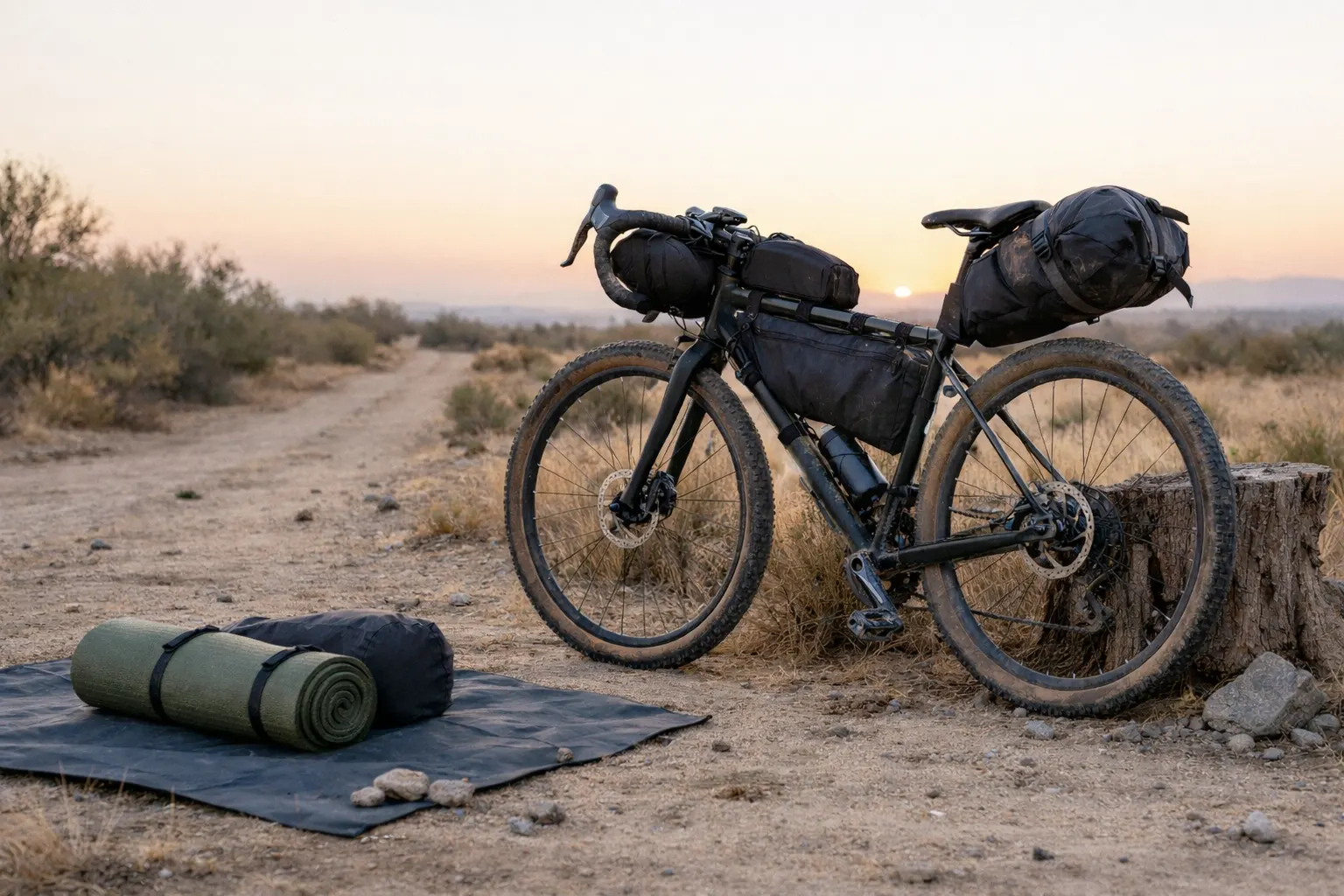
Essential 4-Bag Setup:
- Frame bag: Blackburn Outpost ($45–65)
- Seat pack: Rhinowalk 10L ($30–40)
- Handlebar bag: Rhinowalk Waterproof Handlebar Dry Bag (12L) ($18–30)
- Top tube bag: Rhinowalk 1.2L ($25–30)
Typical total: roughly $120–165 depending on current prices and sizes.
Budget snapshot: Keep your “risk budget” focused: spend more on mounting stability (seat pack + straps), and treat waterproofing as inner dry bags—especially for your sleep kit.
Reinforcement Kit ($25):
- Seam Grip sealer
- Heavy-duty thread for repairs
- Replacement buckles
- Voile straps for mounting upgrades
- DWR treatment spray
Build the reinforcement kit first. It’s the cheapest way to make a budget system feel “reliable” fast.
Conclusion: Smart Compromises for Real Adventures
If you’ve ever felt torn between “cheap” and “reliable,” here’s the reality: you’re not buying “bad” gear—you’re buying a different set of compromises. Spend less where the loads are mellow, reinforce the predictable failure points early, and upgrade the one high-stress bag (usually the seat pack) when it earns the promotion.
Your next steps:
- Pick your route risk — wet weather, rough terrain, remoteness
- Choose your “champions” from the table (don’t shop every bag at once)
- Do the quick reinforcement pass before your first loaded ride
- Upgrade the single weak link once it proves it’s the problem
Bottom line: Start simple, reinforce early, and only “upgrade to premium” when a specific bag earns it.
This guide shares general education and field experience on choosing and reinforcing budget bikepacking bags—it’s not personalized gear or safety advice. Your bike fit, route roughness, weather, and packing style can change what’s “safe enough,” so results will vary. If you’re planning remote riding or you’re unsure about stability/clearance, consult a qualified bike shop or experienced bikepacking guide before committing.