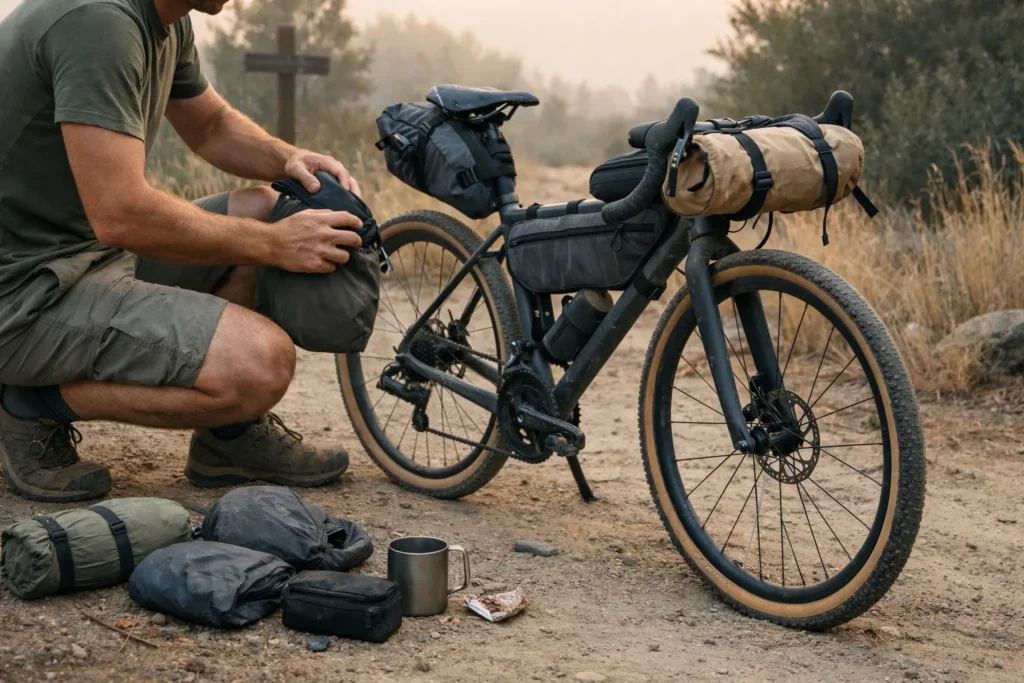
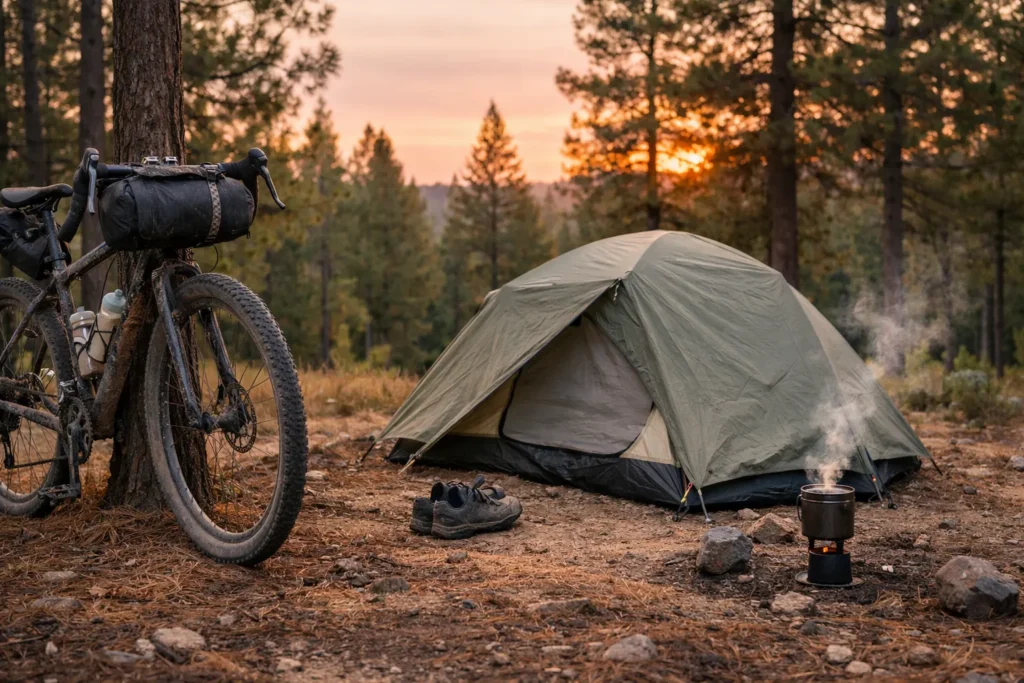
Day 23. Somewhere in rural Portugal, outside a petrol station that sold nothing I actually wanted to eat. I’d been riding since 7am, it was 4pm, and I sat on the kerb with a lukewarm Fanta and thought: I don’t want to do this anymore.
Not “I’m tired.” Not “this stretch is hard.” I mean I genuinely didn’t want to be there. Didn’t want to get back on the bike. Didn’t want to make the fourteen decisions between the kerb and wherever I’d sleep that night. I wanted to be in my flat. I wanted to watch something stupid on a laptop and not have to think about anything.
That moment scared me more than any descent or dodgy road I’d been on. Because I’d planned this trip for two years. I’d wanted this. And somewhere around week three, I’d stopped wanting it — and I had no idea if that was temporary or if something had actually broken.
That’s what nobody talks about honestly — mental health on long bike tours doesn’t announce itself as a crisis. It’s more like a slow leak. The air goes out so gradually you don’t notice until you’re sitting outside a petrol station wondering what happened to the person who was excited about this four weeks ago.
Here’s what I’ve learned about why it happens, what made it worse before I figured out what helped, and how to tell the difference between a rough patch and something that actually needs attention.

Table of Contents
- Why it happens — and why it’s not your fault
- The worst few days
- What didn’t help
- What actually helped
- How it changed over time
- Normal fluctuation vs something that needs attention
- Evening Mental Pit-Stop Check-In
- What I’d tell myself before leaving
- Frequently Asked Questions
- Wrapping Up
(More on the broader resilience side of long-distance touring is in the mental resilience guide for long bike tours, if that’s useful.)
Why it happens — and why it’s not your fault
There wasn’t one cause. There were about four, all arriving at the same time.

The first is nervous system fatigue. Bike touring is relentless low-grade stress. You’re making decisions constantly — route, water, food, shelter, weather, traffic, body signals. Your nervous system never fully switches off. After three weeks, that accumulation is real. It’s not weakness; it’s biology. You’re running a cognitive load that most normal days at home don’t come close to.
The second is the loss of social feedback. This one surprised me. I thought of myself as reasonably introverted, fine alone, didn’t need people constantly. What I didn’t understand was how much my sense of being okay relied on small daily signals from other humans — a conversation, a joke, being recognised by someone. Research on social isolation confirms this: humans use social interaction to regulate mood in ways we’re barely conscious of. That feedback loop disappears on a solo tour. Days go by where you interact with no one who knows you exist beyond the transaction of buying food. Without realising it, your emotional calibration starts to drift.
The third is identity. At home, you have structure — job, routine, relationships, a sense of role. On a long tour, all of that falls away simultaneously. Someone asks “so what do you do?” at a hostel and you genuinely don’t know what to say — not because the answer is complicated, but because the frame the question assumes no longer applies. You’re just a person on a bicycle, anonymous, undefined, passing through places that don’t remember you the moment you leave. For some people that’s liberation. For others — especially a few weeks in — it’s quietly destabilising in a way that’s hard to name because it doesn’t feel like sadness exactly. It feels more like looseness. Like a tooth that’s slightly loose but hasn’t fallen out.
The fourth is the gap between expectation and reality. The first week or two of a long tour often delivers exactly what you imagined: freedom, movement, landscape, that particular calm that comes from life being reduced to the essentials. Then the novelty fades. The hard riding is just hard riding. The loneliness on long tours that felt romantic in week one stops feeling romantic. And you’re left with the question: was this just the honeymoon phase wearing off, or is something wrong?
Usually it’s the first thing. But it doesn’t feel like it at the time.
The worst few days
The petrol station was the start of a rough stretch, not the bottom of it. The bottom came two days later.
I’d taken a rest day that didn’t help — just spent it lying on a hostel bed, scrolling, feeling worse for the inactivity. Then I had a mechanical on a remote stretch that took two hours to sort in the heat. I hadn’t slept well in four nights. I’d eaten badly for three days — not through carelessness, just bad food access on that route. And I hadn’t had a real conversation with anyone in six days.
What I noticed is that none of those things, individually, would have mattered much. Tired? Fine. Mechanical? Annoying but fine. Lonely? Manageable. But stacked — bad sleep plus calorie deficit plus isolation plus accumulated nervous system stress — they compound into something that doesn’t feel like circumstances anymore. It starts to feel like the truth about you.
That’s the thing about depression while bikepacking that nobody writes about honestly: when it’s mild-to-moderate, it doesn’t announce itself as depression. It just feels like clarity. Like you’ve finally seen through the illusion of the trip and understood that you’re just a person who made a mistake and is now stuck with the consequences of it. The pessimism presents as realism. That’s what makes it hard to spot from the inside — it doesn’t feel like a distortion, it feels like you’ve finally stopped lying to yourself.
I called my sister that evening. I didn’t want to — I felt stupid, like I was failing — but I called her. I told her it was rough. She asked some questions, didn’t fix anything, but she laughed at one point about something unrelated and I laughed too, and that tiny human moment did more than two days of rest had done. I got off the phone, ate a proper dinner, slept for nine hours, and the next morning had shifted. Not fixed. But something had.
What didn’t help
I want to be honest about this part because most articles skip it. When you’re coping with solo travel anxiety and a low mood, knowing what doesn’t help is half the picture.
Forcing positivity didn’t help. I tried telling myself the trip was amazing and I was lucky to be doing it. Both true. Didn’t touch the feeling.
Distraction without connection didn’t help. Podcasts, music, audiobooks — fine for passing time on the bike, but they didn’t address the underlying thing. They’re volume, not solution.
The unstructured rest day didn’t help. I’d assumed that stopping would reset me. But lying in a hostel with nothing to do except think about how I felt wasn’t rest — it was just more time alone with a brain that wasn’t being kind to me. A rest day needs to actually be different from a riding day, not just stationary.
Pushing through also didn’t help, at least not indefinitely. There’s a version of “keep going” that works — sometimes you ride out of a mood — but when you’re actually depleted, grinding forward just deepens the hole.
What actually helped
Calling someone. Not texting — calling. Voice, even for seven minutes, did something that messages didn’t. I started doing this proactively after that, not just when I was low. Every two days, minimum. It became non-negotiable.
Fixing the physical basics first. Sleep, food, water. I know that sounds obvious. But I’d been letting the physical side slide — eating convenience stuff, staying in places that weren’t restful, starting early when I was already exhausted. Once I got strict about those three things, the mental weather shifted faster than anything else I tried.
Giving the rest day actual structure. Not a plan, just anchors: a morning coffee somewhere I’d sit down properly, a walk without the bike, one task (laundry, route check), something that felt slightly social even if brief — talking to the guesthouse owner, sitting in a bar and watching football. Structure turns a rest day from a void into something your nervous system can actually use.
Writing one sentence a day. Not journaling in any serious sense. Just: what happened today, one honest thing about how I felt. Took two minutes. But it gave my brain somewhere to put things instead of cycling them on repeat.
Lowering the daily distance for a week. I’d been riding to targets. Dropping from 90km days to 60–65km days for a stretch reduced the cognitive and physical load enough that I could start recovering while still moving. It felt like giving in at the time. It wasn’t.
How it changed over time
Not linearly. That’s the honest answer.
There were good weeks after the bad patch, then another harder week around week seven — shorter, less severe, but still real. Then a long stable stretch from about week nine onward that felt genuinely different from the early tour optimism. Less euphoric, more solid. Less “I can’t believe I’m doing this,” more “I’m doing this, and I’m okay.”
The anxiety on bike tours that felt sharp and destabilising in week three became something I could see coming and respond to rather than be surprised by. I started to understand my own patterns — what conditions made things harder (bad sleep, isolation stretches over four days, stopping in places I didn’t like), what helped me recover. That felt like actual resilience: not invulnerability, just familiarity with your own terrain.
Solo bikepacking mental health, I’ve come to think, isn’t about staying positive — it’s about shortening the recovery time. The dips come. They come for everyone. What you’re building — gradually, over a long tour — is the ability to move through them a bit faster each time.
Normal fluctuation vs something that needs attention
This is the thing I most wished someone had told me before I left.
| What you’re experiencing | What it likely is | What to do |
|---|---|---|
| Low mood for 1–3 days, recovers after sleep/food/connection | Normal fluctuation | Fix physical basics, call someone, keep riding |
| Persistent low for 5–7+ days, not lifting | Significant depletion | Take a proper reset (2–3 nights in a town, structure, connection), reassess route |
| Unable to feel anything, loss of interest in the trip entirely, thoughts that feel very dark | Needs real support | Stop riding. Call someone close. Speak to a doctor if needed. There is no version of this where continuing is the brave choice. |
The middle row is where most people get stuck — in the grey zone where they’re not okay but not crisis-level, trying to decide whether to push on or stop. My honest advice: if you’ve been in the middle row for more than a week, treat it like the bottom row for a few days. Rest harder than you think you need to. You can always start riding again when you’re actually recovered.
Evening Mental Pit-Stop Check-In
Five questions. Honest answers. Takes two minutes at camp.
What I’d tell myself before leaving
The mental part of a long solo tour is real, it’s hard, and it doesn’t care how experienced you are or how much you wanted this. It catches most people somewhere between week two and week six. That’s not a sign you’re doing it wrong.
More than any coping strategy, it comes down to sleep, food, water, and at least one real human voice every two days. Everything else is secondary. When you’re depleted, you don’t need inspiration — you need the basics covered.
If you’re reading this mid-tour and wondering whether something is wrong with you — it isn’t. What you’re feeling has a name, it has a reason, and it has a way through. You’re not the first person to sit with this on the side of a road, and you won’t be the last.
You’re going to have days where you sit outside a petrol station and wonder what happened to the person who was excited about this. That person isn’t gone. They’re just tired. Give it a night, fix what’s fixable, and see what the morning looks like.
More often than not, that turns out to be enough.
Frequently Asked Questions
You’ll have a hard stretch. That’s not the end of the story.
Mental health on long bike tours is widely under-discussed in the cycling community — not because it’s rare, but because the culture defaults to stoicism. Most riders hit a hard stretch somewhere on the road. Most get through it. The ones who get through it fastest treat the mental side the way they treat mechanicals: catch it early, fix what you can, don’t pretend it isn’t happening. If burnout specifically is what you’re dealing with, the travel burnout recovery guide covers the practical reset. You don’t need to be invulnerable. You need to know what you’ll do when it gets hard — and then actually do it.
This post is written from personal experience, not medical advice. If you’re experiencing persistent low mood, anxiety, or other mental health concerns on the road or at home, please speak with a qualified healthcare professional.