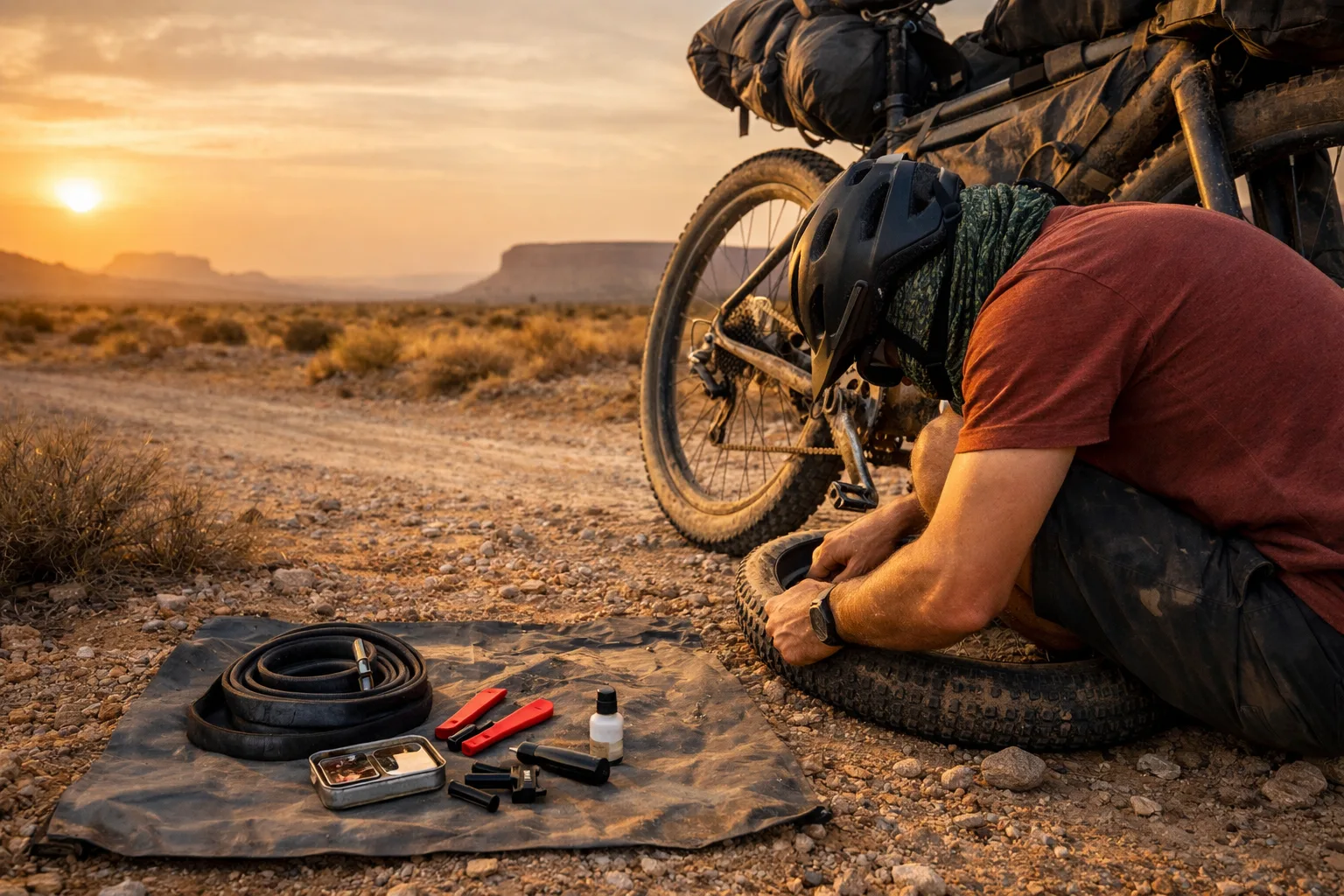
One flat tire in the middle of nowhere can turn a 10-minute stop into a two-hour mess. I learned that the hard way in Utah’s desert—wrong tube size, snapped levers, and a lot of walking. This bikepacking repair kit checklist is what I pack now so a small failure stays small.
It’s built for real bikepacking—tubes or tubeless, weekend to expedition, and routes where you can’t count on a shop. The goal is simple: pack the handful of things that actually stop rides (flats, chain issues, loose bolts, and a few “weird problem” fixes) without hauling a workshop.
Choose your path: 2-minute version · Repair kit builder tool (tailored list)
Compatibility snapshot (save this in your phone):
- Tire size + valve type (example: 29 x 2.35, Presta)
- Chain speed (10/11/12)
- Derailleur hanger model (bike-specific, if you carry one)
- Tool bits you actually need (hex/Torx sizes for stem, cages, racks, crank)
If you want the full bikepacking gear setup (bags, layers, what’s worth the weight), see our bikepacking gear guide.
Repair Kit Builder Tool
Answer 4 quick questions to build your kit.
How long is your trip?
All set — here’s your kit
Want the matching section? 2-minute version · Tubeless vs. tubes
- Screenshot your results.
- Save it with your route notes (or in your phone’s “Trip” folder).
- Pack it in the same pouch every time (muscle memory beats rummaging).
- Retake it if you change tires, bike, or route style.
This page contains affiliate links and may include sponsored content. As an Amazon Associate, I earn from qualifying purchases at no extra cost to you. Amazon links are labeled #ad; other affiliate links may be marked as “affiliate link,” “Sponsored,” or “(paid link).” Learn more.
Key Takeaways
If you only read one part before your next trip, start here. These are the priorities that keep a “minor issue” from becoming a “long day.”
- Compatibility beats “more gear”: valve size, chain speed, and hanger fit matter more than brand choice.
- Flats + chain issues are the big two: solve those quickly and most rides stay fun.
- Tubeless changes the workflow: plugs + sealant are the first line; a tube is the bailout plan.
- Organization is part of the fix: a chaotic kit costs minutes when you’re cold, tired, and losing daylight.
- Know your bail triggers: some failures are safety issues—plan exits instead of gambling.
Quick default if you don’t want to overthink it: bring a multi-tool that actually fits your bike and includes a real chain breaker. It’s the item that prevents the most “walk of shame” moments.
What matters more than brand:
- It fits your bolts (stem, cages, racks, crank).
- The chain breaker actually works with your chain (test once at home).
- It’s usable under stress (cold hands, gloves, fading light).
- If you run Torx hardware, it includes the Torx size you need (often T25 for rotors).
If you want a no-drama default, this is the style I’d pack:
If you could only bring one: a compact multi-tool with a real chain breaker (Crankbrothers M19 or similar).
Covers the bolts your bike uses plus a chain breaker you can trust. Quick tip: test-fit every bolt at home once.
2-Minute Version (Starter Kit + Remote Upgrades)
Here’s the fast answer. Pack the starter kit below, then add upgrades based on remoteness and tire setup.
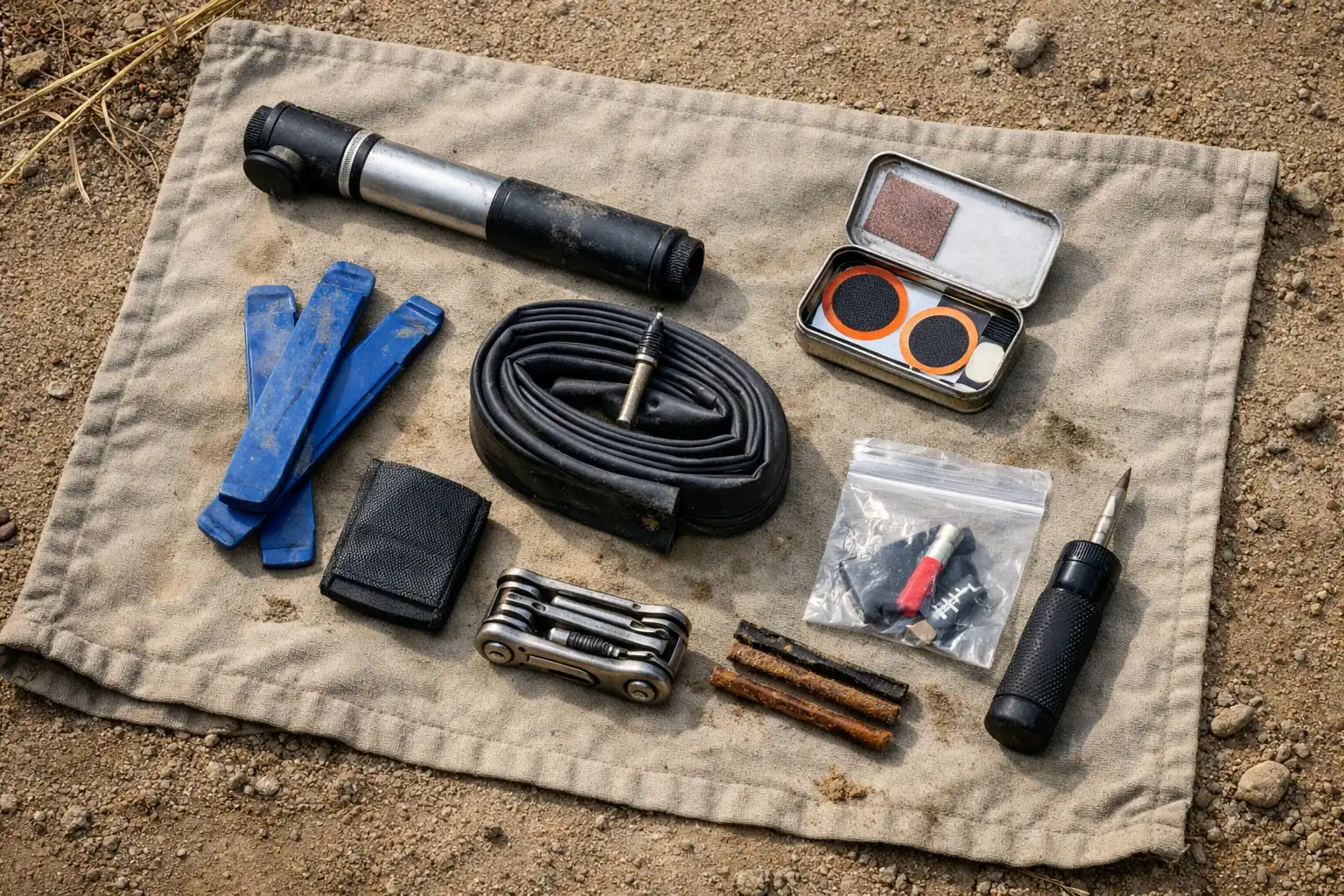
Starter kit (Default)
This is the smallest kit that reliably solves the most common “we’re stopped” failures.
- Multi-tool (fits your bike) + chain breaker
- Quick links (match your chain speed) — 2 minimum
- 2 tubes (correct size + correct valve)
- Tire levers (2–3 that won’t snap)
- Mini pump (reliable beats tiny)
- Tire boot (or an old tube section)
- Zip ties (a few sizes)
- Tape (wrapped on pump)
- Tiny baggie for small parts (so links/cores don’t vanish in dirt)
What to do next: if your route is remote (or you’re out for a week+), the upgrades below are the “worth the weight” adds that prevent repeat failures.
Remote upgrades (what changes)
If your route is remote (or you’re out for a week+), you’re optimizing for first-time success and redundancy.
- Spare derailleur hanger (bike-specific)
- More quick links (total 4–6)
- Patch kit (backup to tubes)
- Spoke option (spoke wrench + emergency spoke or 1–2 spares)
- Chain lube (small bottle)
- Spare brake pads (especially mountains/wet)
- One spare cable (shift or brake) if you run mechanical systems
- Extra tape + extra zip ties (remote is where “weird problems” happen)
Hanger tip: if you don’t know your exact hanger model, search: “[your bike model] derailleur hanger” and order an exact match before the trip.
Tubeless riders: add a plug tool + plugs, valve core tool, and a small sealant top-up. Still carry at least one tube for cuts or rim issues.
Quick actions (60 seconds at home):
- Confirm chain speed (10/11/12) and pack matching quick links.
- Note valve type + derailleur hanger model in your phone.
- Do one practice repair (tube swap or a tubeless plug + reinflate).
Table of Contents
- Repair Kit Builder Tool
- Key Takeaways
- 2-Minute Version (Starter Kit + Remote Upgrades)
- What Actually Breaks Most Often on Bikepacking Trips
- The 5 Repair Kit Mistakes That Turn Small Problems Into Long Days
- Bikepacking Repair Kit Checklist by Ride Type
- Tubeless vs. Tubes: How Your Repair Kit Changes
- My Baseline Week-Long Kit (No Brands—Just What Works)
- Detailed Breakdown by Category
- Three Common Trail Scenarios (And What to Do First)
- When to Call for Help vs. Field Repair
- Frequently Asked Questions
- Conclusion
- Printable Checklist
What Actually Breaks Most Often on Bikepacking Trips
Most “we’re stopped” moments aren’t mysterious. The same few problems show up again and again—especially when the route is rough, the weather turns, or your bike’s been rattled for days.
- Tires: punctures, slow leaks, sidewall cuts (tubes or tubeless)
- Drivetrain: chain trouble (snaps, stiff links) and shifting issues after a knock
- Bolts + mounts: racks, cages, stem, crank—anything that vibrates loose
- Brakes + wheels: pads wear faster than expected, rotors rub, spokes/rims take hits
The goal of a bikepacking repair kit checklist isn’t “cover every possible mechanical.” It’s covering the problems above well—because those are the ones that repeatedly stop people on real trips.
The 5 Repair Kit Mistakes That Turn Small Problems Into Long Days
Most riders don’t fail because they forgot a “big” tool. They fail because one small compatibility detail—or one missing tiny part—breaks the whole repair flow.
1) Packing the wrong tube (or the “right” tube with the wrong valve)
It’s one of the most common trip-ruiners: the tube is the wrong diameter, the wrong width range, or it doesn’t match your valve type.
- Fix: write your exact tire size and valve type in your phone notes (ex: “29 x 2.35, Presta”).
- Reality: even tubeless riders should pack at least one tube for big cuts or rim issues.
2) Carrying a multi-tool that doesn’t fit your bike
Some bikes need Torx for rotors, some use larger hex sizes for axles/bolts, and some setups require specific bits you won’t know you’re missing until you’re stuck.
- Fix: at home, touch every bolt you might need to tighten with your tool.
- Shortcut: if your bike uses Torx a lot, include a Torx bit that matches your common bolts.
3) Forgetting the “tiny enablers” (valve cores, quick links, tape)
They weigh almost nothing, but they’re often the difference between a working fix and a long day.
- Fix: pack quick links that match your chain speed, plus a small amount of tape and zip ties.
- Why: tape + zip ties solve weird problems that no “perfect tool” can solve.
4) Overpacking parts you can’t realistically use on the trail
It’s easy to pack “more stuff” and still be unprepared—because the stuff you added is hard to use when you’re cold, tired, and racing daylight.
- Fix: prioritize repairs you can actually do: flats, chain fixes, bolt tightening, basic adjustments.
- Reality: a kit you can’t use is just extra weight.
5) Not practicing a single repair before you need it
The first time you try a repair shouldn’t be at 9 p.m. with numb fingers.
- Fix: do one practice run at home: a tube swap or a tubeless plug + reinflate.
- Bonus: you’ll discover what doesn’t fit and what’s missing.
Bikepacking Repair Kit Checklist by Ride Type
Weekend (1–3 days)
For short trips, the starter kit is usually enough. If you’re close to help, don’t overpack—just make sure your tube size, valve type, and tool fit are correct.
Week-long (4–10 days)
Longer trips raise the odds you’ll need a second chance. These are the “worth the weight” adds:
- Patch kit (backup to tubes)
- Spoke option (spoke wrench + emergency spoke or 1–2 spares)
- Small bottle of chain lube
- Spare brake pads (especially mountains/wet)
Expedition / Remote (2+ weeks or far from help)
Remote touring is different: when it breaks, the fix needs to work the first time.
- Spare derailleur hanger (bike-specific)
- Extra quick links (bring more than you think)
- More tape + more zip ties (remote is where weird problems show up)
- Extra tube beyond your baseline (even if tubeless)
- A little extra lube + a tiny dab of grease for wet/grindy days
| Ride type | What to optimize for | What usually changes |
|---|---|---|
| Weekend | Fast fixes | Starter kit coverage + correct compatibility |
| Week-long | Second chances | Add patches, lube, a wheel option, and a wear-item spare |
| Remote / expedition | First-time success | Add bike-specific parts (hanger), redundancy, and more “weird-problem” tools |
Tubeless vs. Tubes: How Your Repair Kit Changes
Tubeless: the “seal it fast” workflow
With tubeless, the goal is “rolling again,” not “perfect.” Most punctures seal with sealant; when they don’t, plugs are the hero. If it’s a longer cut (or the sidewall is torn), skip the wrestling match and go straight to a tube + boot.
Tubeless-specific additions:
- Plug tool + plugs (your primary roadside fix)
- Valve core tool (clogs happen, and cores can loosen)
- Spare Presta valve cores (2–3 total) — tiny item, big save when inflation fails
- Small sealant top-up (helpful on longer trips)
- 1–2 backup tubes (for sidewall cuts or rim damage)
What to look for in a plug kit: glove-friendly grip, plugs that don’t shred on insertion, and storage that’s reachable fast (top-tube bag beats “buried”).
If you want the easy default: a plug kit that’s glove-friendly with plugs that don’t tear.
A solid starting point: a tubeless plug kit (tool + quality plugs).
Fixes most punctures without pulling the wheel. Quick tip: keep it in a top-tube bag.
If you’re new to tubeless, here’s a quick refresher before you need it on the trail: How to set up and check your tubeless tires.
Tubes: the “swap and go” workflow
Tubes are simple and predictable—especially if you don’t want sealant mess at 2 a.m. in a headlamp beam.
- Simpler variables: fewer failure points
- Cleaner fixes: especially in cold weather
- Easy bailout plan: swap, inflate, ride
My Baseline Week-Long Kit (No Brands—Just What Works)
This is a practical “default” kit for a typical week-long route. It’s not the lightest possible. It’s what keeps failures from spiraling when walking feels expensive.
| Category | Baseline items | Notes (the part people miss) |
|---|---|---|
| Tires | 2 tubes (correct size + correct valve), levers, mini pump, tire boot | Pack at least one tube even if tubeless; boots save sidewall cuts. |
| (Tubeless only) | Plug tool + plugs, valve core tool, spare cores, small sealant top-up | Valve cores must be removable; plugs fix what sealant won’t. |
| Drivetrain | Multi-tool with chain breaker, quick links (matching speed) | Quick links must match chain speed; bring more for remote routes. |
| Brakes | Spare pads (if long descents/wet), small rotor rub know-how | Worn pads are common on big mountain days; carry if it’s realistic. |
| Wheels | Spoke wrench + emergency spoke option (or 1–2 spare spokes) | If your bike uses odd spoke lengths, note them before you leave. |
| Fasteners | Zip ties + tape (wrapped on pump) | These solve 10 weird problems a “perfect tool kit” can’t. |
| Bike-specific | Derailleur hanger (remote routes) | If you don’t know your hanger model, find it before the trip. |
Detailed Breakdown by Category
Tire Repair Essentials
| Item | Quantity | Why it earns a spot |
|---|---|---|
| Tubes | 2 | Correct size + valve matters more than brand. Pack what fits your rims. |
| Tire levers | 2–3 | Cheap levers snap at the worst time. Carry ones you trust. |
| Pump | 1 | A reliable pump means unlimited air—especially when you’re out for days. |
| Tire boot | 1 | Sidewall cut? A boot can turn “walk out” into “limp to town.” |
Pump features that matter on tour: doesn’t leak at the valve, works with your valve type without fiddly adapters, doesn’t flex like crazy as pressure climbs, and packs easily so it’s always with you.
If you want a reliable mini pump: see a solid mini pump option on Amazon.
The 60-Second Flat Fix (what I do on the trail)
Tubes: wheel out → find the culprit → pull one bead → swap tube → inflate just enough to seat → full pressure and go.
Tubeless: rotate the hole down so sealant pools → add a plug if it still hisses → reinflate with the mini pump.
Drivetrain Components
| Item | Quantity | Critical notes |
|---|---|---|
| Quick links | 2–6 | Match your chain speed (10/11/12-speed). Remote routes: bring more. |
| Chain tool | 1 | Test it once at home so you know it works with your chain. |
| Derailleur hanger | 0–1+ | Bike-specific part. If you go remote, this is worth the tiny weight. |
If your chain snaps
Find the damaged link, remove it with your chain breaker, then reconnect with a matching quick link. If you had to shorten the chain, avoid big-big and spin easier gears until you reach help.
Quick links stuck (or impossible with cold fingers)?
In mud, grit, or cold hands, a quick link can be stubborn. If you’ve ever fought one on the trail, master link pliers can turn a 10-minute wrestling match into a 30-second fix. If you’ve never struggled, skip them—they’re optional. (See optional add-ons.)
Cable Backup (optional, but useful on some builds)
If you run mechanical shifting or brakes and you’re going remote, one spare cable can be a trip-saver. If you’re running fully hydraulic brakes, cable spares won’t help—but pads still might.
| Item | Purpose | Pro tip |
|---|---|---|
| Brake cable | Safety critical (mechanical) | Pre-cut at home if you know your routing. |
| Shift cable | Convenience | If it fails, “single-speed mode” can limp you to help. |
| Cutting option | Clean cuts | A sharp blade works in emergencies, but it’s not ideal. |
Most-Forgotten Items That Save Trips
These are the tiny items that keep a simple repair from collapsing mid-fix.
- Extra quick links: bring at least one more than you think you’ll need.
- Tire boot + tape: sidewall cuts and “bag/mount is failing” problems love these.
- Trip-specific spare: derailleur hanger for remote routes, brake pads for mountains/wet.
Optional add-ons (only if you need them)
These aren’t “must-pack.” They’re situational tools that earn their spot only when your route, hands, or gear history makes them worth it.
| Optional add-on | Only worth it if… | Why it helps |
|---|---|---|
| Master link pliers | You’ve fought quick links before (mud, cold hands, stiff links). | Turns a frustrating chain fix into a fast one when fingers can’t do it. |
| Gear repair patches (fabric tape/patch kit) | You’ve had bags/straps start ripping on rough routes—or you’re carrying soft luggage. | Stops small tears from becoming “bag is failing” problems mid-trip. |
Three Common Trail Scenarios (And What to Do First)
These aren’t “perfect workshop” repairs. This is the simple decision tree when you’re tired, cold, and short on daylight.
Scenario 1: Tubeless won’t seal (it keeps hissing)
- Rotate the hole down so sealant pools at the puncture; hold it there for 20–30 seconds.
- Add a plug if it still hisses.
- Reinflate with the mini pump.
- If it still fails: install your backup tube and ride out.
Scenario 2: Sidewall cut (tube bulges or plug won’t hold)
- Install a tire boot (or an old tube section) between tire and tube.
- Lower pressure slightly and ride carefully.
- Bail early if the cut keeps spreading.
Boots that actually work: thin + stiff (won’t bunch), big enough to cover the cut with margin, and paired with slightly reduced pressure to limp out.
If you want the classic “ride out” backup:
Worth its weight: emergency tire boots (Park Tool TB-2 or similar).
Tiny, flat, and stupid-simple. Quick tip: pair with a tube and drop pressure a touch.
Scenario 3: Chain snaps (or you have a mangled link)
- Remove the damaged link with your chain breaker.
- Reconnect with a quick link (correct chain speed).
- Shift gently and avoid big-big.
- If shifting is trashed too: consider “single-speed mode” to limp to town.
How to Pack and Organize Your Repair Kit
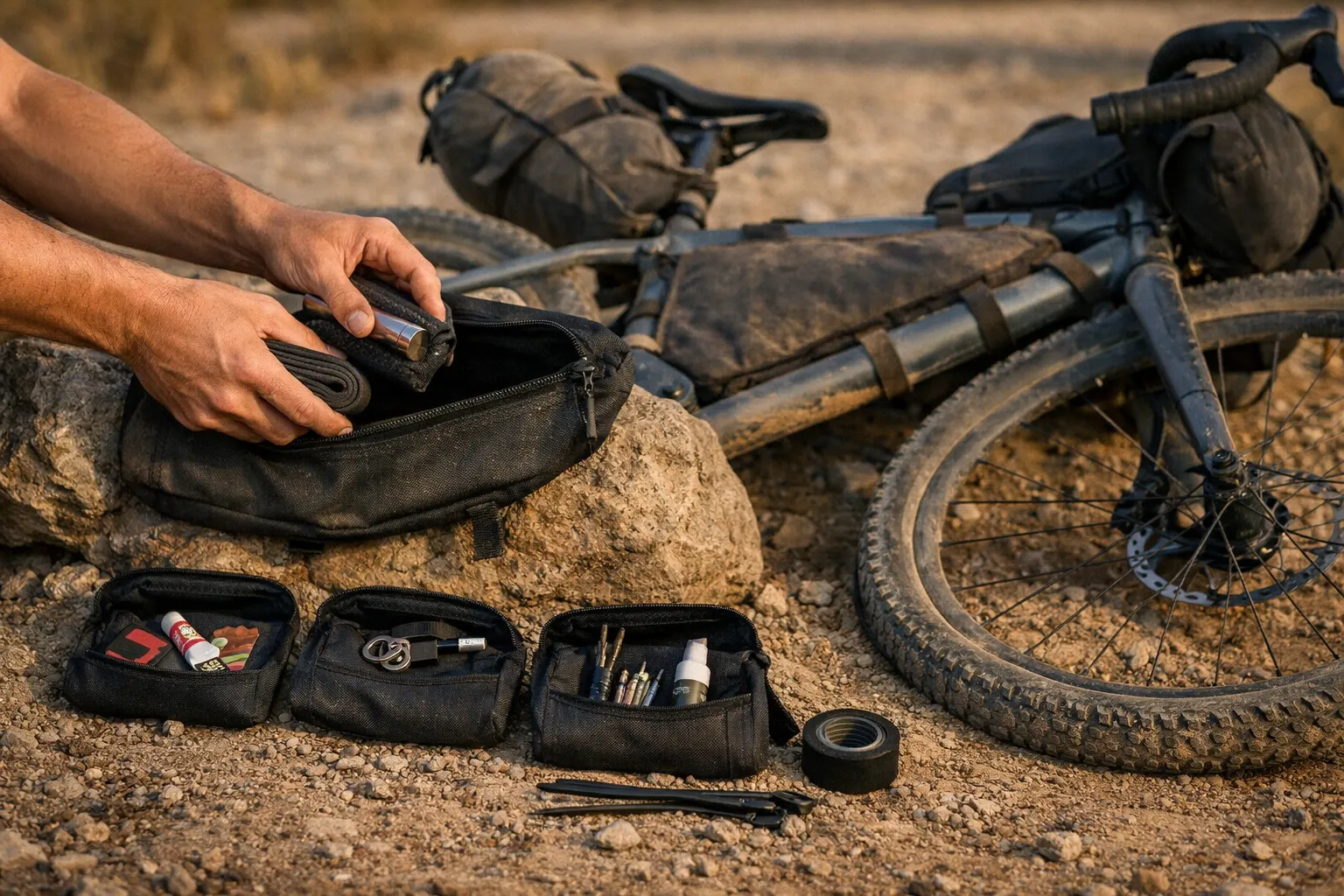
Organization is what makes your kit usable when you’re cold, rushed, and annoyed. Here’s the simple system that works.
Container Strategy
- One main pouch/roll for tools + consumables (so it’s always one grab).
- One tiny container for small parts (quick links, valve cores) so nothing vanishes in dirt.
- Waterproof it if you ride wet climates (patches and lube hate water).
Packing Priority (what goes on top)
| Layer | Keep it here | Why |
|---|---|---|
| Layer 1 | Tube/plug kit, levers, pump, multi-tool | Fastest access = fastest fixes |
| Layer 2 | Quick links, tape, zip ties | Most common “weird problem” solutions |
| Layer 3 | Hanger, spoke option, spare pads, cables (if carried) | Emergency-only spares |
Weight Distribution
Frame bag: heavier items (pump, multi-tool)
Top tube bag: quick-access items (tube/plug kit, levers, quick links)
Seat pack: “rarely needed” spares (hanger, pads, cables)
When to Call for Help vs. Field Repair
Not every mechanical issue has a trail-side solution. Knowing when to attempt a fix versus when to bail can save your trip—and your safety.
Attempt field repair
- Punctures – Usually fixable with the right kit
- Chain breaks – Quick links work reliably
- Loose bolts – Tighten and recheck later
- Minor wheel wobbles – Basic spoke tweaks can limp you to town
Seek professional help
- Cracked frame – Safety critical, no true field fix
- Hydraulic brake failure – Bleeding usually requires tools and fluid
- Multiple broken spokes – Wheel rebuild or serious truing needed
- Seized bottom bracket / major bearing failure – Specialized tools required
- Brakes don’t work safely on descents.
- A tire sidewall is failing repeatedly.
- A frame or fork shows visible damage.
- You’re fixing the same problem twice in one day (it’s escalating).
Keep Moving Repairs (Quick Fixes)
These are the “keep going” repairs you can do tired, cold, and short on daylight.
- Broken chain: remove damaged links, reconnect with a matching quick link, then avoid big-big and spin easy gears.
- Shifting failure: pick one workable gear and limp to town (“single-speed mode”); don’t waste daylight chasing perfection.
- Broken spoke: stabilize it (zip tie to a neighbor), reduce rubbing, ride gently, and bail early if multiple spokes go.
Multi-use items that earn their weight: tape (boots/straps), zip ties (temporary mounts/cables), and an old tube section (boot/rubber strap/protective padding).
Pre-Trip Bike Check (Quick)
This post stays focused on repair kits. Here’s the quick pre-trip check that prevents predictable failures.
- 1 week before: inspect tires, check chain wear, check pad thickness, bolt scan.
- 1 day before: test brakes + shifting, lube chain, quick tire check.
- On tour (daily): visual inspection + quick bolt check + lube if dusty/wet.
Terrain Notes (Quick)
Terrain changes what you’ll actually use. These quick notes help you tighten the kit to match reality.
Desert riding
Sharp rock + dust = more cuts and faster drivetrain wear. Bring an extra tire boot and a bit more lube.
Mountain terrain
Long descents eat pads and impacts bend parts—pads (and a hanger if remote) are often worth the tiny weight.
Coastal routes
Salt + humidity are slow killers. Keep consumables in a waterproof bag and plan to wipe + re-lube more often.
Building Your Personal Repair Kit Checklist
Every rider’s needs differ based on setup, skills, and how remote you’ll be. Use this framework to build a kit you’ll actually use.
Step 1: Assess your bike
- Write down bike-specific parts (hanger model, valve type, chain speed).
- Confirm your tool fits the bolts you actually have.
Step 2: Match kit to the trip
- Remote route = redundancy (extra quick links, extra tube, hanger).
- Wet/mountains = wear items (pads, lube, better organization).
Step 3: Test once (seriously)
- Practice a flat fix and a chain fix at home.
- Store small parts so they can’t vanish in dirt.
Step 4: Refine through experience
- Track what you used and what you didn’t.
- Remove dead weight and add the tiny enablers you wished you had.
Frequently Asked Questions
Conclusion
A well-built kit turns “disaster” into “annoying.” If you want a single north star, this bikepacking repair kit checklist is it: cover flats and chain first, then scale up based on remoteness and trip length.
Start with the smallest kit that solves the common failures. Then add only what your route demands. And remember: the best repair kit is the one you know how to use—practice these repairs at home before you need them on the trail.
Printable Checklist
If you want a quick pre-trip sanity check, grab the printable version and keep it with your route notes.
Download the printable checklist (PDF)
This article is general education, not personalized mechanical advice. Bikes, components, and routes vary, and what works for one setup may not fit another. If you’re unsure about safety-critical parts (brakes, frame damage, wheel issues), get help from a qualified bike mechanic.