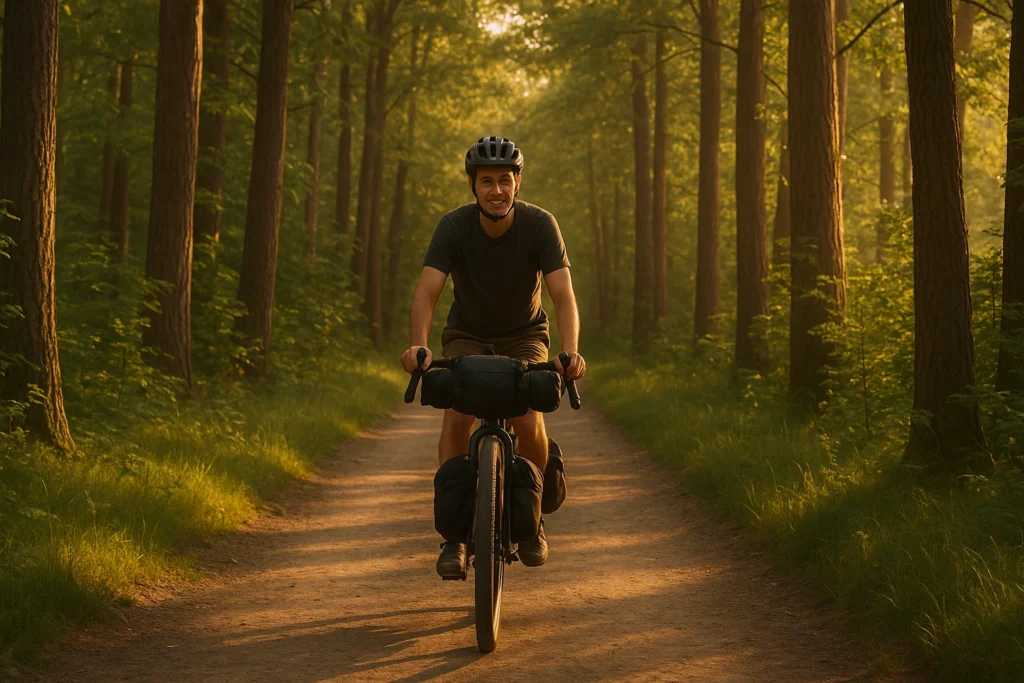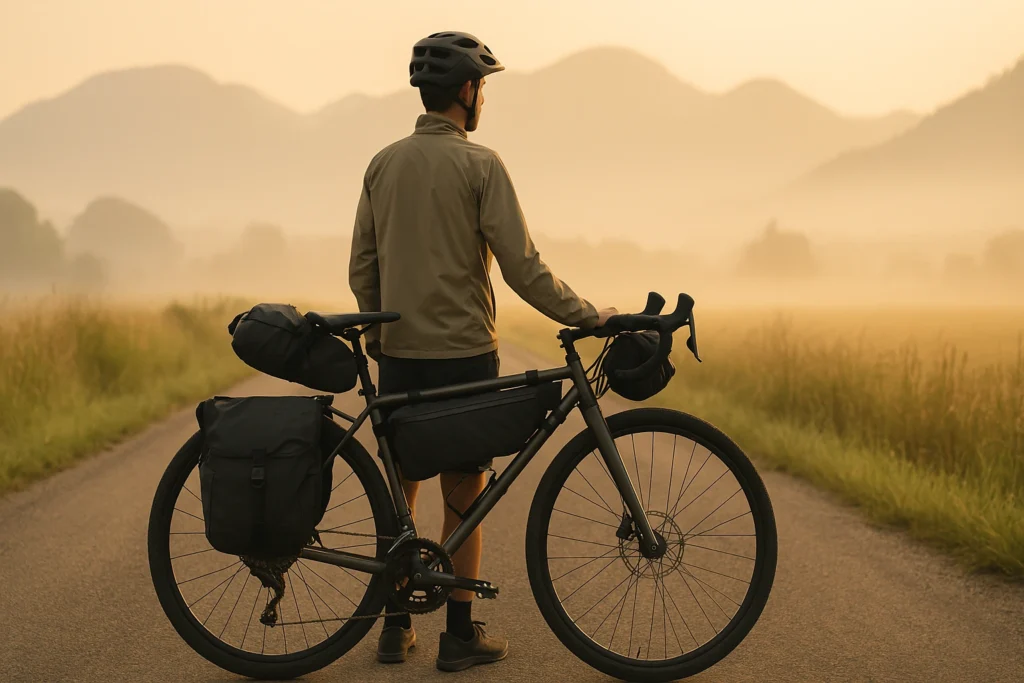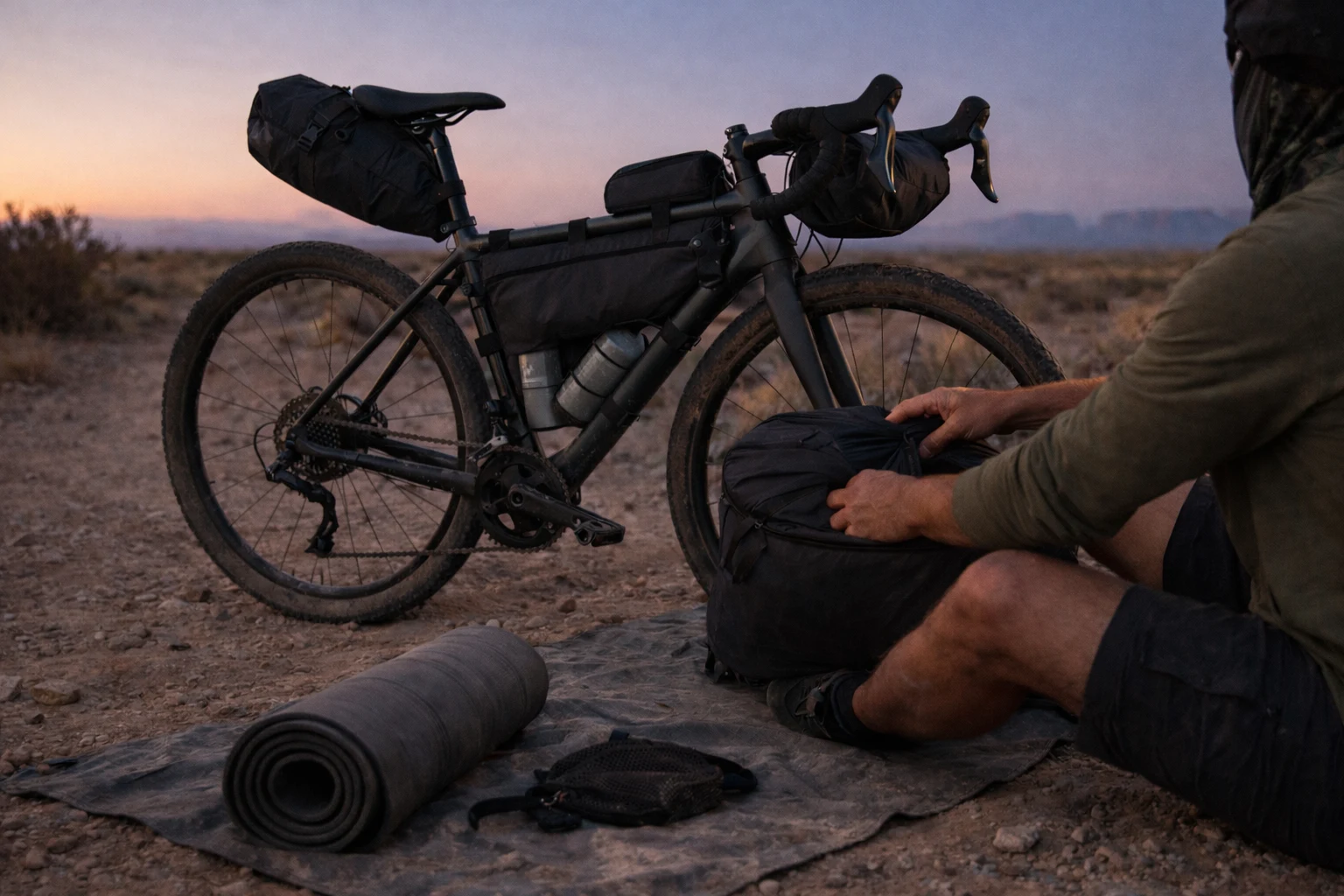
If you’re chasing a minimal sleep system for bikepacking, the real headache usually isn’t weight—it’s bulk. Where do you put it so your bike still handles well? And staying warm is harder when the forecast lies a little.
Sound familiar? It’s day three, the wind picks up, and your bike starts feeling “off.” The fix isn’t magic gear. It’s smarter volume choices and calmer packing.
By “minimal,” I’m talking packed-volume first: the kind of sleep kit that packs small, rides stable, and still handles real 3-season nights. For most riders it’s the same simple core: bag/quilt + pad + shelter. For a broader gear overview, see our complete bikepacking gear guide.
Best-Fit Sleep System Picker
Choose temps, sleep style, space, and priority—get a simple setup target you can actually pack.
What’s the coldest night you actually plan for?
Tip: pick the lowest night you’ll actually see (not the average).
Your best-fit setup
This page contains affiliate links and may include sponsored content. As an Amazon Associate, I earn from qualifying purchases at no extra cost to you. Amazon links are labeled #ad; other affiliate links may be marked as “affiliate link,” “Sponsored,” or “(paid link).” Learn more.
Top 3 Sleeping Pads That Pack Small
Top 3A shortlist for most riders: a budget starter for mild nights, a small-packing 3-season “default” you’ll keep for years, and a foam backup that never punctures.
Note: Models and prices change a lot—use this shortlist as a starting point and double-check current specs before you buy.
Therm-a-Rest NeoAir XLite NXT
When you don’t want to guess, this is the pad that just works—warm enough for most 3-season lows without eating bag space.
- Best for: The “just tell me what works” pick for most trips.
- Long-term value: Covers most 3-season routes, so you’re less likely to buy a “warmer pad later.”
- Format: Inflatable (compact packed size).
Klymit Static V2
A calm “start here” pad when you’re building your kit piece by piece. Great for getting out there—just be honest about temps.
- Best for: Budget tier riders camping mostly above ~35°F.
- Upgrade path: If you start camping colder, you may outgrow it—plan for that.
- Format: Inflatable (value-focused).
Therm-a-Rest Z Lite Sol
Not the smallest to pack—but it’s the “always works” backup that can save a trip. Stack it under an inflatable for extra insulation and protection.
- Best for: Remote trips, cold ground, or inflatable insurance.
- Backup role: Stack under an inflatable to boost warmth and protect it on rough ground.
- Format: Foam (durable, no-fuss).
Now that you’ve got the quick shortlist, here’s how to choose based on packed volume, R-value, and the coldest night you’ll actually face.
Table of Contents
- Best-Fit Sleep System Picker
- Top Picks (Pads That Pack Small)
- Key Takeaways
- Why Packed Size Matters More Than Weight in Bikepacking Sleep Systems
- Choose Your Setup in 60 Seconds (Budget vs Balanced vs Ultralight)
- The Only Specs That Matter: Packed Volume, R-Value, and Durability
- Temperature Rating Guide for Minimal Sleep Systems
- Strategic Packing Tips for Minimal Sleep System Components
- Route & Weather Adaptations
- Budget Optimization Strategies
- Frequently Asked Questions
- Conclusion
Key Takeaways
Here’s the short version—use it as a quick pre-trip check before you start stuffing bags.
- Packed size trumps weight — A slightly heavier bag that packs smaller often rides better than a lighter bag that eats your space
- Three pieces cover most trips — Bag/quilt + pad + shelter handle the majority of 3-season routes
- Plan a comfort buffer — Many riders aim for margin below the “rated” number, especially if they sleep cold
- Pack for bike handling — Keep bulk centered (frame/seat) so the bike stays calm in wind and rough descents
Quick action: Grab your sleep kit and note what’s forcing its way onto your handlebars. That’s the first thing to shrink or move.
Why Packed Size Matters More Than Weight in Bikepacking Sleep Systems
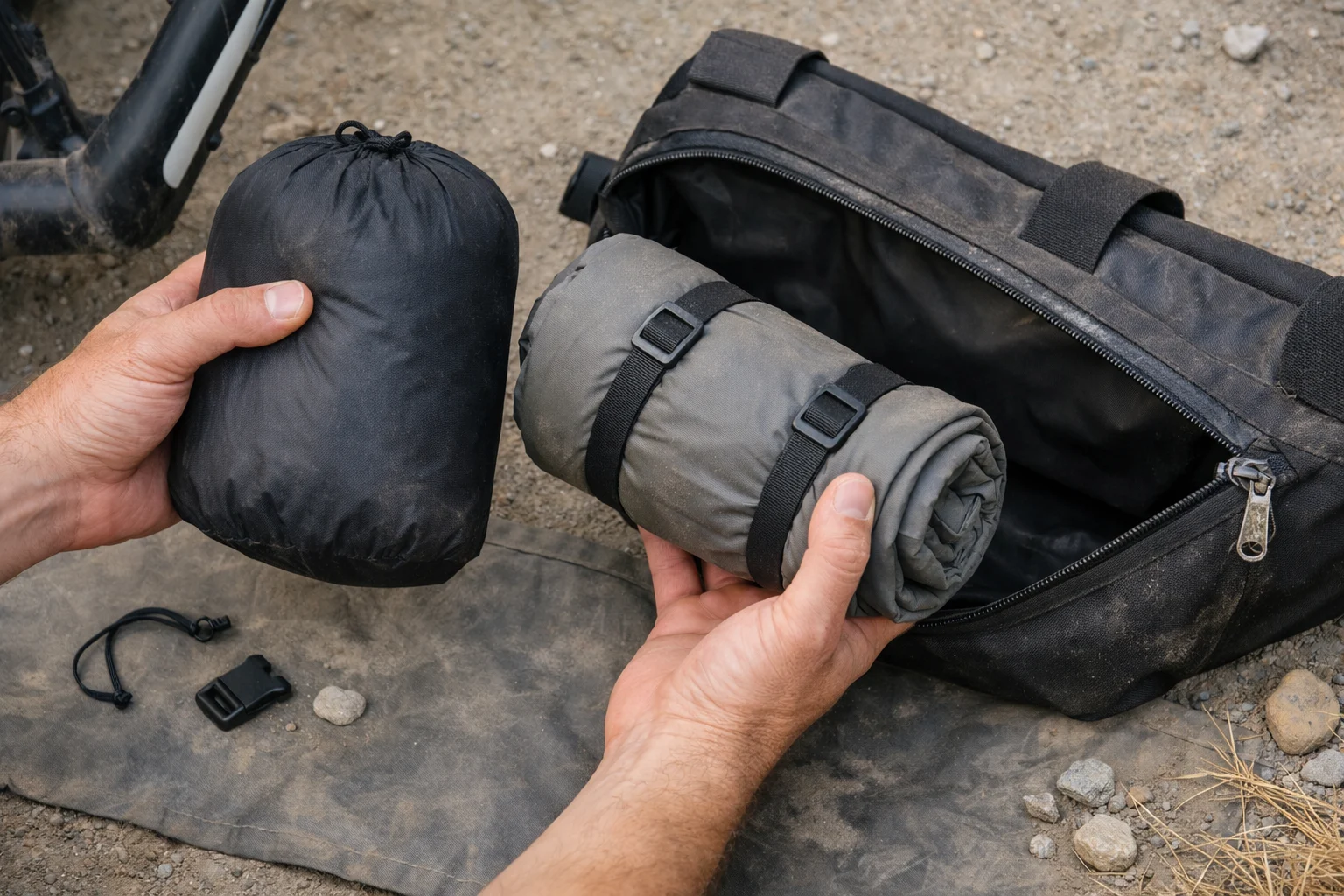
Backpackers chase ounces. Bikepackers chase where the bulk ends up. A bulky kit forces gear onto your bars and saddle, and that’s when the bike starts feeling twitchy—especially in crosswinds or rough descents.
The Cubic Inch Reality
I learned this on a windy desert route: my “light” quilt looked perfect until it took over the frame bag. Food got pushed into a handlebar roll, the bike caught every gust, and suddenly the ride felt like work. That’s what bulk does.
- Frame bags are fixed — you don’t get more liters just because you’re tired
- External bulk changes handling — wind + wobble is a real combo
- Centered loads ride better — the calmer the bike, the better you recover
Choose Your Setup in 60 Seconds (Budget vs Balanced vs Ultralight)
If you don’t want to overthink this, pick a tier and build around it. You’ll get warmer sleep and a steadier bike without turning your setup into a gear puzzle. This bikepacking sleep system approach keeps it simple and repeatable.
Here’s the fast decision that works on real trips (not just in gear spreadsheets):
- Budget: You mostly camp above ~35°F and just want dependable basics.
- Balanced: You ride mixed weather (20–40°F nights happen) and want the easiest “set it and sleep” feel.
- Ultralight: Your pack space is tight, you usually sleep warm, and you’re willing to dial in a quilt + pad combo.
If you want the quick shortlist, jump to the Top 3 sleeping pads (it’s the easiest “upgrade-first” decision most people feel immediately).
3 Sleep System Tiers at a Glance
| Tier | Bag/quilt examples | Pad examples | Typical cost range | What you’re trading |
|---|---|---|---|---|
| Budget | Kelty Cosmic 20 (often ~$150–$220) | Klymit Static V2 (often ~$50–$70) | ~$200–$320 | More bulk, but tough and forgiving |
| Balanced | REI Co-op Magma series (pick your warmth; often ~$250–$400) | Therm-a-Rest NeoAir XLite NXT (often ~$230–$270) | ~$500–$700 | Best comfort-to-packability for most riders |
| Ultralight | Enlightened Equipment Revelation quilt (often ~$300–$450+) | Therm-a-Rest NeoAir XLite NXT (Short/mummy size; often ~$230–$270) | ~$550–$850 | Smallest pack; you may trade some plushness for packability (and quilts need draft control) |
Note: Prices and model names shift over time and sales are common—use these as real-world anchors, then confirm current specs before you buy.
Budget Setup Deep Dive
Budget works when you keep it simple: a tough bag, a pad that’s “good enough,” and packing that keeps your bars clean. If you’ve ever gone to bed thinking, “I’ll be fine”… and then shivered at 2 a.m., you already know why pad insulation matters.
Example approach: Start with something like a Kelty Cosmic 20 class of bag (durable, decent warmth for the money), then put your first “real upgrade” dollars into pad insulation or comfort.
Balanced Setup Deep Dive
Balanced is the low-stress choice for mixed conditions. You’re not fighting drafts all night, and you’re not carrying a giant stuff sack either. It’s the tier that keeps trips fun when the weather gets moody.
Example approach: A compressible down bag (like the REI Co-op Magma family, picked for your lows) paired with a higher-insulation pad is a classic “pack small + sleep well” combo—especially if you want the easiest path to consistent recovery.
Sanity check: Look up your route’s low temps (and elevation) and choose warmth for the coldest night you actually expect, not the average.
Ultralight Setup Deep Dive
If you want an ultralight bikepacking sleep setup riders actually stick with, focus on draft control and packing shape. For this trip, you’re basically building an ultralight sleep setup bikepacking riders can pack cleanly and trust at 2 a.m.—draft control first, then packed shape. The payoff isn’t just grams—it’s a cleaner loadout (especially cleaner bars) and more stable handling when wind or rough descents punish bulky rolls.
• Tight pack space (small frame bag, big food/water carries)
• Windy/technical routes where bar bulk hurts control
• You usually sleep warm and don’t mind dialing in a quilt system
Skip ultralight when:
• You’re a cold sleeper or you camp exposed and hate drafts
• You don’t want to practice pad straps/neck closure
• You prioritize plush comfort over packed shape
Example approach: A quilt like the Enlightened Equipment Revelation can pack impressively small, but it rewards practice—pad straps, neck closure, and a “no gaps” habit when you roll over.
Practice first: Before your trip, set up your quilt + pad at home and do one “toss-and-turn test” to find where drafts sneak in.
Quick Shortlist (so you don’t have to start from zero)
- Budget bag/quilt idea: Kelty Cosmic 20 (value), similar durable synthetic bags in the same warmth range
- Balanced bag idea: REI Co-op Magma series (choose warmth), similar compressible down bags from major outdoor brands
- Ultralight quilt idea: Enlightened Equipment Revelation, similar down quilts with solid draft-control systems
- Pad shortlist: If you want the quick picks by tier, jump to Top 3 Sleeping Pads.
Optional: Shelter upgrades (only if your shelter is the bulky culprit)
If your shelter already works, keep it. But if your current shelter is the thing forcing gear onto your bars, these are compact directions to consider—without turning “minimal” into a shopping spree.
| Shelter type | Good for | Example |
|---|---|---|
| Bikepacking tent | Short pole sections, tidy packing | Big Agnes Copper Spur HV UL Bikepacking Tent |
| Value 1P | Budget-friendly, simple | ALPS Mountaineering Lynx 1 |
| Bivy | Fast + minimal (more exposure/condensation management) | Outdoor Research Helium Bivy |
The Only Specs That Matter: Packed Volume, R-Value, and Durability
Ignore the noise. On a bike, you’re really choosing for packed volume, insulation under you, and durability. The “best” gear is the gear you can pack cleanly and sleep on without babying it.
What’s the simplest “bag/quilt” rule for bikepacking?
If you’re searching for the best bikepacking sleeping bag setup, keep it simple: pick the option that stays warm for how you actually sleep and doesn’t explode your pack volume. If you move a lot at night, a bag can feel easier. If you sleep warm and want maximum packability, a quilt can be great—just don’t skip the draft-control learning curve.
Pick a lane: Choose sealed-and-simple (bag) or compact-and-flexible (quilt), then build your pad and packing around that choice.
Sleeping bag vs quilt: which is better for bikepacking?
In the sleeping bag vs quilt bikepacking debate, the right answer is usually the one that reduces your “2 a.m. frustration.” Bags are more idiot-proof in wind and when you toss around. Quilts can pack smaller and vent better, but they reward practice (pad straps + neck closure + no gaps). If you hate drafts, don’t force a quilt just because it’s trendy.
Quick head-to-head (pick your lane):
| If this sounds like you… | You’ll probably prefer… | Why it feels easier on real trips |
|---|---|---|
| You hate drafts, camp exposed/windy, or toss around all night | Sleeping bag (more enclosed) | Less “2 a.m. fixing” and fewer gaps when you roll over |
| You run warm and care most about packed volume + venting | Quilt (more flexible) | Packs small and vents well—if you dial in straps/closure |
| You want quilt packability but an easier “closed” mode sometimes | Zip quilt style | Middle-ground feel for warm-weather trips |
Low-stress shortcut: If drafts wake you up (especially as a side sleeper), an enclosed bag is usually the easiest answer—here’s a popular option.
If drafts wake you up, Big Agnes Sidewinder SL (35°) is a popular enclosed pick among side-sleeping bikepackers.
Side-sleeper cut + enclosed feel = less twisting and fewer gaps. If you regularly see 20–35°F nights, consider the 20° version.
Warm-weather quilt alternative (zip quilt style): Big Agnes Fly Creek UL Zip Quilt can be a nice middle-ground for warm-weather trips—quilt-like packability, with an easier “more closed” mode when you want it. If you’re pushing into cooler shoulder season, step up to the warmer version.
Bikepacking sleeping pad R-value guide
Your bikepacking sleeping pad does more insulation work than most people expect. If you’re unsure, lean warmer—especially for shoulder season routes.
| R-Value (rough) | Season | Best for |
|---|---|---|
| 1.0–2.0 | Summer | Warm nights |
| 2.1–3.5 | 3-season | Most bikepacking |
| 3.6–5.0 | Cold / 4-season | Near-freezing trips |
| 5.0+ | Extreme cold | Winter routes |
Simple upgrade reminder: If you’ve ever woken up cold while your bag “should be warm enough,” point your upgrade budget at the pad.
More pad options (if you want alternatives)
- Klymit Static V2 — budget-friendly inflatable for mild nights (see Top Picks).
- Therm-a-Rest Z Lite Sol — cheap “can’t-fail” foam. Bulkier to pack than inflatables, but great as backup insulation or stacked under an inflatable on colder/remote trips (see Top Picks).
- Sea to Summit Ether Light XT — comfort-first feel if you want more thickness.
Optional: Pillows (tiny comfort upgrade)
If you sleep fine without one, skip it. But if neck/shoulder stiffness messes with recovery, a small pillow can be one of the best “comfort per gram” upgrades.
When neck stiffness kills morning recovery, Sea to Summit Aeros Premium Pillow is my small-packed luxury that actually helps.
Small packed size, “real pillow” feel.
Worth it when: you wake up stiff and spend the first hour loosening up.
- Trekology Aluft 2.0 Pillow — budget option if you just want “good enough” support without thinking about it.
Temperature Rating Guide for Minimal Sleep Systems
Temperature ratings can be confusing. And when they’re wrong for your body or your route, you don’t just get a bad night—you get a night that steals tomorrow’s ride.
Decoding Temperature Ratings
EN/ISO Testing Standards: For a reader-friendly explanation of how sleeping bag temperature ratings work (and why comfort vs limit matters), see REI’s temperature rating guide.
- Comfort — a “comfortable sleep” reference point (method-defined)
- Limit — a lower-end reference point (method-defined)
- Extreme — survival-focused, not comfort
Real-world planning:
- Many riders plan a comfort buffer below the printed number
- Cold sleepers often need more margin
- Wind exposure and higher routes can feel colder than forecasted
Write this down: Note your route’s coldest night (not the average), then choose warmth for that number with a comfort buffer.
Strategic Packing Tips for Minimal Sleep System Components
Packing isn’t just storage—it’s handling. If your bike ever felt sketchy because a bar roll was overloaded, this section is your reset.
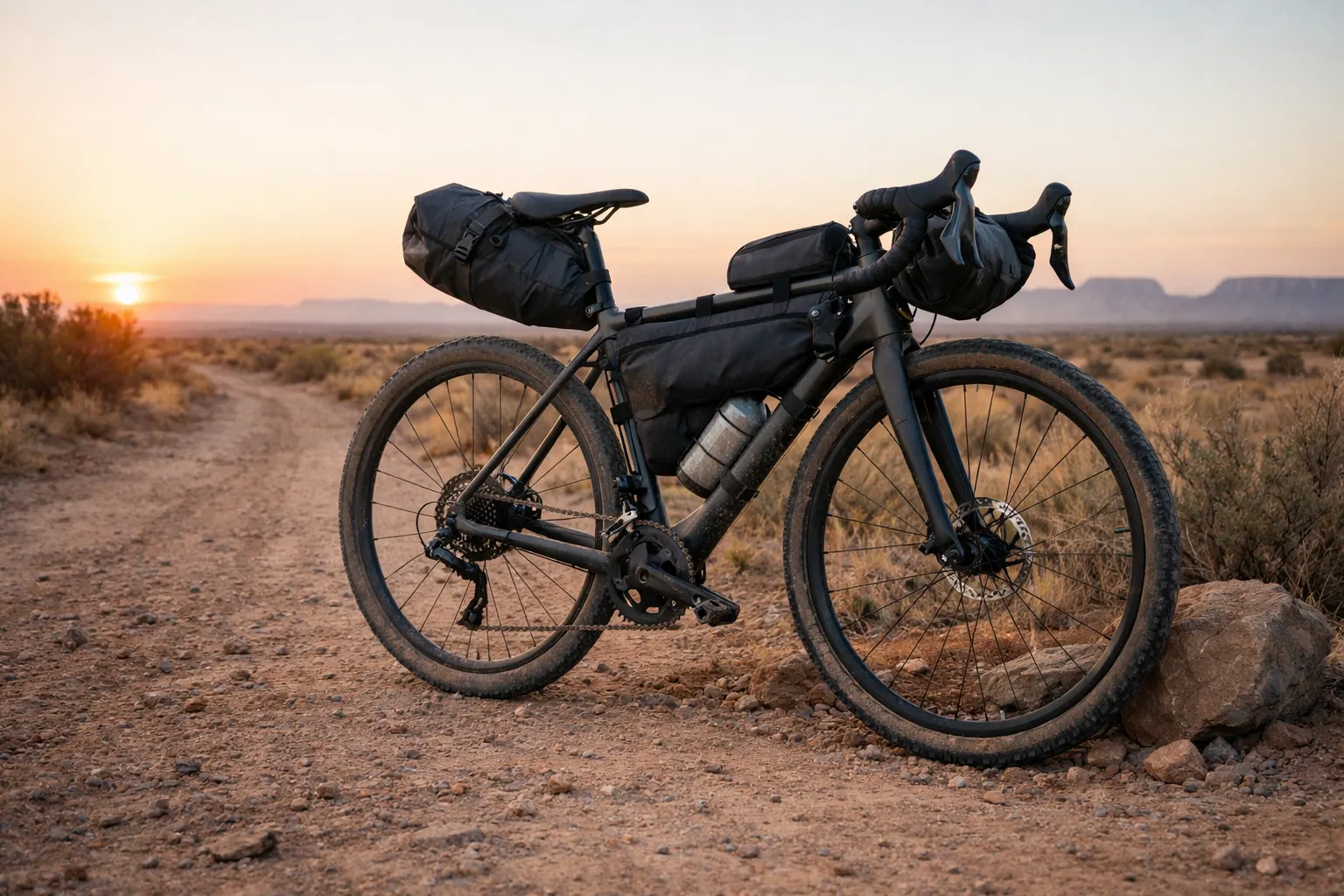
Frame Bag Packing Hierarchy
- Sleeping bag/quilt — biggest “space hog,” pack first
- Extra clothing — fills gaps and protects items
- Electronics / first aid — centralized and easier to find
Seat Pack Strategy
- Long items (pad/shelter) often ride best here
- Keep it tight to reduce sway
- Put heavier items closer to the seat post
Handlebar and Top Tube Placement
- Top tube: small items you want fast (pillow, cables, snacks)
- Handlebar: avoid stuffing your whole sleep kit here if you can
Handling test: Do a “wind ride” on purpose. If your bars feel weird in gusts, reduce bar bulk and move the sleep kit inward.
Route & Weather Adaptations
Most sleep system “surprises” happen when the route is colder, windier, or damper than expected. Plan for the worst-night scenario you can reasonably hit—then keep your sleep layers protected and easy to access.
Desert Touring Adaptations
Desert routes trick you: warm days, sharp night drops. Plan for the night lows, not the afternoon sun.
Mountain Pass Strategies
High routes are where comfort buffers pay off. Nights can feel colder than forecast because of exposure and wind.
Coastal and Forest Touring
Humidity and condensation can make you feel colder. Ventilation and keeping sleep clothes dry helps more than most people expect.
Spring & Fall Swings
Spring and fall can feel like two seasons in one day—sunny climbs, cold nights. Keep your “sleep clothes” in a dedicated dry spot so you always have something warm and dry at camp.
Route check: Pick your “worst-night” scenario (cold + wind or damp + condensation) and plan your sleep system around that.
Budget Optimization Strategies
If money’s tight, upgrade in the order that improves sleep fastest. Most riders feel the biggest change from pad insulation and draft control.
Gradual System Building
Step 1: Reliable basics
Step 2: Better pad (warmth + comfort)
Step 3: Smaller, warmer bag/quilt
Step 4: Small comforts (pillow/liner)
Keep your kit reliable (small habits, big payoff)
- Don’t store bags compressed — loft is warmth
- Air out daily if you can — especially after humid nights
- Carry a sleeping pad repair kit if you rely on an inflatable (a real pad/fabric kit is more reliable than guessing with bike tube patches).
Imagine finding a slow leak mid-route and realizing you brought “maybe” supplies. For remote trips, a real pad repair kit saves the most stress per gram.
For remote routes where a pad leak would ruin the trip, GEAR AID Seam Grip WP Camp & Trail Repair Kit is the tiny kit many riders carry for real fixes.
Tiny tin, real supplies—so a slow leak mid-route doesn’t turn into “I can’t sleep tonight.” Tube patches can be a one-night save, but bonding varies a lot by pad material.
Five-minute check: Inflate your pad at home and leave it for an hour—if it softens, fix it before your trip does.
Cut bulk without buying new gear
- Use multi-use items (puffy as pillow)
- Add a thin foam layer as backup + warmth boost
- Choose simpler packing over extra sacks and straps
Pick one upgrade: Choose pad, draft control, or dry storage for your next trip—then test it before buying anything else.
Frequently Asked Questions
Conclusion
A compact sleep kit makes bikepacking simpler: your bike handles better, camp setup is faster, and you recover more overnight. Start by matching your setup to the coldest nights you truly expect, then prioritize a pad with enough insulation for those lows.
If you want to go lighter later, do it in the order that protects sleep: pad → draft control → bag/quilt packability. And if you’re building your minimal sleep system for bikepacking from scratch, pick a tier, copy the logic, and only upgrade one thing at a time.
Fast recap: retake the quiz or check the Top 3 Pads above.
This guide is general education, not personalized advice. Gear comfort and temperature performance vary by person, route, and conditions, so double-check current specs and plan conservatively for your own trip. If you’re unsure about cold-risk or safety in remote areas, talk with a qualified outdoor professional or medical provider before you go.