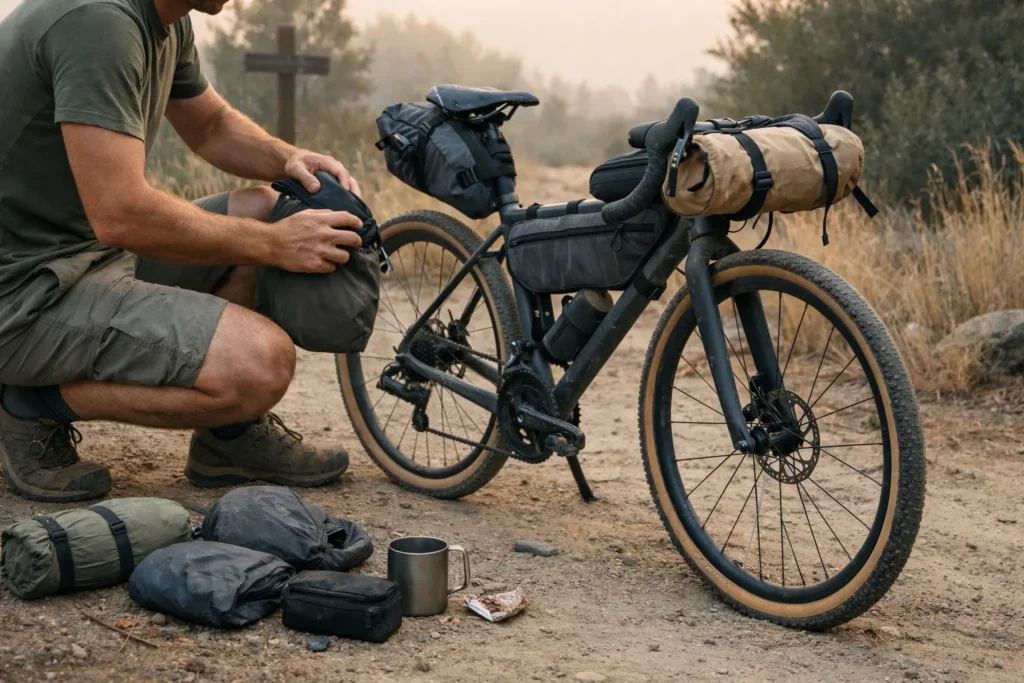
Day 3. Somewhere in the high desert, mid-afternoon, and I was pushing my loaded bike up a climb I should have been riding. My legs had stopped communicating with my brain about forty minutes earlier. I reached into my frame bag, pulled out a half-crushed jar of peanut butter I’d been saving, and ate it with my fingers standing on the side of the road. That’s a bonk — a full, stupid, completely avoidable bonk caused by one thing: no trail nutrition strategy. I’d packed 2,600 calories for a day that burned closer to 4,000.
Here’s what I know now: the problem was never the food itself. It was having no system. No calorie target, no resupply rhythm, no framework I could trust when I rolled into a tiny town at 7pm with one store left open. This article is that system — real numbers, real foods, and a repeatable approach to bikepacking food that works whether your next resupply is a gas station or a supermarket. Food is just one piece of the full kit — our complete bikepacking gear guide covers the bags that carry it and everything else you’ll need on multi-day tours.
Table of Contents
- Trail Nutrition Basics: How Many Calories Do You Actually Need?
- The Bikepacking Food Framework
- Calorie Density — The One Number That Changes Everything
- Real Resupply Foods by Store Type
- Resupply Rhythm — How Many Days to Carry
- Full No-Cook Day Example
- Appetite Fatigue: Why You’ll Hate Your Food by Day 6 (And How to Fix It)
- The 3-Day Haul — Exact Shopping List
- Carry Weight Calculator
- Common Beginner Mistakes
- The System, Condensed
- Frequently Asked Questions
- Conclusion
This page contains affiliate links and may include sponsored content. As an Amazon Associate, I earn from qualifying purchases at no extra cost to you. Amazon links are labeled #ad; other affiliate links may be marked as “affiliate link,” “Sponsored,” or “(paid link).” Learn more.
Trail Nutrition Basics: How Many Calories Do You Actually Need?
Most beginners lowball this badly — because they’re thinking like office workers, not loaded-bike riders. The formula that’s worked for me and most touring cyclists I know:
Example: 155 lb rider, 65 miles, moderate terrain = ~4,925 cal
Conservative baseline for easier days: 3,200–3,600 cal
Hard mountain days or 80+ miles: 4,500–5,500 cal
That’s more than most articles will tell you, and it’s still probably an underestimate on hilly terrain. According to TrainerRoad’s cycling nutrition guide, daily energy needs for endurance cyclists are highly individual and can vary dramatically based on intensity, terrain, and body weight — which is exactly why having a personal formula matters more than generic targets. The key variables that push you toward the higher end: elevation gain, heat (your body burns extra trying to cool down), loaded bike weight, and headwind. When in doubt, pack more. Carrying an extra 400 calories weighs almost nothing. Bonking 40 miles from town is a different problem entirely.

Here’s what 3,500 calories actually looks like spread across a riding day:
| Meal | Food | Approx. Calories |
|---|---|---|
| Breakfast | 2 tortillas + peanut butter + banana | 650 |
| On-bike snacks (hourly) | 2 bars, trail mix, chips, chocolate | 1,200 |
| Lunch | Tortilla wrap, hard cheese, summer sausage | 850 |
| Recovery snack | Chocolate milk or Nutella + crackers | 400 |
| Dinner | Couscous + olive oil + nuts + tuna packet | 900 |
| Total | ~4,000 cal |
The Bikepacking Food Framework
The structure that works isn’t complicated, but you have to commit to it from day one — not day six when you’re already struggling.
One-third of your calories ride with you. Whatever’s in your handlebar bag is your fuel. You should be eating something every 45–60 minutes while pedalling, without stopping. Soft bars, trail mix, chocolates, chips — anything you can reach one-handed. If you’re stopping to eat your on-bike snacks, they’re in the wrong bag. A top tube bag is the easiest fix — snacks right in front of you, no stopping required.
Breakfast is non-negotiable. Even if you’re not hungry. A cold tortilla with peanut butter takes 90 seconds and keeps you out of trouble for the first two hours.
No-cook dinner is not failure — it’s strategy. After a long day you often don’t want to cook. You want to eat and sleep. A no-cook dinner that works: tortilla + summer sausage + hard cheese + crackers + Nutella for dessert. That’s 800–1,000 calories and zero cleanup. If you’re still working out your stove setup, the minimalist bikepacking cooking system covers which setup actually makes sense for multi-week touring.
50% sweet, 50% savory from day one. Not day six. If you front-load sweet bars, by day four they’ll taste like cardboard and you’ll be craving something — anything — salty. Pack the balance from the start. (There’s a full section on why this matters later — appetite fatigue is a leading reason calorie intake collapses mid-tour.)
Calorie Density — The One Number That Changes Everything
On a bike, every gram of food is weight you’re carrying up every hill. Calorie density (calories per 100g) is the metric that separates good touring food from bad — and choosing the right calorie dense foods for backpacking and bikepacking is the fastest way to cut pack weight without cutting energy. Here’s the cheat sheet:
| Food | Cal / 100g | Cost per 1,000 cal | Verdict |
|---|---|---|---|
| Olive oil | 884 | ~$0.80 | 🏆 Elite — add to everything |
| Peanut butter | 588 | ~$0.60 | 🏆 Elite — buy always |
| Nuts (mixed) | 560–650 | ~$1.20 | ✅ Excellent |
| Nutella | 539 | ~$0.90 | ✅ Excellent |
| Summer sausage / salami | 400–450 | ~$1.50 | ✅ Great + savory fix |
| Hard cheese | 380–420 | ~$1.80 | ✅ Great — lasts 4–5 days unrefrigerated |
| Chocolate / Snickers | 490–540 | ~$1.00 | ✅ Excellent snack |
| Tortillas | 290–310 | ~$0.50 | 👍 Good base — light, durable |
| Chips (potato/corn) | 520–550 | ~$0.80 | 👍 Underrated — salty + dense |
| Couscous (dry) | 370 | ~$0.40 | 👍 Cheap hot meal base |
| Bread (sliced) | 230–260 | ~$0.60 | ⚠️ Okay — crushes, goes stale fast |
| Fresh fruit | 50–80 | ~$3.00+ | ❌ Eat at resupply, don’t carry |
| Cooked rice pouch | 120–140 | ~$2.50 | ❌ Terrible density — avoid |
| Yogurt | 60–100 | ~$4.00+ | ❌ Not a touring food |
The practical rule: anything below 300 cal/100g needs a very good reason to be in your bags. Everything above 500 cal/100g is gold. Olive oil is the secret weapon — a 250ml bottle weighs 230g and contains 2,000 calories. Add a splash to your couscous every night and you’ve just turned a low-calorie meal into a proper one. After testing this on several multi-week tours, the riders who struggled most with energy weren’t eating too little food — they were carrying the wrong food.
Worth calling out separately: protein matters more than most touring guides admit. Tuna packets, hard cheese, and summer sausage aren’t just convenient — they help your muscles recover overnight so your legs actually work the next morning. Try to get at least one protein-heavy item into each meal, not just dinner.
Real Resupply Foods by Store Type
Most resupply articles were written by someone who’s never been inside a rural gas station at 8pm. Here’s what you’re actually working with — and how to work it.
Gas station / C-store
- Peanut butter packets (single-serve) or small jar
- Snickers, Reese’s, Twix — better calorie density than most energy bars
- Chips — potato, corn, pork rinds (pork rinds: ~540 cal/100g, seriously underrated)
- Tortillas — most carry them, usually near the bread
- Summer sausage sticks or Slim Jims near the register
- Chocolate milk — best recovery drink available, ~600 cal per litre
- Instant oatmeal packets if there’s a microwave
- Bouillon cubes or salt packets — free electrolytes, grab extras every stop
Small town grocery
- Hard cheese block (cheddar, parmesan) — no refrigeration needed for 3–4 days if uncut
- Salami or pepperoni stick
- Peanut butter (jar)
- Nuts — any variety, 400g minimum
- Tortillas (flour, large)
- Couscous, instant mashed potato, or ramen
- Olive oil (small bottle)
- Tuna packets (not cans — lighter, easier to eat on the road)
- Crackers (Ritz, Triscuits — dense and durable)
- Nutella (small jar)
- Chocolate bars × 2–3
Big resupply (every 5–7 days)
Everything above, plus a hot meal at a restaurant before you leave, fresh fruit eaten in the parking lot (don’t carry it), and a replacement of anything worn out — stove fuel, sunscreen, batteries. The 40L bikepacking packing list shows how food weight fits into your full load without tipping the balance.
Resupply Rhythm — How Many Days to Carry
The rule that saves weight and sanity: never carry more than 4 days of food. If your route has a 5+ day gap without resupply, reroute. The weight penalty isn’t worth it.
| Gap between resupply | Food weight (3,500 cal/day) | Strategy |
|---|---|---|
| 1–2 days | 1.5–3 kg (3–7 lbs) | Carry light — buy fresh at gas stations |
| 3 days | 3–4.5 kg (7–10 lbs) | Standard carry — high-density foods only |
| 4 days | 4.5–6 kg (10–13 lbs) | Heavy — ruthless on density, zero dead weight |
| 5+ days | 6+ kg (13+ lbs) | Reroute if possible. If not: olive oil + nuts heavy, max every gram. |
Buy on arrival, not on departure. When you hit town tired at 6pm, the instinct is to grab whatever’s closest and leave. That’s when you overpack day-1 food and underpack the back half. Instead: buy for the full stretch, pack the first day’s food last so it’s accessible, and put dinners at the bottom of the pannier. And while you’re in the store — check your water carry plan too. Remote sections that need 4 days of food often have equally long gaps between reliable water sources.
Full No-Cook Day Example
No stove, no problem. The best no cook backpacking meals for bikepacking are the ones you can build from whatever’s in a small-town grocery or gas station — no special ingredients, no prep. Here’s a complete 3,400+ calorie day without cooking anything:
| Time | Food | Calories |
|---|---|---|
| 7:00am — Breakfast | 2 large tortillas + 4 tbsp peanut butter + banana (eat it, don’t carry it) | 700 |
| 9:00am — Snack | Snickers + handful of nuts | 450 |
| 10:30am — Snack | Chips (small bag) + pork rinds | 400 |
| 12:30pm — Lunch | Tortilla + summer sausage + hard cheese + mustard packet | 750 |
| 2:30pm — Snack | Trail mix + chocolate bar | 500 |
| 4:30pm — Snack | Crackers + Nutella | 350 |
| 7:00pm — Dinner | Tortilla + tuna packet + cheese + olive oil drizzle + crackers | 700 |
| Total | ~3,850 cal |

Appetite Fatigue: Why You’ll Hate Your Food by Day 6 (And How to Fix It)
Nobody talks about this, but every multi-week rider knows it: somewhere around day 5 or 6, the Snickers that tasted incredible on day 2 now makes you feel slightly sick. Sweet bars stop working psychologically. You start fantasising about salt, vinegar, hot food — anything that isn’t a bar.
This is appetite fatigue, and if you don’t plan for it, it’ll wreck your calorie intake right when you need it most. The fix: build the savory rotation into your kit from day one. Every resupply, aim for roughly 50% sweet (bars, chocolate, dried fruit) and 50% savory (chips, crackers, cheese, sausage, peanut butter). A few savory rescues that work when everything sweet is unbearable:
- Instant ramen or soup packet — even cold, the salt hit is powerful
- Salami + crackers + hot sauce packet
- Bouillon cube dissolved in hot water — basically free electrolytes and tastes like a meal
- Plain chips with olive oil drizzled in — sounds odd, works brilliantly
- Miso soup sachets if your grocery carries them
The 3-Day Haul — Exact Shopping List
This is what a solid 3-day carry looks like from a small town grocery, built for a 165 lb rider averaging 65 miles/day (~3,800 cal/day target). Every item was chosen for three reasons: high calorie density, available in any small grocery, and split roughly 50/50 sweet-savory. Total target: ~11,400 calories.
| Item | Quantity | Approx. Calories | Weight | Approx. Cost |
|---|---|---|---|---|
| Flour tortillas (large) | 1 pack (8) | 1,600 | 380g | $2.50 |
| Peanut butter | 1 medium jar (340g) | 2,000 | 340g | $3.50 |
| Mixed nuts | 400g bag | 2,400 | 400g | $5.00 |
| Hard cheese (cheddar block) | 200g | 820 | 200g | $3.00 |
| Summer sausage / salami | 200g stick | 860 | 200g | $3.50 |
| Tuna packets | 3 packets | 300 | 270g | $4.50 |
| Couscous (dry) | 300g | 1,110 | 300g | $1.50 |
| Olive oil (small bottle) | 250ml | 2,000 | 230g | $3.00 |
| Chocolate bars | 3 bars | 750 | 150g | $3.00 |
| Chips (2 bags) | 2 × 80g | 880 | 160g | $3.00 |
| Crackers (Ritz / Triscuit) | 1 sleeve | 500 | 135g | $2.00 |
| Nutella (small jar) | 200g | 1,078 | 200g | $2.50 |
| Total | ~14,298 cal | ~2.97 kg (6.5 lbs) | ~$37.00 |
That’s slightly over target — which is intentional. A small buffer costs almost nothing in weight and protects against a longer day or a missed resupply. You’ll eat the excess as extra snacking, which is fine.
One-pot cook system:
TOAKS Titanium 750ml Pot — for couscous, olive oil, tuna. 96g, cleans in 30 seconds.
Carry Weight Calculator
Bikepacking Food Carry Calculator
Enter your stats to find out how much food to carry and what to expect.
Common Beginner Mistakes
Packing for how hungry you are today, not how hungry you’ll be on day 4. Rest day appetite and day-4-of-climbing appetite are completely different. Plan for the latter.
Only packing sweet food. You will hate yourself by day 6. Pack savory from day one — every single resupply.
Assuming small towns have a real grocery store. Many have a gas station and a bar. Know your route. When you do hit a proper grocery, buy for the full next stretch — not just tomorrow.
Ignoring electrolytes until you cramp. Bouillon cubes cost pennies and weigh almost nothing. One per day of hard riding. Don’t wait until you’re in trouble.
Carrying food in the wrong bags. Snacks that aren’t reachable while riding don’t get eaten. Undereating on the bike is how bonks happen. Handlebar bag = fuel. Always.
Cooking every night when you’re exhausted. Have a plan for no cook bikepacking meals every single day — not as a backup, but as the default. When you’re done at 7pm and still need 800 calories before sleep, a good trail nutrition habit is having dinner sorted before you even pitch the tent.
The System, Condensed
You don’t need to memorise all of this. Three rules cover 90% of it:
- Calories: (bodyweight lbs × 15) + (miles × 40) = daily target. Round up on mountain days.
- Density: Above 500 cal/100g = gold (olive oil, peanut butter, nuts, chocolate, chips). Below 200 cal/100g = eat at resupply, don’t carry.
- Carry max 4 days. If your route has a longer gap, reroute or go pure density. Never carry more — the weight penalty compounds fast.
Frequently Asked Questions
Conclusion
Get the trail nutrition system right and food stops being the thing you worry about — which means your brain is free for the parts that actually matter: the road, the view, and figuring out where you’re sleeping tonight. Start with the calorie formula, commit to the 50/50 sweet-savory split from day one, and never carry more than four days of food. Everything else follows from there. And if you do end up pushing your bike up a hill eating peanut butter with your fingers — at least now you’ll know exactly why, and exactly how to make sure it doesn’t happen again.
If you’re still putting your full kit together, our complete bikepacking gear guide covers bags, shelter, and everything else that carries alongside your food system.
For the route-level planning side — mapping resupply stops before you leave — our bikepacking routes hub is the right starting point.
This bikepacking food and trail nutrition guide is for general education based on real touring experience. Calorie needs vary by individual — use the formula as a starting point and adjust based on how you feel on the road.