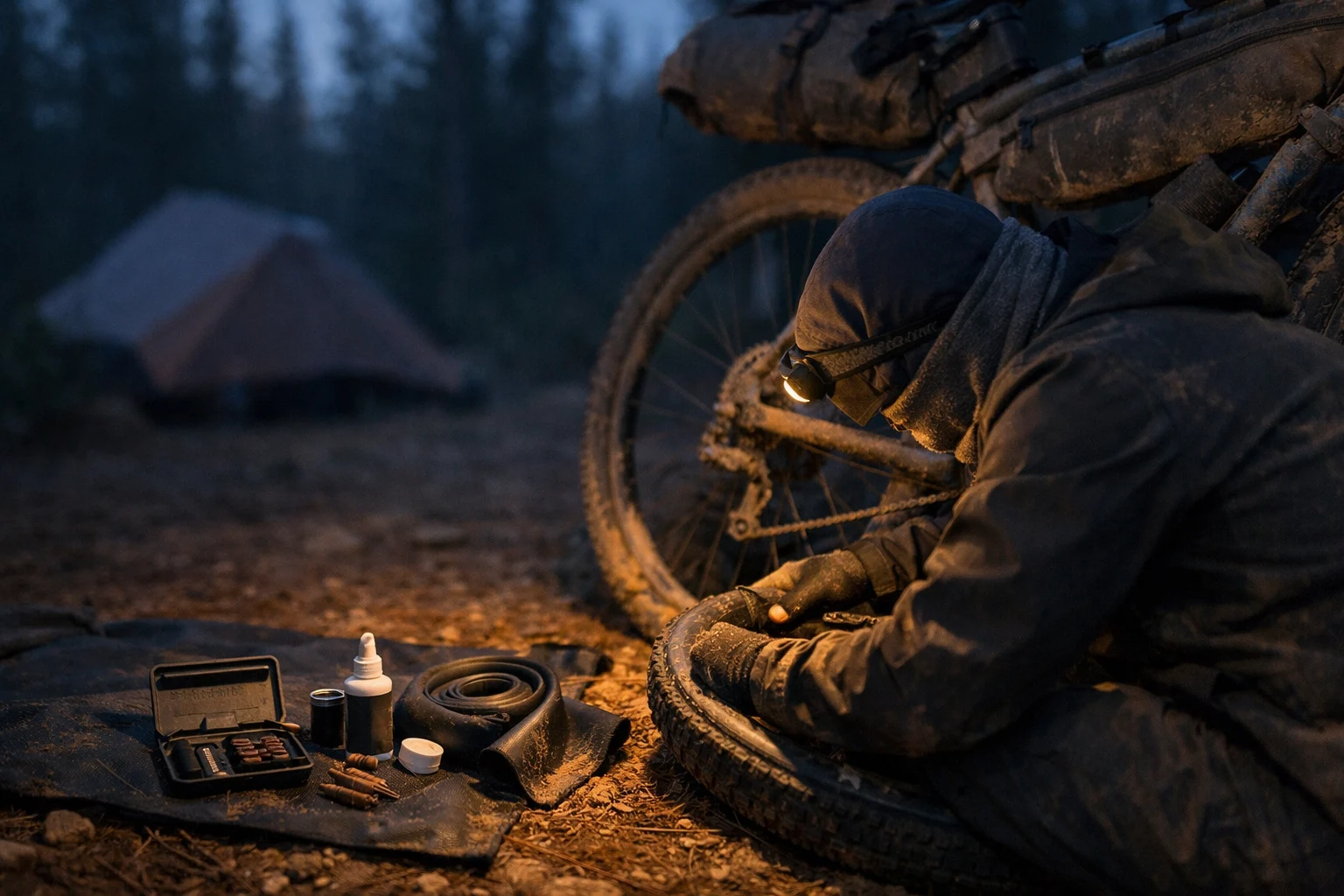
Stuck choosing tubeless vs tubes bikepacking for a trip? One tiny thorn can be a shrug—or a 2 a.m. wrestling match when you’re cold and tired.
Quick version: tubeless saves time on thorny/rocky routes because sealant handles many small punctures. Tubes don’t prevent as many flats, but repairs are simple and repeatable when you’re far from help. Below is the decision framework I use, the failure modes that matter most on tour, and what I pack so a flat doesn’t derail the day. For more gear context, see our bikepacking gear guide.
Personal note: I used to run tubeless everywhere—until one stubborn bead with numb hands taught me why a boring backup plan matters.
Run hybrid (tubeless front, tube rear) and pack: one tube, boot, patch kit, plugs, and a pump you trust.
Short on time? Jump to: Decision framework → What fails most → Carry list.
This page contains affiliate links and may include sponsored content. As an Amazon Associate, I earn from qualifying purchases at no extra cost to you. Amazon links are labeled #ad; other affiliate links may be marked as “affiliate link,” “Sponsored,” or “(paid link).” Learn more.
Table of Contents
- Quick Decision Framework: Tubeless vs Tubes for Bikepacking
- Tubeless vs Tubes: The Real Pros and Cons
- What Actually Fails Most: My Experience + Common Issues
- The One Repair I Practice Before Big Trips
- Essential Carry List: What to Pack for Each System
- My Current Setup: What Works After 8,000+ Miles
- Tubeless Conversion Tips: Getting It Right
- Sealant and Tire Recommendations (Updated for 2026)
- Real-World Scenarios: When Each System Shines
- Troubleshooting Common Tire Setup Issues
- Making the Final Decision for Your Bikepacking Setup
- Frequently Asked Questions
- Conclusion
Quick Decision Framework: Tubeless vs Tubes for Bikepacking
If you’re stuck, decide with three things: terrain, how remote you’ll be, and how confident you are fixing a flat when you’re tired. For most riders, the right bikepacking tire setup comes down to those variables.
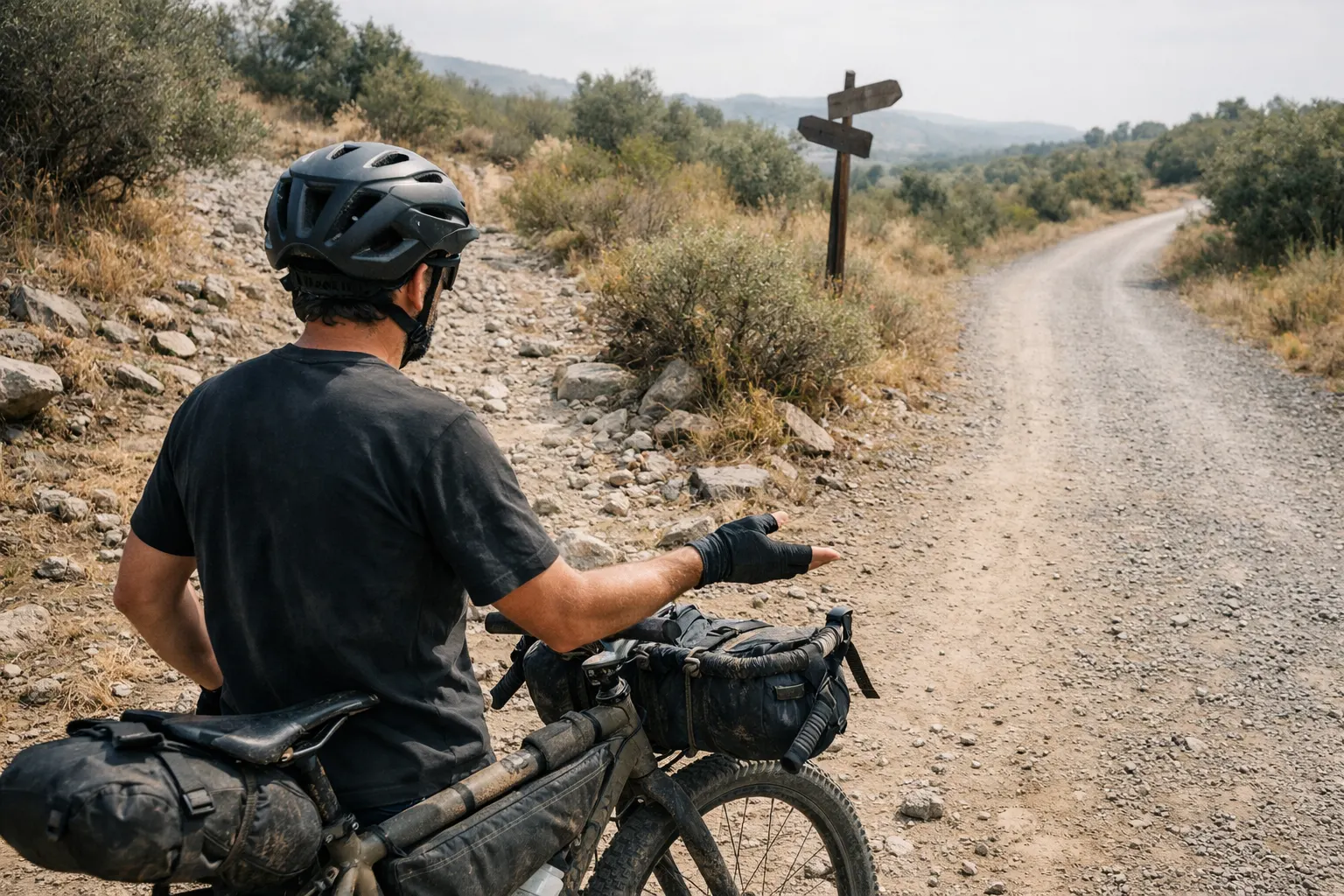
The “best” setup is the one you can fix quickly with the tools you actually carry.
Key Takeaways:
- Remote routes reward predictable repairs: tubes (or hybrid) keep life simpler when shops are scarce.
- Tubeless shines on thorns + sharp rock: fewer stops—until you hit a cut that needs a fallback.
- If you run tubeless, still bring a tube: it’s your reset button for rim-tape, sidewall, and “won’t seat” issues.
Go Tubeless If:
- You’re riding primarily rocky or thorny terrain where small punctures are common
- You have solid tire repair skills and don’t mind some sealant mess
- Your route has regular bike shop access for complex fixes
- You prioritize rolling feel and traction over simplicity
Stick With Tubes If:
- You’re doing long-distance touring through remote areas
- You want simple, predictable repairs that work in any weather
- You ride mixed surfaces with lots of road and gravel
- You prefer boring reliability over finicky setup
Go Hybrid If (Best “Middle Path”):
- You want tubeless benefits where handling matters most (usually the front wheel for steering + traction)
- You’d rather keep the “heavy-hit” wheel simpler to fix when you’re tired (usually the rear wheel)
- Your route mixes rough sections with long connecting miles, and you want fewer stops + fewer headaches
Consider Your Skill Level:
- Beginner: Tubes are more forgiving and easier to troubleshoot
- Intermediate: Either system works with proper preparation
- Advanced: Tubeless offers performance benefits if you can handle the complexity
Start a little higher than you think, then lower pressure in small steps until comfort/traction improves without rim strikes. If you’re unsure, follow your tire/rim maker’s max/min guidance and err on the conservative side for loaded riding.
Tubeless vs Tubes: The Real Pros and Cons
Most debates miss the only thing that matters on day four: what fails in the field—and how annoying it is to fix when you’re over it.
| Tubeless Tires | Tubes |
|---|---|
| ✅ Self-sealing for thorns/small punctures | ✅ Simple repairs anyone can do |
| ✅ Lower rolling resistance | ✅ Works in all temperatures |
| ✅ No pinch flats (one less failure mode) | ✅ Cheaper to maintain |
| ✅ Better traction at lower pressures | ✅ Reliable in remote areas |
| ❌ Complex repairs when sealant fails | ❌ Pinch flat risk |
| ❌ Sealant dries out in heat/time | ❌ More punctures from thorns |
| ❌ Messy to work with | ❌ Higher rolling resistance |
| ❌ Sealant can thicken in cold (and dry faster in heat) | ❌ Heavier overall system |
| Weight reality: tape/valves are small, but sealant adds volume. Net “system weight” can swing either way—especially once you include what you carry. | Weight reality: a tube adds weight, and bikepacking often means carrying 1–2 spares. The upside is you’re carrying the simplest universal fix. |
This chart is a map, not a promise. Tire casing, rim fit, pressure, and sealant freshness can swing your results a lot.
What Actually Fails Most: My Experience + Common Issues
Quick note: these rankings are from my own roadside failures over a few thousand miles—not a lab test. Treat this as a “what bites most often” list. Casing strength, rim/tire fit, and sealant freshness can change what you experience.
Tubeless: what fails most (and what it looks like)
- Sidewall cuts too big for sealant → boot + tube is the fastest reset
- Sealant drying out (heat + time) → slow leaks that won’t fully seal
- Valve/core problems (clogs or bent cores) → air won’t hold, pump feels pointless
Field order: plug first, then air up; if it’s still hissing or the cut is wide, install a tube with a boot.
Tubes: what fails most (and why)
- Pinch flats from underinflation + hard hits → add a little pressure and/or go wider
- Multiple punctures in thorn country → you’ll burn tubes unless you patch
- Patches that won’t stick in wet/cold → surface prep matters more than the brand
Field order: swap the tube to keep moving, then patch the punctured tube later when you can do it calmly.
Hard lesson: sometimes the fight is the bead, not the puncture. That’s why I always pack a tube + boot even when I’m running sealant.
The One Repair I Practice Before Big Trips
If you only practice one thing before a big ride, make it this: do one full “worst case” flat repair at home with the exact tools you’ll carry.
- Break the bead and get one side of the tire fully off the rim.
- Boot drill: place a tire boot like you would for a sidewall cut.
- Tube install: put in a tube without pinching it, then seat the bead.
- Inflate with your actual pump until it’s rideable.
Essential Carry List: What to Pack for Each System
Pick your system first, pack the must-haves, then add extras only if your route demands it.
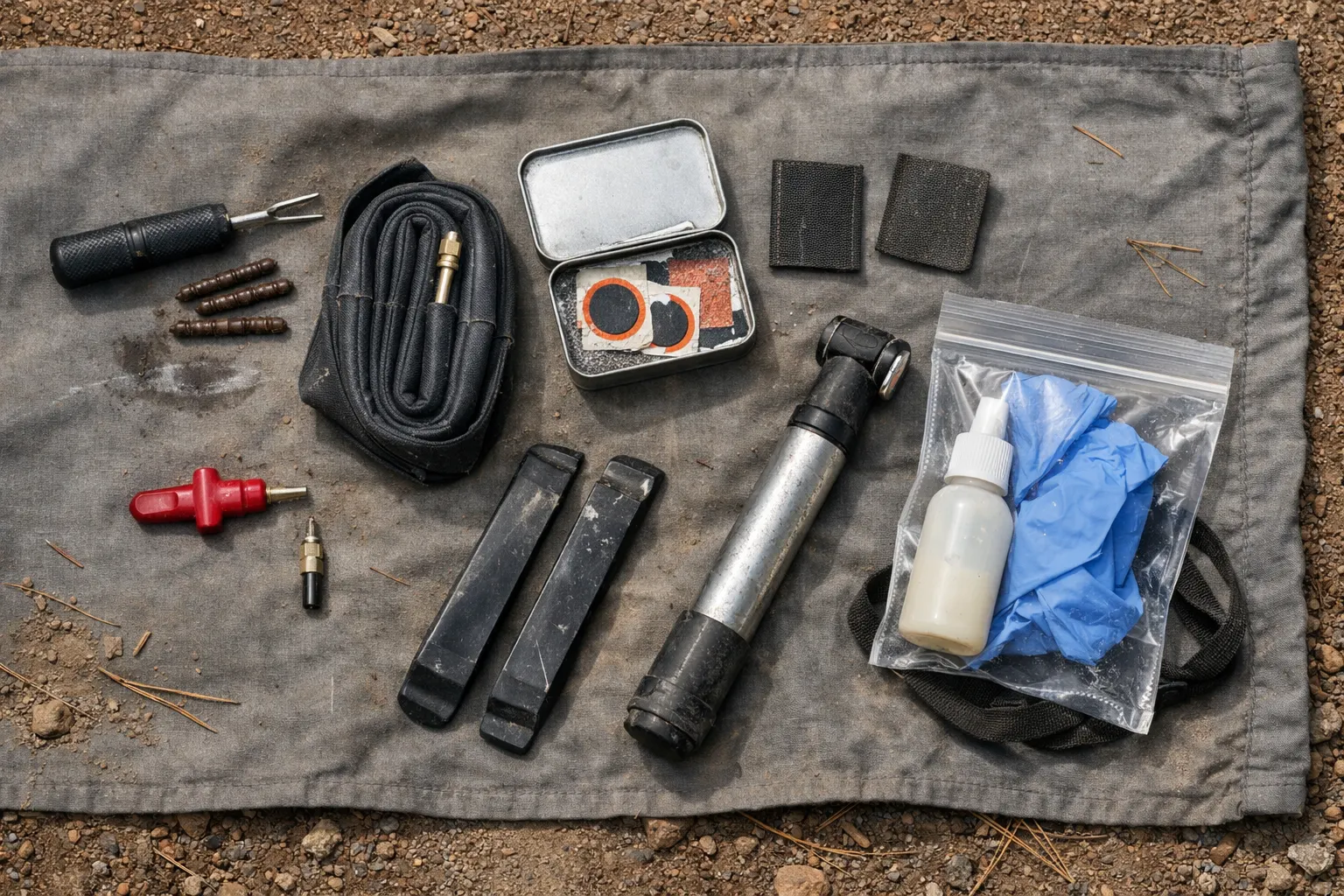
Match the tube’s stated size range to your tire (example: 700×35–43 for a 40mm tire). Bring the valve type you run (usually Presta), and pick a stem length that clears your rim (longer if you have deeper rims). For big tours, I still prefer butyl as the “boring and dependable” option—it patches well and tolerates heat/cold. TPU is great for saving space, but I treat it as a performance spare, not my only plan. If you’re remote: carry 2 tubes. If you’re near towns: 1 tube + a solid patch kit. If you’re still unsure what spare tube to carry, match the width range first, then pick a valve stem length that clears your rim.
Tubeless-Only Setup
If you want a simple starting point for a tubeless repair kit for bikepacking, this list covers the non-negotiables.
| Item | Quantity | Why You Need It |
|---|---|---|
| Tubeless tire plugs | 10–15 plugs | Large hole repairs |
| Sealant refill | 2–4 oz bottle | Top-offs and dry-outs |
| Tire boot patches | 3–4 patches | Sidewall tear backup |
| Valve core tool | 1 | Valve maintenance |
| Spare valve cores | 2–4 cores | Cheap insurance for clogs/bent cores |
| Tire levers (strong) | 2–3 levers | Tight tubeless beads |
Bikepacking rule: even if you’re tubeless, carry at least one tube. It’s the fastest reset for big cuts, rim-tape issues, and stubborn beads.
Packing order: plugs + inserter, valve core tool (and a spare core), a tire boot, and an inflation plan you’ve tested at home. Add a small sealant top-off for heat/long tours.
If your bead is notoriously tight, flimsy levers can snap. The Park Tool TL-1.2 set is a simple “access tool” for flat repair: get the tire off → fix the problem → get it back on. Park Tool TL-1.2 Tire Lever Set.
Tube-Only Setup
| Item | Quantity | Why You Need It |
|---|---|---|
| Spare tubes | 1–2 tubes (2 if remote) | Primary repair method |
| Patch kit | 1 quality kit | Backup repairs |
| Tire levers | 2–3 levers | Tire removal |
| Portable pump | 1 reliable pump | Inflation |
| Tire boot patches | 2–3 patches | Sidewall protection |
If you like the “no-mess, get-moving” style of tube repairs, Park Tool GP-2 is a handy backup patch kit. This link is for a 2-pack, but Amazon typically offers 3-pack and 5-pack options on the same listing if you want bulk for long tours or group trips: Park Tool GP-2 Super Patch Kit. For very wet/cold trips, consider also packing a small vulcanizing (glue) patch kit—adhesive patches can struggle when everything’s damp.
Universal Items (Both Systems)
| Item | Quantity | Why You Need It |
|---|---|---|
| Multi-tool with chain breaker | 1 | General repairs |
| Duct tape | 2–3 feet | Emergency everything |
| Cable ties | 4–5 ties | Secure loose items |
| Spare derailleur hanger | 1 | Common failure point |
Bring any compact multitool you trust and a pump you’ve tested with your exact tire/rim combo. CO₂ is fine as a bonus, not a plan.
Before a big trip, confirm your pump can (1) get your tire to a rideable pressure and (2) reseat the bead if you have to install a tube. If it can’t, pack a different pump (or plan a backup) before you find out the hard way.
Quick test: Lay your kit on the floor and do one full flat repair (tire off, tire on, air up) with what you’re carrying.
My Current Setup: What Works After 8,000+ Miles
I run a hybrid approach because it gives me fewer puncture stops up front and simpler fixes on the wheel that carries more load.
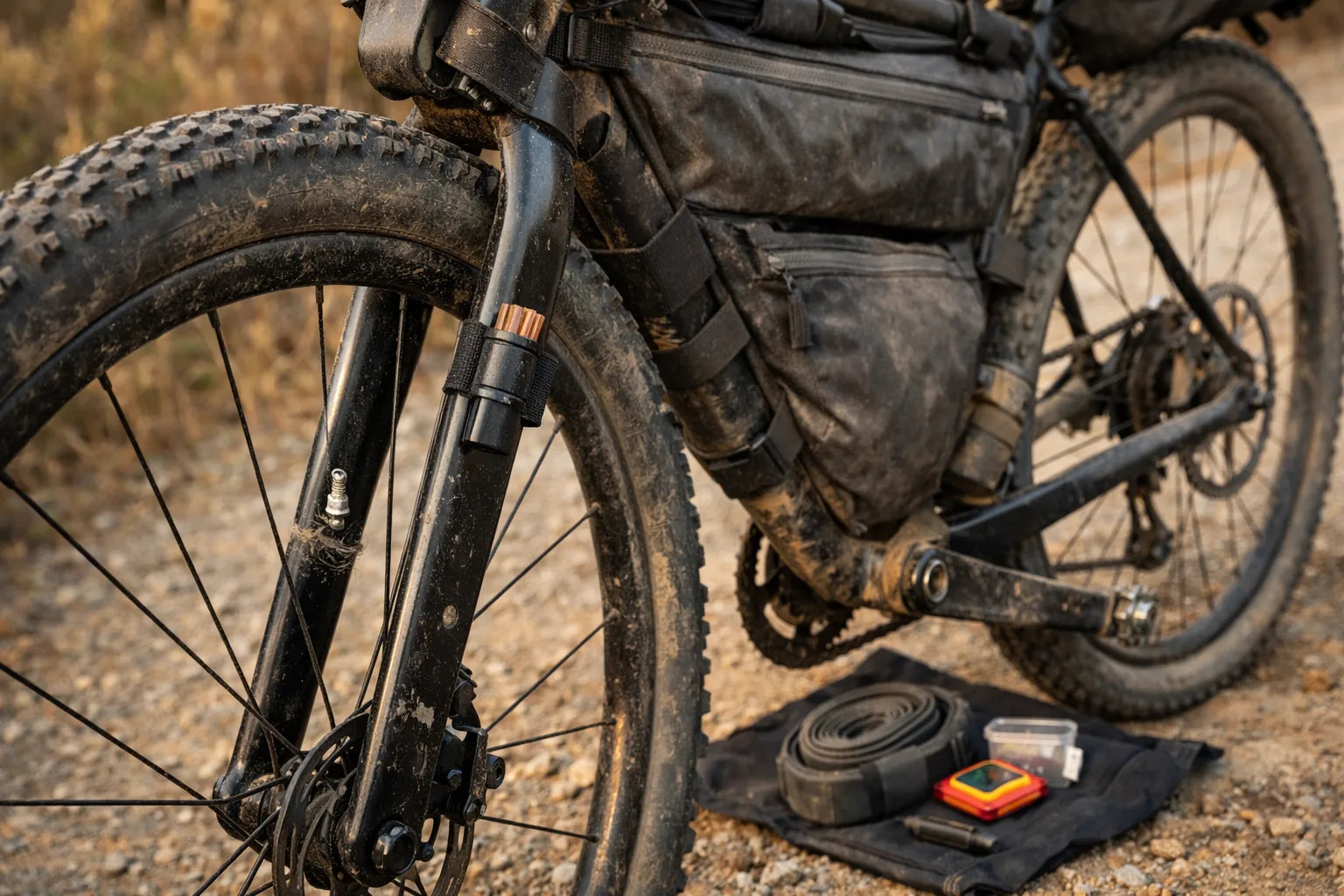
Front Wheel: Tubeless
- Tire: Schwalbe G-One Allround 40mm tubeless
- Sealant: Stan’s NoTubes Race (topped up every couple months, more in heat)
- Pressure: mid-30s to mid-40s PSI depending on load + terrain
I’ve used Stan’s for years; if you want fewer top-offs on long tours, Orange Seal Endurance is the lower-drama option.
Rear Wheel: Tube + Tubeless-Ready Tire
- Tire: Same Schwalbe G-One but with a tube
- Tube: Continental Race 28 (lighter than standard)
- Pressure: a bit higher than the front for durability
Why This Combo Works:
- Front wheel gets tubeless benefits for steering/traction
- Rear wheel keeps the repair plan boring under higher load
- One tire choice means one tube size + one boot fits both wheels
Tubeless Conversion Tips: Getting It Right
Conversion isn’t hard—but the first time can feel finicky. Doing one slow “practice install” at home saves a lot of trailside frustration later.
Compatibility check: rims, tires, and inserts
Before you convert, confirm your rims are tubeless-ready (bead locks help prevent burping), your tires are labeled tubeless-ready/TR, and your rim tape width actually matches the rim bed. If you run hookless rims or very low pressures, follow your wheel/tire manufacturer guidance for compatibility and max pressure.
If you want a clear, step-by-step walkthrough, Park Tool’s guide is solid: tubeless tire mounting and repair.
Before You Convert:
- Check rim/tire compatibility — not all rims seal well
- Buy quality tape — cheap tape causes many conversion failures
- Practice once — learn the process before you’re on tour
Conversion Process:
- Clean rims thoroughly with alcohol
- Apply tape in 2–3 overlapping layers
- Add the right sealant amount (per your tire size)
- Seat the beads with a high-pressure burst (compressor helps)
Common Conversion Mistakes:
- Using too little sealant
- Skipping the tape overlap at valve hole
- Not checking for rim tape wrinkles
- Installing valve stem crooked
Do one overnight test at home: if it holds pressure until morning, you’re in a much better place.
Sealant and Tire Recommendations (Updated for 2026)
These are the ones I’d buy again because they caused the least drama when conditions got annoying.
Updated January 2026 based on what’s been reliable on tour.
Best Tubeless Sealants:
For most riders, the “best” sealant is the one you’ll actually maintain. Decide what you hate more: frequent top-offs, or valve cleanup. Endurance formulas usually last longer; race blends can seal faster but may clump more.
Solid all-around pick: Orange Seal Endurance — a steady option when you want fewer “why is my sealant dry?” surprises. Endurance-style formulas often last longer between top-offs.
Top Bikepacking Tires:
Tire choice matters more than most “tubeless vs tubes” debates. A tougher casing and the right pressure can prevent the sidewall cuts that force a full trailside reset.
I’ve settled on the Schwalbe G-One Allround because it rolls fast on pavement/gravel connections, still grips decently on dirt, and holds up under load. It’s the “no drama” choice for mixed routes.
- More speed on smooth gravel/road: Schwalbe G-One RS or Continental Terra Speed
- More bite in loose/muddy: Schwalbe G-One Bite (same sizes)
- Budget durable pick: Panaracer GravelKing SK
Quick sanity check: 700c/29er use a 622 bead-seat diameter; 650b/27.5 uses 584.
Common sizes (easy starting points): Pick your wheel size, then match width to your route (wider for rough/loaded, narrower for mixed pavement/gravel).
- 700c gravel (faster, mixed routes): Schwalbe G-One Allround 700×35 (go wider if you’re riding rough or carrying heavy loads)
- 650b / 27.5" gravel (comfort + traction): Schwalbe G-One Allround 40-584 (27.5×1.5)
- 29er bikepacking (mixed terrain, fast-rolling): Schwalbe G-One Allround 57-622 (29×2.25) (for chunkier/looser routes, consider a more aggressive tread like the G-One Bite)
Essential Tools:
If you only add one “real” tubeless tool, make it a plug kit. It’s the difference between a two-minute fix and a long, cold wrestling match.
Hard to regret: PRO BIKE TOOL Tubeless Tyre Repair Kit
A compact, simple plug kit for punctures sealant won’t close—keep it somewhere you can reach fast.
If you’re missing the tiny “make it work in the field” parts, these three are the highest value:
- Valve core tool + spare cores (cheap insurance that can save a whole day)
- Tire boot (your backup for sidewalls and weird cuts)
- Small sealant top-off (especially for heat / long tours)
Real-World Scenarios: When Each System Shines
Two situations where the “right” choice becomes obvious:
Desert thorns + heat: tubeless saves time
- Sealant handles frequent small punctures
- Fewer stops when thorns are relentless
- Pack: extra plugs + a small sealant top-off (heat dries sealant faster)
Remote + cold: tubes are calmer
- Predictable repairs in harsh conditions
- No “will sealant behave today?” guessing
- Pack: butyl tubes + a real glue patch kit (keep glue warm in a pocket)
Troubleshooting Common Bikepacking Tire Setup Issues
Start with the fastest fixes first: plug → air up → check the valve/core → then inspect tape/bead.
Tubeless: the top 3 problems & solutions
- Sealant won’t seal a hole: plug it; if it’s a cut/tear, install a tube with a boot.
- Valve keeps clogging: remove core, clean, reinstall; carry a spare core and swap it fast.
- Slow leak overnight: check rim tape (gaps/wrinkles), then add sealant and rotate the wheel to coat.
Tubes: the top 3 problems & solutions
- Pinch flats: increase pressure a bit; consider wider tires if you’re hitting hard.
- Patches won’t stick: roughen + clean the tube, let cement get tacky, then apply.
- Repeated punctures: inspect the tire casing carefully (embedded thorn/glass) before installing the next tube.
If you’re riding truly remote, it’s worth saving (offline) the two fixes you’re most likely to need before you lose service.
Making the Final Decision: Tubeless vs Tubes Bikepacking
If you’re still torn, ask one question: Which “worst flat” am I most likely to face—and can I fix it out here? That’s the real difference in tubeless vs tubes for touring. For sharp-thorn routes, tubeless is a sanity-saver. For truly remote miles, tubes often win because the fix is clean and repeatable. If you want a safer middle path, hybrid is hard to beat.
My Personal Choice:
I run the hybrid setup (tubeless front, tube rear) because it reduces front puncture interruptions while keeping the rear wheel’s repair plan boring.
Frequently Asked Questions
Conclusion
Pick the setup you can fix fastest when you’re cold, wet, and out of patience. Tubeless saves time on puncture-heavy terrain, tubes keep the repair plan predictable, and hybrid gives you a calmer middle path.
Your Next Steps:
- Assess your terrain — thorns/rocks favor tubeless, long mixed days often favor tubes or hybrid
- Be honest about repairs — practice once before you commit
- Build your kit around your “worst day” scenario, not your best
- Test locally before the trip that matters
This tubeless vs tubes bikepacking guide is general education, not personalized mechanical or safety advice. Setups vary by rider weight, tire casing, rim design, and conditions—so what works for one route may not work for yours. If you’re unsure about compatibility or safe pressures, consult a qualified bike mechanic or your wheel/tire manufacturer’s guidance.