Fastest way to start: use the Gear System Builder below, then scroll for the gear list + the three proven setups.
Building a bikepacking gear setup doesn’t have to mean carrying your whole closet. The goal is a system that keeps you warm, dry, and self-sufficient—without the “just in case” pile.
This bikepacking gear guide is both a practical packing framework (baseline + swap rules) and a usable bikepacking gear list by category. Use the Builder to pick your baseline, then scroll for the checklist, module swaps, and real sample systems.
Whether you’re heading out for a gravel overnight or an MTB-heavy route with rough sections, the structure stays the same—you just swap the right modules.
If you only want the checklist, jump here: Bikepacking Gear List by Category.
I’ve watched too many riders get buried under “just in case” gear, turning what should be a fun escape into a slow grind. The fix isn’t carrying more. It’s choosing a few pieces that play well together—then swapping smartly when weather changes.
Disclosure: This post contains affiliate links. If you purchase through them, I may earn a commission at no extra cost to you. This helps keep the site running.
Field-guide mindset: Your kit feels “easy” when you have a simple routine: keep sleep insulation sealed and dry, isolate wet stuff, and pack the same way every morning.
Gear System Builder
Pick one option in each row—your “core + swaps” plan updates instantly. This helps you decide on your ideal bikepacking setup based on your specific needs and conditions.
1) Your approach
2) Conditions
3) Food style
Your result will show here
Choose one option in each row to see your tailored “core + swaps” plan. Detailed gear recommendations are in the full gear list below.
💡 Tip: If you’re cold at night, change “Conditions” first—then re-check sleep + insulation.
Table of Contents
- Gear System Builder
- Key Takeaways
- Bikepacking Essentials & Core Principles
- Bikepacking Gear List by Category
- My Current Ultralight Baseline
- Three Proven Setups
- Seasonal Adaptations
- Weight and Volume Breakdowns
- Common Packing Mistakes to Avoid
- Maintenance and Longevity
- Build Your Gear Setup (in 30 minutes)
- Advanced Strategies
- Real-World Testing Results
- Future-Proofing Your Setup
- Frequently Asked Questions
- Conclusion
Key Takeaways
If you only remember a few things, make it these. They’ll keep you light and comfortable.
- Protect sleep + rain first — Cut weight everywhere else, but don’t gamble on warmth or weather
- Multi-purpose items are the foundation of practical bikepacking gear
- Three proven setup styles (Budget/Balanced/Ultralight) let you match gear to your priorities
- Match gear to terrain — Smooth gravel lets you get away with less bulk; rough MTB routes reward durability and stability
- A quick shakedown before big rides prevents costly mistakes on the trail
Pick your setup style:
- 🏷️ Budget — Cost-conscious and forgiving while you learn
- ⚖️ Balanced — Durable, comfortable, and simple in mixed conditions
- 🪶 Ultralight — Low bulk and high efficiency if you like dialing things in
Micro-action: Pick one module (sleep, shelter, or clothing) and remove one duplicate item today.
Sleep: quilt/bag + pad + (optional) pillow.
Shelter: tent/tarp + stakes/lines + ground protection.
Weather/layers: base layer + insulation + rain/wind shell.
Food/water: capacity + treatment + simple meal plan (hot optional).
Repair/safety: flat kit + chain fix + first aid + navigation backup.
Power/lighting: lights + small power bank (especially if you navigate by phone).
Bikepacking Essentials & Core Principles
If this is your first overnight, don’t try to “perfect” everything. Focus on the bikepacking gear essentials that prevent the common failures: cold sleep, wet insulation, no water plan, or a small mechanical turning into a walk.
| Priority | What to get right | What beginners overdo |
|---|---|---|
| Sleep | Warm enough bag/quilt + pad insulation | Extra blankets and duplicate “just in case” layers |
| Shelter | One shelter you can pitch fast (practice once) | Bringing a “backup shelter” instead of mastering one |
| Water + repair | Water capacity + treatment + flat/chain fix | Overpacking tools but not knowing how to use them |
Bags + Carry: What Matters Most
- Stability first: choose bags that don’t sway when you stand or climb—handling matters more than saving an ounce.
- Clearance check: confirm frame bag fit, bottle access, and tire clearance (especially on smaller frames or full-suspension rigs).
- One grab-it-now pocket: top tube/feed bag for snacks + phone + sunscreen so you stop unpacking mid-ride.
- Wet/dry separation: keep sleep insulation sealed; wet layers get their own “wet pocket.”
Related: Bikepacking Bags System
Tires + Flats: Choose Your Baseline
Whether you run tubeless or tubes, the “right” answer is the one you can fix calmly on the side of the trail.
- Tubeless: lower pinch-flat risk and great ride feel, but you must carry plugs (and know how to use them).
- Tubes: simple and universal, but more pinch-flat risk if pressure drops on rocky routes.
- Non-negotiable: a way to inflate, a way to seal/patch, and a plan for a torn tire (boot).
Related: Tubeless vs Tubes for Bikepacking
Repair + Spares That Prevent a Walk
| Problem | Carry | Why it matters |
|---|---|---|
| Chain break | Quick link + chain tool (or multi-tool with breaker) | A 2-minute fix that saves a long hike-a-bike |
| Flat / torn tire | Tube (even if tubeless) + patches/plugs + tire boot | Redundancy here is worth it—flats are the #1 trip-stopper |
| Brake fade / worn pads | Spare brake pads on long/remote routes | Cheap, light, and can save your descent (or your rims) |
| Loose bolts / rattles | Mini multi-tool + a few zip ties | Prevents bag rub, cable snags, and “mystery noise” slowdowns |
Related: Bikepacking Repair Kit Checklist
Lighting + Power: The Safety Floor
- Front + rear light: even if you “don’t plan” to ride at night—delays happen.
- One headlamp: camp + repairs; it turns a stressful fix into a calm one.
- Power plan: small power bank + short cable (and keep it accessible, not buried).
- Offline navigation: download maps before you leave; battery + GPS + signal is not guaranteed.
Specific recommendations for the best bike lights for bikepacking—covering visibility, runtime, and charging—are here.
Core rules (so your kit stays simple)
The Multi-Purpose Rule
Every item in your kit should serve at least two functions. Your rain jacket becomes a pillow. Your bike can serve as a tarp support (or you can carry one lightweight pole if you prefer). Your phone handles navigation, entertainment, and emergency communication.
- Merino wool base layer = sleepwear + hiking shirt + emergency warmth
- Lightweight tarp = shelter + ground sheet + gear cover
Weight Distribution Hierarchy
Not all weight is created equal. I prioritize weight savings in this order:
- Shelter system (biggest impact on handling)
- Sleep system (easy wins with modern materials)
- Clothing (layers beat duplicates)
- Cooking gear (simple food plans save serious weight)
- Tools/repair (knowledge weighs nothing)
Carry System: Bags + Dry Strategy
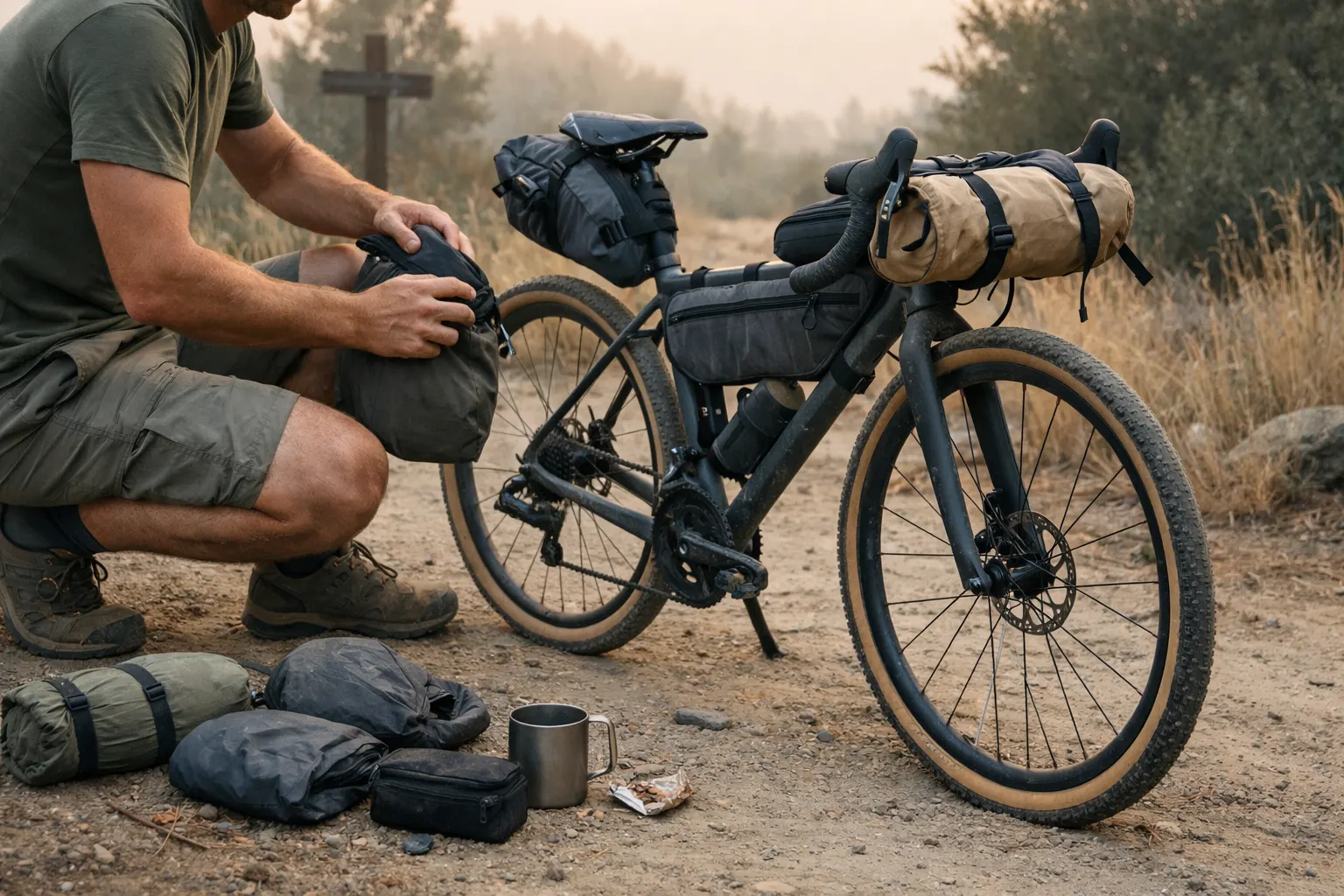
A “simple” kit only feels simple if it packs clean. Most setups work best with the classic trio (frame/seat/handlebar), plus a small place for grab-it-now items.
- Frame bag: dense items (tools, food, stove fuel) for stable handling
- Handlebar roll: bulky/light (sleep kit) to keep steering calm
- Seat pack: compressible (clothing) to reduce sway
- Top tube/feed bags: snacks, sunscreen, phone, mini trash bag
Dry strategy (the simple version): keep your quilt/bag and puffy in a sealed dry bag. Wet stuff goes in its own “wet pocket” or plastic bag so it can’t contaminate insulation.
Rain Management: Keep Your Sleep Kit Dry
- Pack order: sleep insulation packed first (deep), rain layer packed last (easy access)
- Wet separation: dedicate one bag/pocket for wet jacket, wet gloves, wet socks
- Ground rule: insulation never touches bare ground—use a groundsheet, tarp, or clean bag as a work surface
- Morning rule: if it’s still raining, pack shelter last so your sleep kit stays covered while you work
Gear by Trip Length (quick swap guide)
- Overnight: one shelter, one sleep kit, easy food plan; bring a stove only if hot drinks help you sleep.
- 2–4 days: same modules, better layering; add spare brake pads/tire plugs if remote.
- Week+: durability and repeatability; more charging capacity + consumable spares.
The 48-Hour Test
Before a major tour, spend a weekend using only your planned kit. You’ll catch the annoying stuff early (cold feet, leaky shelter, missing patch kit) without paying the price 200 miles from town.
Bikepacking Gear List by Category
Use this as your essential bikepacking gear list, then swap modules by season and route. If you prefer a simple checklist format, treat this section as your bikepacking packing list and customize by season below.
Bike + Bags (Carry System)
This is the part of bikepacking gear that most affects handling. A stable load feels faster, safer, and less tiring—especially off pavement.
- Core bags: frame bag + handlebar roll + seat pack (or saddle bag) as your default baseline
- Optional add-ons: top tube bag + feed bags for snacks/water access
- Dry strategy: sleep insulation sealed; wet layers isolated
- Contact protection: a little frame tape where bags rub prevents long-term wear
Bike Repair Kit + Spares
Keep this in one pouch so you can fix problems quickly (and without dumping your whole setup on the ground).
- Flat kit: tire levers, patches, one spare tube, and an inflation method
- For tubeless: plugs + a way to re-seat (CO₂ or reliable pump); a tube as backup
- Chain + bolts: quick link, small multi-tool, and a few zip ties
- Remote add-ons: spare brake pads and a tire boot for longer routes
Shelter Systems
| Type | Weight Range | Pros | Cons | Best For |
|---|---|---|---|---|
| Ultralight Tent | 1-2 lbs | Full protection, easy setup | Higher cost, less durable | Variable weather |
| Tarp + Bivy | 0.5-1.5 lbs | Maximum versatility | Steeper learning curve | Experienced bikepackers |
| Tarp Tent | 1-1.5 lbs | Good compromise | Limited headroom | Most conditions |
To compare tent vs bivy vs tarp for bikepacking and which fits your riding style, see this full breakdown.
Sleep Systems
The sleep system makes or breaks your recovery. I learned this the hard way on a 1,200-mile tour where my bargain bag left me waking up wrecked.
| Component | Weight | Temperature Rating | Pack Size |
|---|---|---|---|
| Down Sleeping Bag | 1-2 lbs | 20°F to 40°F | Varies (often ~softball–small melon) |
| Synthetic Alternative | 2-3 lbs | 20°F to 40°F | Football |
| Quilt System | 0.8-1.5 lbs | 15°F to 45°F | Softball |
Sleep warmth rule of thumb: if you’re cold at night, upgrade the pad before you buy a bigger bag. A warmer pad (higher insulation/R-value) often fixes “mystery cold” faster than adding clothes.
For three tailored minimal sleep systems for 3-season bikepacking, these setups work well.
Cooking and Hydration
This is where weight can quietly creep up—so a simple food plan goes a long way. I’ve gone from a 3-pound cooking setup to something that barely registers on the scale.
Ultralight approach:
- No-cook meals 80% of the time
- Single titanium cup for hot drinks
- Lightweight alcohol stove for emergencies
Balanced approach:
- Integrated canister stove system — Fast boils, simple workflow, reliable in wind
- Titanium spork and lightweight bowl
- Mix of hot and cold meals
Several tested minimalist bikepacking cooking systems are broken down here.
Food Storage & Camp Kitchen Workflow
This is small, but it’s what makes camp feel calm instead of chaotic.
- Smellables rule: keep food + toothpaste + trash together (one “smellables” bag)
- Critters: don’t sleep with food near your head—store it away from your shelter and follow local guidance (hang, canister, or secured storage where required)
- Simple kitchen flow: water first → eat → pack trash immediately → quick wipe → stash smellables
- Morning habit: pre-pack the kitchen before breaking shelter if weather looks sketchy
Simple, packable one-pot bikepacking meals that pair with any stove setup are here.
Clothing: The Layering System
Forget cotton everything. Modern ride-and-camp clothing is about layers that dry fast, pack small, and cover a wide temperature range.
Base Layer (worn while riding):
- Merino wool long-sleeve shirt
- Lightweight merino boxer briefs
- Moisture-wicking socks
Insulation Layer:
- Lightweight down or synthetic puffy (choose durability + warmth-per-weight for your conditions)
- Merino wool beanie
Weather Protection:
- Packable wind shell (small, fast access for descents and exposed ridgelines)
- Lightweight rain shell (a true waterproof shell for sustained rain)
- Rain pants (only for extended wet weather)
Navigation & Electronics
This category is easy to ignore—until you’re tired, it’s getting dark, and your phone is at 7%.
- Primary navigation: phone app or GPS (plus offline maps)
- Backup navigation: route notes / paper map / second device option
- Power: small power bank + short cable + (optional) wall plug for towns
- Communication: optional satellite messenger for remote routes
- Lighting: front light + rear light + one small headlamp (camp + fixes) + a tiny backup if you routinely finish late
- My full power and charging setup for bikepacking (lights, phone, GPS, batteries) is detailed here.
- Many riders carry cameras—my lightweight bikepacking photography gear with protection and minimal kit picks is here.
Hygiene, Chafe & Foot Care
This is the “proper backpacking gear” stuff people forget until it hurts.
- Chafe prevention: small chamois cream or anti-chafe stick
- Quick clean: a few wipes + tiny sanitizer (small daily resets beat big showers)
- Teeth + hands: mini toothbrush/toothpaste + a tiny soap option (use away from water sources)
- Feet: blister care (tape + small dressing) + one dry sleep sock option if you run cold
- Camp comfort: tiny pack towel or bandana for face/hands
First Aid (Small but Real)
You don’t need a big kit—you need the right few items where you can find them fast.
- 2–4 adhesive bandages + 1–2 larger dressings
- Blister tape or moleskin + a small antiseptic wipe
- Ibuprofen/acetaminophen (whatever you tolerate) + any personal meds
- Small roll of athletic tape (also works for gear fixes)
- Nitrile gloves (optional, but useful)
- Any allergy med / antihistamine if you have sensitivities
My Current Ultralight Baseline
After a lot of real-world testing, this is the low-bulk system I reach for when I want less stuff without gambling on sleep or safety. The detailed category framework is above; this is the “what I actually grab” version — weights are approximate and will vary by size and version.
My Current Ultralight Baseline (~8.3 lb)
- 1-person ultralight shelter — ~14 oz
- 20°F quilt (or equivalent) — ~19–20 oz
- Light insulated inflatable pad — ~12 oz
- Inflatable pillow — ~2–3 oz
- Lightweight puffy insulation — ~10–12 oz
- Packable wind layer — ~3–4 oz
- 550ml titanium cup + minimal stove + spoon — ~3–4 oz total
- Repair/first aid/misc (combined) — ~12 oz
Total base weight: 8.3 lb (excluding food, water, bike bags)
For riders documenting trips, this lightweight adventure photography gear for bikepacking pairs well with low-weight loads.
Three Proven Setups
These are copyable examples you can adapt with the swap rules above. Think of them as “starter baselines,” not rigid shopping lists.
Quick Comparison: Three Proven Setups
| Component | Budget | Balanced | Ultralight |
|---|---|---|---|
| Shelter | Naturehike Cloud-Up 1 | Big Agnes Copper Spur HV UL1 | Zpacks Plexamid |
| Sleep | Kelty Cosmic 20 + Klymit Static V | Western Mountaineering UltraLite + NeoAir XLite | EE Revelation 20°F + NeoAir XLite |
| Insulation / Rain | Basic fleece + rain jacket | Patagonia Down Sweater + solid shell | Minimal puffy + packable rain shell |
| Cooking | BRS-3000T stove + small pot | Jetboil Flash | Alcohol stove or mostly no-cook |
| Target base weight | ~11–13 lb | ~9–11 lb | ~6–9 lb |
| Rough core cost | Under $700 | ~$1,500 | ~$1,900 |
Use this as a starting point—swap based on your conditions and priorities.
Budget Setup
If you’re new (or you just hate wasting money), this approach gets you riding sooner—without buying “temporary” gear you’ll regret later.
- Best for: first overnighters, local routes, and learning what you actually use
- Prioritize upgrades: sleep warmth (pad) + dependable rain shell, then bags that reduce sway
- Swap rules: colder nights → warmer sleep; remote routes → add plugs/patches + quick link + spare pads
Bags are the biggest budget variable—here are budget bikepacking bags that last, with the real trade-offs.
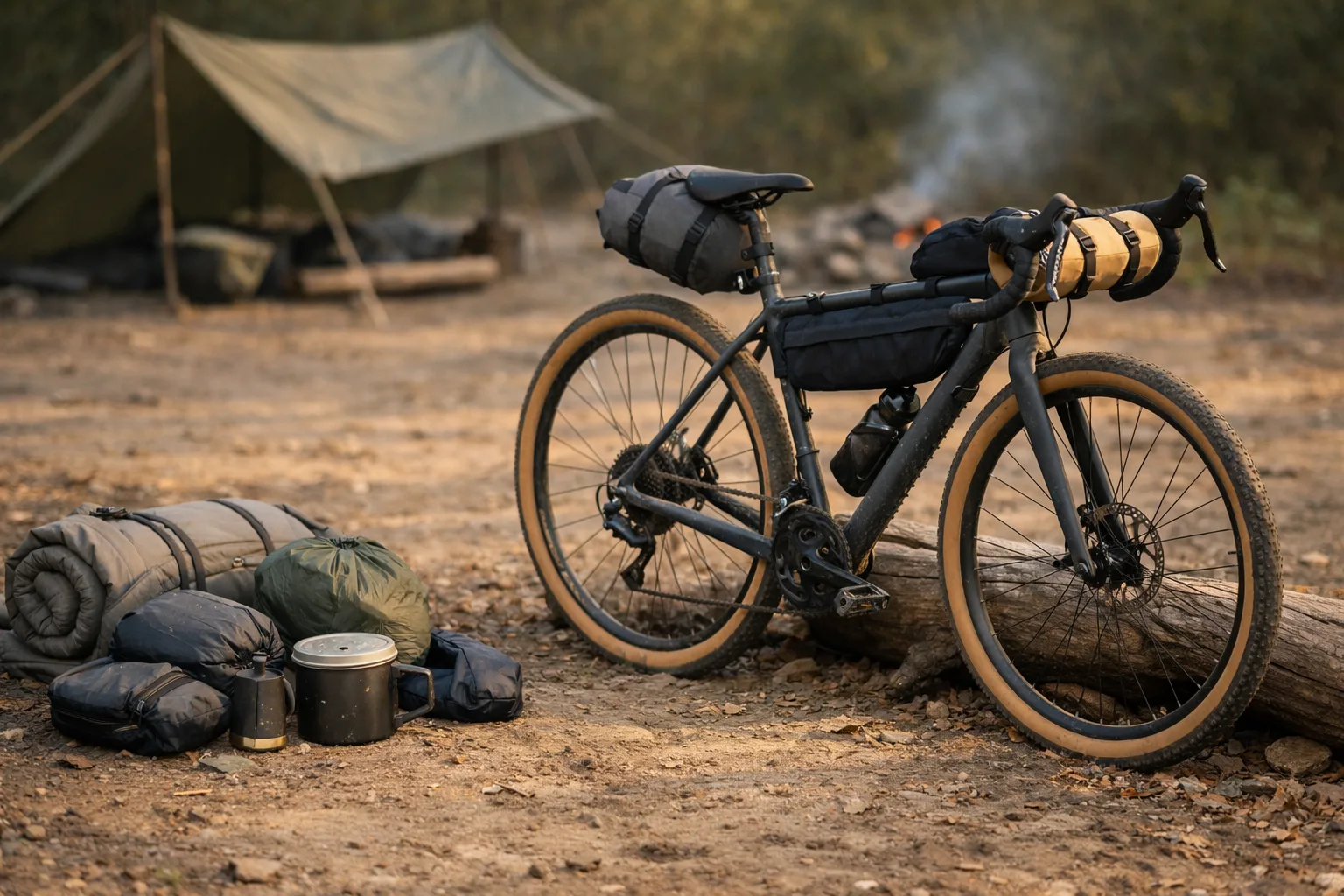
- Shelter/Sleep (starter): Naturehike Cloud-Up 1 or similar + Kelty Cosmic 20 + Klymit Static V
- Clothing (starter): simple base layers + fleece + basic rain jacket + 2 pairs of socks
- Cooking (starter): tiny canister stove + small pot + spork
Typical total: under ~$700–900 for core camp items (bags/tools/accessories vary). Expect ~12 lb base weight depending on choices.
Balanced Setup
If you want gear that lasts (and you ride in mixed conditions), this is the “buy once, cry once” zone—without going full boutique.
- Best for: mixed conditions, multi-day trips, and riders who want fewer surprises
- Prioritize upgrades: durable shelter + reliable rain/wind layer + stable carry system
- Swap rules: shoulder season → warmer sleep + insulation; long descents → keep wind protection accessible
Typical total: around ~$1,200–1,600 for core items; ~9–11 lb base weight depending on durability choices.
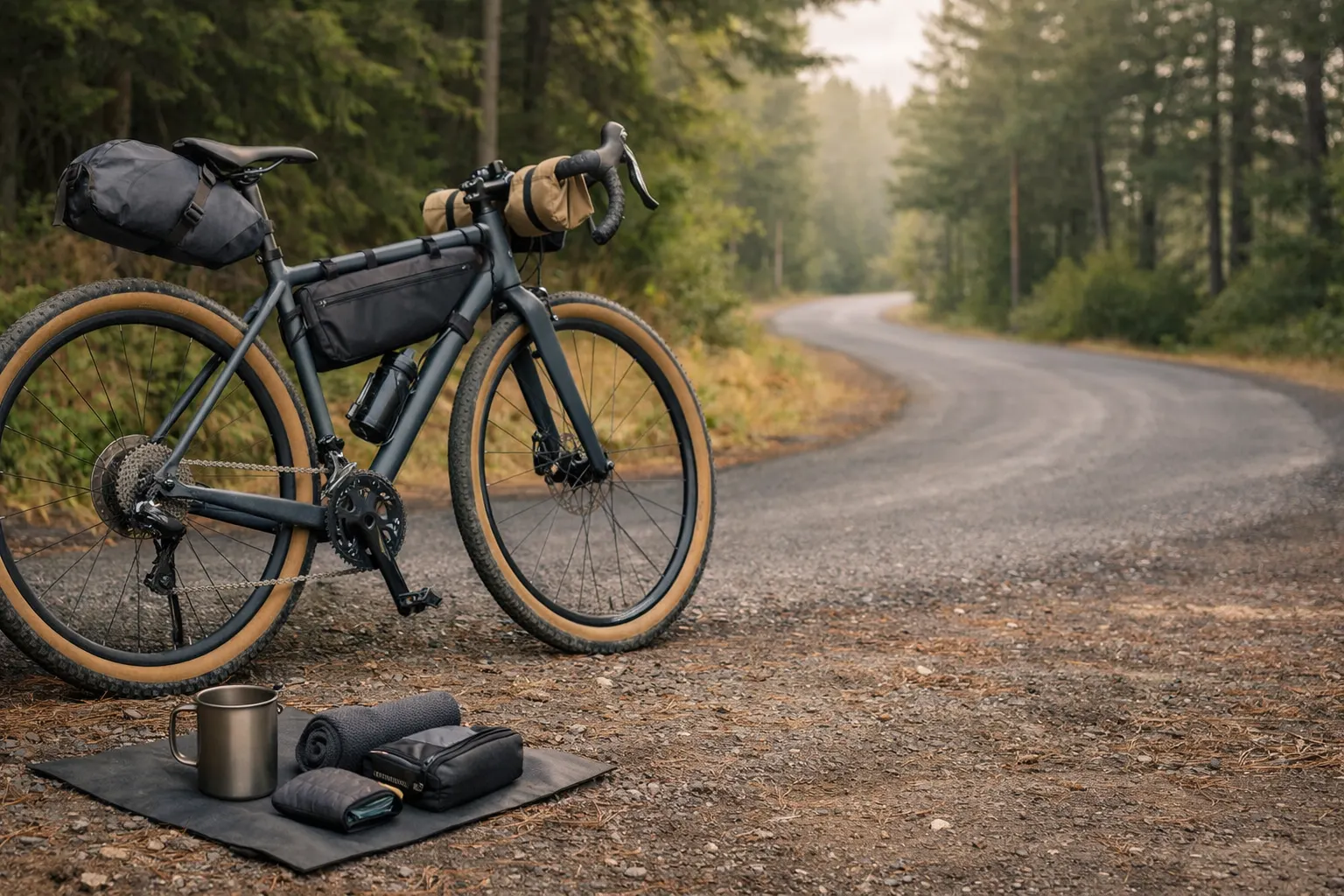
Ultralight Setup
If you’re chasing pack volume and long-day comfort, ultralight can feel like a superpower—as long as you protect your sleep and weather margin.
- Best for: riders who enjoy dialing systems in and keeping camp simple
- Prioritize upgrades: sleep warmth per ounce + stable carry + dependable rain protection
- Swap rules: if conditions worsen, add warmth before you add “extra stuff”
In ultralight setups, I use this ultralight camera kit for bikepacking.
- Shelter/Sleep (example): Zpacks Plexamid or similar + Katabatic Allsek / EE Revelation + Nemo Tensor / NeoAir XLite NXT
- Clothing (example): one true insulation piece + minimal layers (no duplicates)
- Cooking (example): titanium cup + minimal stove (or mostly no-cook)
Typical total: around ~$1,700–2,200; base weight ~6–9 lb depending on accessories.
Seasonal Adaptations for Your Bikepacking Gear
Quick example: you’re riding shoulder-season mountains with cold nights and surprise rain. Keep the same core modules, then swap two things—sleep rating and insulation. Everything else stays put.
Spring/Summer Modifications
- Drop the insulation layer — Save weight by leaving the down jacket home
- Switch to 40°F quilt — Another 6-8 oz savings
- Minimize rain gear — A wind layer helps a lot; bring a rain shell when the forecast calls for it
- Reduce clothing — One spare set maximum
Fall/Winter Additions
- Upgrade insulation — Heavier down jacket or synthetic puffy
- Add base layer bottoms — Merino wool long underwear
- Warmer sleep system — 0°F to 20°F rated quilt/bag
- Emergency bivy — Extra protection for unexpected weather
Desert Touring
- Maximize sun protection — Long sleeves, hat with neck protection
- Increase water capacity — Extra bottles or hydration reservoir
- Lighten sleep system — 50°F+ rating often sufficient
- Add electrolyte supplements — Critical for multi-day desert crossings
Mountain/Alpine Touring
- Redundant warmth — Backup insulation layer
- Four-season shelter — Stronger tent or tarp configuration
- Emergency gear — Whistle, emergency shelter, first aid expansion
- Navigation backup — Paper maps as phone backup
Weight and Volume Breakdowns
A Rough Weight Split (Starting Point)
- Shelter system: ~35% of base weight
- Sleep system: ~25% of base weight
- Clothing: ~20% of base weight
- Cooking: ~10% of base weight
- Tools/misc: ~10% of base weight
This is just a starting point—route, weather, and your comfort needs will change the math.
Volume Considerations
Weight isn’t everything — bulk matters too. I prioritize compressible items because they make packing simpler and your bags more stable.
High priority for compression:
- Down insulation (sleeping bag/jacket)
- Shelter (modern tents pack incredibly small)
- Extra clothing
Accept the bulk:
- Sleeping pad (don’t compromise comfort for pack size)
- Food (you’ll eat it anyway)
- Water (safety first)
For extreme minimalism, this 40L minimalist packing list for long-term travel shows what’s possible.
The goal isn’t suffering—it’s choosing lightweight bikepacking gear where it noticeably improves handling, then keeping real safety margins for sleep and weather.
The 10% Upgrade Rule
When considering new gear, it should be at least 10% lighter or meaningfully more functional than what it replaces. Marginal gains usually aren’t worth the cost and complexity—especially if they add “fuss” in the field.
Bike Bag Placement: Quick Packing Flow
A pack-light setup feels “light” when your bags are stable and predictable—not just when the scale number is lower.
- Frame bag: dense/heavy items (tools, food, stove fuel) for best handling
- Handlebar bag: bulky/light items (sleep kit) to keep steering calm
- Seat bag: soft, compressible items (clothing) to reduce sway
- Top tube/feed bags: snacks + phone + sunscreen—anything you’ll grab while rolling
Quick bags note: most riders do well with the classic trio (frame/seat/handlebar). Match volumes to your bike and route, and keep heavy items centered so handling stays calm on rough sections. A stable bikepacking setup is more about placement than perfection.
Micro-action: Put your heaviest 3 items in the frame bag tonight and see how much calmer the bike feels.
Common Packing Mistakes to Avoid
The “Just in Case” Trap
I used to carry backup everything. Now I carry knowledge instead. Learn basic repairs, weather reading, and route planning. Skills weigh nothing.
Cutting Safety Margins Too Thin
There’s pack-light, and there’s dangerous. Always carry:
- Emergency shelter (space blanket minimum)
- First aid basics
- Navigation backup
- Emergency food/water
- Lights + a small power bank if you’re riding long days or using your phone for navigation, and consider the best travel insurance for bikepacking on long tours.
Ignoring Comfort Items
Some comfort items earn their weight. My camp pillow adds 2.75 oz but protects my sleep. That’s a trade I’ll make every time.
Small Habits That Prevent Big Problems
- Night routine: put tomorrow’s layers somewhere dry and reachable
- Keep insulation clean: don’t cook or spill food near your quilt/bag
- One “tiny pouch” rule: put your repair odds-and-ends (tape, patch glue, a couple zip ties, spare valve core) in one small pouch so you can find it fast
- Protect contact points: add a little frame protection where bags rub before it becomes a worn spot
Not Testing the Complete System
One weekend with your bags packed will reveal the real problems—before you’re committed to a long remote stretch. (If you do one “test,” make it the 48-hour shakedown from the Core Rules section.)
Micro-action: Plan one overnight this month where you use only the gear you’ll take on your next big ride.
Maintenance and Longevity
Daily Care
- Dry everything possible each evening
- Inspect high-wear items (tent floor, pack contact points)
- Clean and lubricate moving parts
Long-term Strategies
- Rotate gear — Don’t use the same sleeping bag year-round
- Proactive repairs — Fix small issues before they become big problems
- Upgrade gradually — Replace worn items with lighter/better versions
Tiny Field Fixes Worth Practicing Once
- Patch a tube (or plug a tubeless tire) before you need to do it in the dark
- Use a quick strap or tape wrap to stop bag sway/rub
- Pitch your shelter in wind at least once so you know the order
Build Your Gear Setup (in 30 minutes)
Start with the Big Three
Focus your initial investment on shelter, sleep, and pack. These drive comfort, warmth, and bike handling more than anything else.
Test Incrementally
Don’t overhaul everything at once. Replace one category at a time, then run a quick overnight or weekend shakedown so you know it actually works for you.
Consider Your Riding Style
- Credit card touring — Ultra-minimalist approach works
- Remote wilderness — Build in more redundancy
- Multi-week expeditions — Durability trumps ultimate weight savings
Budget Over Time
Quality gear is an investment. I’d rather own one piece I trust than three “almost good” items that create problems when conditions get real.
Micro-action: Set a timer for 30 minutes, pick your approach in the Builder, then write your “big three” choices in a notes app.
Advanced Strategies
The Modular Approach
Same core idea as above—your kit is a set of modules you can mix and match. If you ride in very different seasons, many riders keep two versions of one key module (usually sleep or insulation) so swaps stay simple.
- Module 1: Core camping (shelter + sleep)
- Module 2: Weather protection (rain gear + insulation)
- Module 3: Cooking system (stove + cookware)
- Module 4: Repair/safety (tools + first aid)
This lets you customize for specific trips without rebuilding your entire kit.
Real-World Testing Results
800-Mile Desert Tour (Arizona Trail)
System weight: 9.2 lbs
Key learnings:
- Alcohol stove struggled in wind
- Merino wool was game-changing in temperature swings
- Ultralight tent handled surprising weather
2,100-Mile Mountain Tour (Continental Divide)
System weight: 11.4 lbs
Key learnings:
- Extra insulation layer was essential
- Redundant navigation saved the trip
- Quality rain gear earned its weight
800-Mile Coastal Tour (Pacific Coast)
System weight: 7.8 lbs
Key learnings:
- Minimal cooking worked perfectly
- Salt air demanded better gear care
- Comfort items mattered more on long days
These are personal trip logs—your numbers will change with season, food/water carries, and route conditions.
Future-Proofing Your Setup
What’s actually improving (without chasing hype)
Gear changes fast, but a few trends tend to help most riders over time. Treat these as “nice when you find them,” not must-haves.
- Better weatherproofing per ounce — Fabrics and coatings keep improving, so you can get solid rain/wind protection without huge bulk.
- Smarter durability — Reinforced high-wear zones (floors, straps, rub points) can extend gear life without adding much weight.
- Warmer-for-weight insulation options — Both down and synthetics keep evolving, but real-world warmth still depends on fit, layering, and moisture.
- More efficient power setups — Smaller power banks and better lights make navigation and safety easier on long days.
Sustainable Choices
Pack-light thinking aligns with environmental consciousness: you buy fewer items, keep them longer, and repair instead of replacing.
- Buy once, use forever — Quality over quantity
- Repair over replace — Extend gear lifespan
- Multi-season versatility — Reduce total consumption
Frequently Asked Questions
Conclusion
Pack-light bikepacking gear isn’t about suffering with less—it’s about choosing better.
The key is finding your personal balance between weight, comfort, and safety. Start with the principles above, do a quick shakedown, then refine based on real trail feedback.
Gear evolves fast — revisit this guide or your own notes after each season to keep your setup dialed.
Your next steps:
- Choose your approach — Budget, Balanced, or Ultralight
- Start with shelter and sleep — The biggest impact items
- Test everything before your next major tour
- Refine based on experience — Every trip teaches something new
Less chaos, more riding—that’s the whole point.
This guide is general education only, not personalized advice. Conditions, bodies, bikes, and routes vary—so treat these setups as starting points and adapt them to your terrain and comfort needs. For medical concerns or safety-critical decisions, consider speaking with a qualified professional or an experienced local shop/guide.